


You know that feeling when one line from a poem just sticks with you? Little feet on the stairs, something like that.
It shows up out of nowhere, years after you first heard it, and it just won’t leave.
That’s usually how people end up here, at The Children’s Hour poem. Not looking for facts about Longfellow, just one image that stuck.
I’ve read this poem so many times, honestly. It still gets me in the same spot, every time.
Overview of the Poem
Longfellow wrote “The Children’s Hour” in 1860. He published it as part of a collection called Birds of Passage.
The poem isn’t fiction. Those three daughters he writes about were real, and so was the ritual.
Every evening, work would pause. His daughters would come rushing in, and he’d let them.
That’s the whole setup. No grand event, no drama. Just a father noticing something ordinary and deciding it mattered enough to write down.
That’s part of why the poem still lands. It’s not about a big moment. It’s about a small one, repeated, until someone finally paid attention to it.
Billy Collins does something similar in The Lanyard: the same quiet tenderness between a parent and child, noticed only in hindsight.
The Children’s Hour Poem lyrics by Longfellow

Reading this poem feels like stepping into a quiet, golden memory. There’s something so comforting about how Longfellow turns a simple bedtime ritual with his kids into this whole tender little fortress-and-banditti fantasy.
It reminds me that the busiest, most “important” parts of a day often aren’t the work we do, but these small, noisy interruptions of love we don’t see coming.
Between the dark and the daylight,
When the night is beginning to lower,
Comes a pause in the day’s occupations,
That is known as the Children’s Hour.
I hear in the chamber above me
The patter of little feet,
The sound of a door that is opened,
And voices soft and sweet.
From my study I see in the lamplight,
Descending the broad hall stair,
Grave Alice, and laughing Allegra,
And Edith with golden hair.
A whisper, and then a silence:
Yet I know by their merry eyes
They are plotting and planning together
To take me by surprise.
A sudden rush from the stairway,
A sudden raid from the hall!
By three doors left unguarded
They enter my castle wall!
They climb up into my turret
O’er the arms and back of my chair;
If I try to escape, they surround me;
They seem to be everywhere.
They almost devour me with kisses,
Their arms about me entwine,
Till I think of the Bishop of Bingen
In his Mouse-Tower on the Rhine!
Do you think, O blue-eyed banditti,
Because you have scaled the wall,
Such an old moustache as I am
Is not a match for you all!
I have you fast in my fortress,
And will not let you depart,
But put you down into the dungeon
In the round-tower of my heart.
And there will I keep you forever,
Yes, forever and a day,
Till the walls shall crumble to ruin,
And moulder in dust away!
Meaning of the Poem

At its heart, this poem is about a father who refuses to let a small moment pass unnoticed.
Longfellow isn’t writing about parenting in general. He’s writing about one hour, every single day, that belongs only to his daughters.
The castle he mentions isn’t a real place. It’s his study, his desk, his work.
He calls his daughters “banditti” because they storm in and take over. He doesn’t fight it. He lets himself be outnumbered.
That’s the simple version. But the poem goes further in its final stanzas.
There, Longfellow stops talking about the moment itself. He starts talking about holding onto it forever.
He says he’ll keep his daughters in his heart, “moulder in dust away.” That’s a strange, heavy phrase for a poem about bedtime chaos. It means this: he knows these moments are borrowed. His daughters will grow. He’ll grow old.
Someday, none of it will be here anymore a feeling Robert Frost captured just as quietly in Nothing Gold Can Stay. So he’s not just describing an evening. He’s trying to hold onto something he already knows he’ll lose
Themes in the Poem
This poem runs on four ideas, and they all work together: love, innocence, time, and the ordinary rhythm of home life.
Parental Love
This theme is about love shown through habit, not words. Longfellow doesn’t announce his feelings for his daughters. He shows them through what he does every single evening.
He stops working. He lets three kids take over his study, climb on him, and interrupt everything.
That’s what love looks like in this poem. Not a big declaration, just a choice he keeps making, night after night, without fail.
Childhood Innocence
This theme is about kids acting exactly like kids, with no filter. Longfellow’s daughters don’t knock. They don’t wait their turn or act careful around him.
They rush in, climb over him, and take over the room like it already belongs to them.
He never corrects that behaviour. He welcomes it. That’s the innocence he’s capturing here: children who haven’t learned to hold back yet, and a father who doesn’t want them to.
Time and Impermanence
This theme is about knowing a good moment won’t last. Longfellow isn’t just describing a fun evening with his kids. He’s aware, even as it’s happening, that it’s temporary.
His daughters will grow up. This exact version of them, small and loud and climbing all over him, will eventually disappear.
So underneath the joy in this poem, there’s a quiet sadness. He’s holding onto something he already knows he’ll lose.
Domestic Life
This theme is about finding meaning in something completely ordinary. Nothing dramatic happens in this poem. There’s no real castle, no actual battle, no big event.
It’s just a father, a study, and three daughters who show up at the same time every evening.
Longfellow didn’t need anything bigger than that. He found the whole poem sitting inside one small, repeated moment at home.
About Henry Wadsworth Longfellow
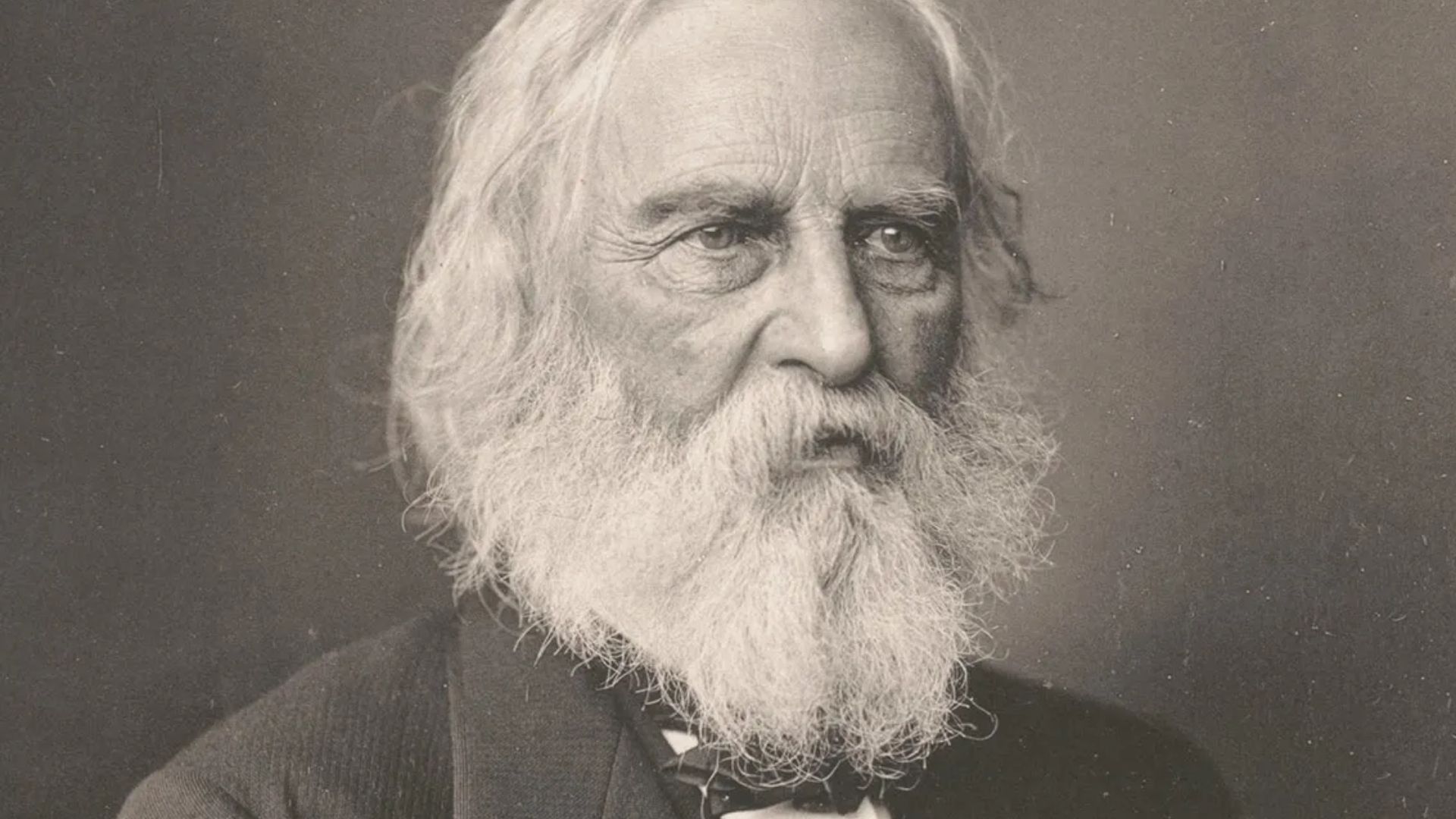
Longfellow was one of the most popular American poets of the 1800s. He wrote “Paul Revere’s Ride,” “Evangeline,” and “The Song of Hiawatha.”
He taught at Bowdoin College, then later at Harvard.
His personal life had real grief in it. His first wife died young. His second wife, Frances, died in a fire in 1861, just a year after “The Children’s Hour” was published.
That timing matters. He wrote about holding onto a fleeting moment with his daughters, then lost his wife not long after.
The three daughters in the poem were real: Alice, Edith, and Anne Allegra. They were the “banditti” who stormed his study every evening.
That ritual wasn’t invented for the poem. It was just his life, and he happened to write it down.
Final Takeaway
The Children’s Hour poem still works because Longfellow wasn’t trying to write something big. He just paid attention to one small hour and refused to let it slip by unnoticed.
That’s really the whole point. The moments that matter most rarely announce themselves. You usually only see how much they meant once they’re gone.
If this poem stuck with you, sit with that feeling for a bit. Then go notice something small in your own day before it passes you by.
And if you’ve got a favourite line from this poem, drop it in the comments. I’d love to know which part stayed with you.
Frequently Asked Questions
Is “The Children’s Hour” LGBTQ?
No. Longfellow’s 1860 poem is about a father and his three daughters. The confusion comes from Lillian Hellman’s 1934 play of the same name, which is about a rumour concerning two female teachers.
What is Henry Wadsworth Longfellow’s most famous poem?
Longfellow’s most famous poem is generally considered to be “Paul Revere’s Ride” (1860), though “The Song of Hiawatha” and “Evangeline” are also among his best-known works.
What is a memorable quote from The Children’s Hour?
One well-known line describes the daughters storming in like little bandits, taking over the room without asking. It captures how sudden and joyful their arrival felt.
What is the most famous children’s poem?
There’s no single agreed-upon answer, but poems like “The Children’s Hour” and “Twinkle, Twinkle, Little Star” are often mentioned. Fame here depends a lot on personal or cultural exposure.
Can I download The Children’s Hour poem as a PDF?
Yes. The poem is in the public domain, so you can freely print it or save this page as a PDF