


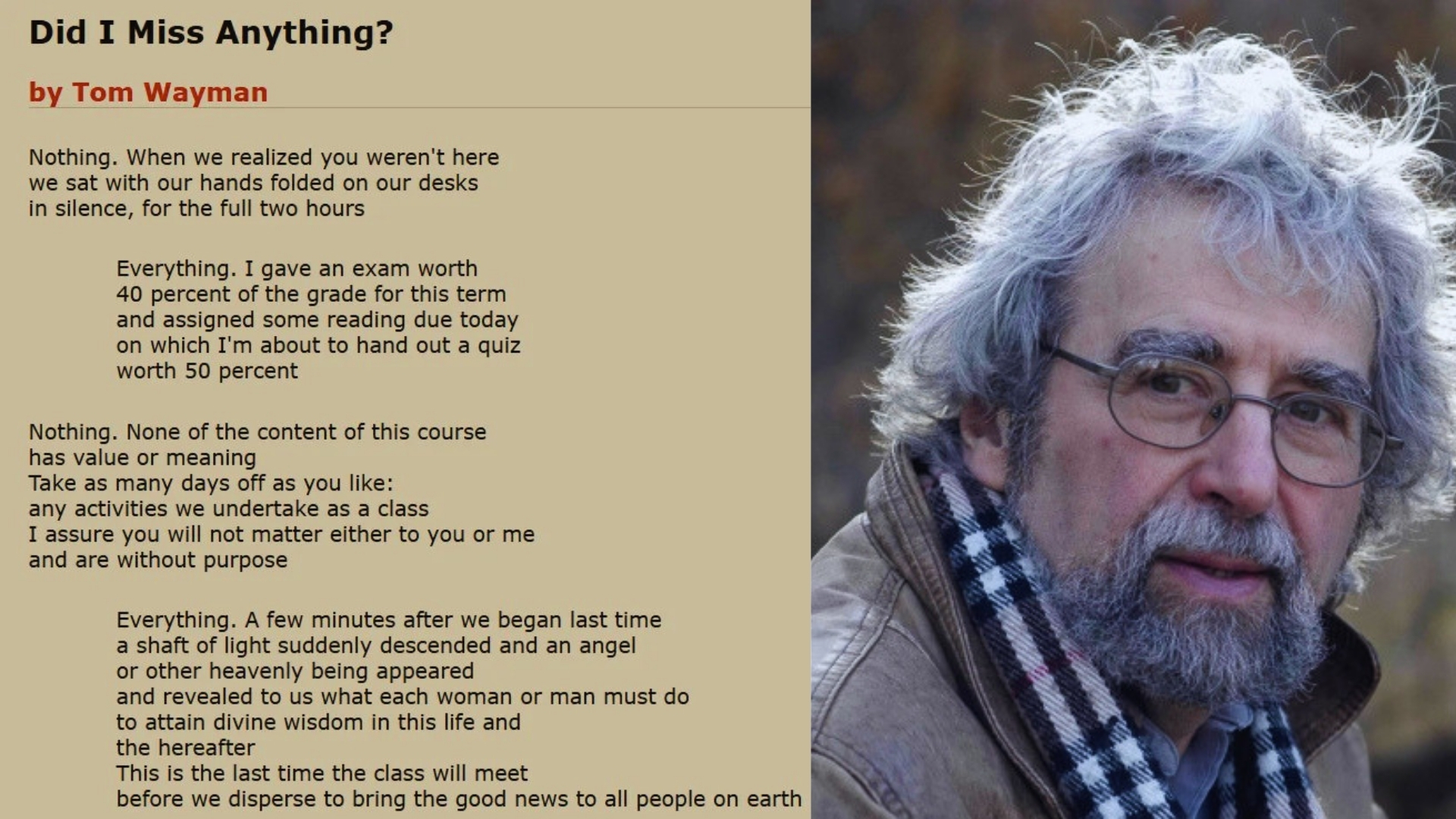
I still remember sitting in class and wondering if I actually missed something important. That feeling is real. The “Did I Miss Anything” poem full text by Tom Wayman speaks directly to that moment.
In this blog, I will cover the full poem, its meaning, themes, tone, and a simple line-by-line breakdown. I will also share what this poem teaches us about showing up in life.
With years of reading and analyzing poetry, I can help you understand this poem clearly and simply.
Overview of Did I Miss Anything Poem

The poem is a teacher’s response to a student who skipped class and casually asked, “Did I miss anything?” Throughout the poem, the teacher answers in two opposite ways.
One answer says nothing happened, delivered with clear sarcasm. The other says everything happened, showing that real learning and growth took place.
These two sides push against each other to make one strong point: your presence matters. The “Nothing” side reflects the student’s own careless attitude.
The “Everything” side shows what was truly lost. Together, they make the reader stop and think about the real cost of showing up or not.
Did I Miss Anything Poem Full Text
This section shares the complete poem in an accessible way.
Nothing. When we realized you weren’t here
we sat with our hands folded on our desks
in silence, for the full two hours
Everything. I gave an exam worth
40 percent of the grade for this term
and assigned some reading due today
on which I’m about to hand out a quiz
worth 50 percent
Nothing. None of the content of this course
has value or meaning
Take as many days off as you like:
any activities we undertake as a class
I assure you will not matter either to you or me
and are without purpose
Everything. A few minutes after we began last time
a shaft of light suddenly descended and an angel
or other heavenly being appeared
and revealed to us what each woman or man must do
to attain divine wisdom in this life and
the hereafter
This is the last time the class will meet
before we disperse to bring the good news to all people on earth.
Nothing. When you are not present
How could something significant occur?
Everything. Contained in this classroom
is a microcosm of human experience
assembled for you to query and examine and ponder
This is not the only place such an opportunity has been gathered
but it was one place
And you weren’t here
Themes and Message of the Poem
The poem carries strong lessons that go beyond a classroom setting.
Importance of Being Present
The biggest theme in this poem is presence. Showing up is not just physical. It means being mentally there, ready to take part. The poem mocks the idea that skipping class has no cost.
Value of Education and Effort
The poem quietly defends teachers and the effort they put into each class. When a student skips, they miss more than notes.
They miss the energy, the discussions, and the small moments that make learning real.
What the Poem Teaches Readers
- Skipping has real consequences, even if they are invisible at first.
- Presence is an act of respect, for yourself and others.
- Education is not just information. It is an experience.
Tone, Style, and Literary Devices
Wayman uses sharp wit and smart language to deliver a serious message.
Use of Sarcasm and Humor
The poem opens with dry humor. The “Nothing” responses are clearly not meant to be taken at face value. They are meant to sting a little. The tone is not mean, but it is pointed.
Irony and Exaggeration
The “Everything” responses use a kind of overstatement to make the point hit harder. Of course not every single class is life-changing.
But the exaggeration forces the student, and the reader, to think about what could have been missed.
How Language Conveys Hidden Meaning
Wayman keeps the language plain and direct. There are no fancy words. That simplicity is a choice. It mirrors how a tired, slightly frustrated teacher might actually speak.
The plain tone makes the message land harder.
Line-by-Line Explanation (Simple)
Breaking down the poem so students and readers can follow along easily.
Explanation of Key Stanzas
A simple stanza-by-stanza breakdown that makes the poem easy to follow for every reader.
First “Nothing” stanza: The teacher says nothing happened. This is sarcasm. The teacher is reflecting back the student’s own attitude toward class.
First “Everything” stanza: The teacher describes a real moment of learning. A student had a breakthrough. That moment cannot be replayed for the one who was absent.
Repeating pattern: The poem keeps switching between Nothing and Everything. Each time, the gap between the two feels wider. The reader starts to feel the weight of absence.
Final lines: The poem ends on a strong note. The message is clear. Being absent is a choice, and choices have costs.
Easy Understanding for Students
Think of it this way. You ask your friend what happened at a party you missed. They say, “Nothing much.” But later you find out something big happened.
That is the feeling this poem creates. Missing out is real, even when it does not feel that way at first.
About the Poet – Tom Wayman

Tom Wayman was born in 1945 in Ontario, Canada. He studied at the University of British Columbia and the University of California, and has spent much of his life teaching at Canadian universities.
He is known for writing poems about work, everyday life, and education. Wayman writes in a style called “poetry of work,” focusing on ordinary people in everyday situations.
His language is simple and direct. He wants his poems to be understood by anyone, not just scholars. He has published more than a dozen poetry collections.
“Did I Miss Anything?” became one of his most read poems because teachers and students across the world connected with it.
It captures a real moment in education in a way that feels both funny and honest.
Conclusion
I find this poem so honest. It says what many teachers feel but never says out loud. The contrast between “Nothing” and “Everything” is clever and true at the same time.
The “Did I Miss Anything” poem full text is more than a classroom joke. It is a reminder that showing up, paying attention, and being engaged is something you do for yourself.
Have you ever skipped something and later wished you had not? I know I have. Drop a comment below and share your thoughts. Share this post if it helps you.
Frequently Asked Questions
What is the main message of “Did I Miss Anything?” by Tom Wayman?
The poem’s main message is that being present in class matters. Skipping has real costs, even when it does not feel that way.
Who wrote the poem “Did I Miss Anything?”
Tom Wayman, a Canadian poet and educator, wrote this poem. It appears in his collection Did I Miss Anything? Selected Poems 1973-1993.
What literary devices does Tom Wayman use in this poem?
He uses sarcasm, irony, and repetition. These tools help him make a serious point in a way that is also funny and relatable.
Why is “Did I Miss Anything?” so popular among students and teachers?
It captures a very real moment that almost every teacher and student has experienced. It is honest, sharp, and easy to understand.
What does the “Nothing” vs “Everything” structure mean in the poem?
The two responses represent two ways of seeing the same situation. “Nothing” reflects a student’s casual attitude. “Everything” shows what learning really looks like when you pay attention.