
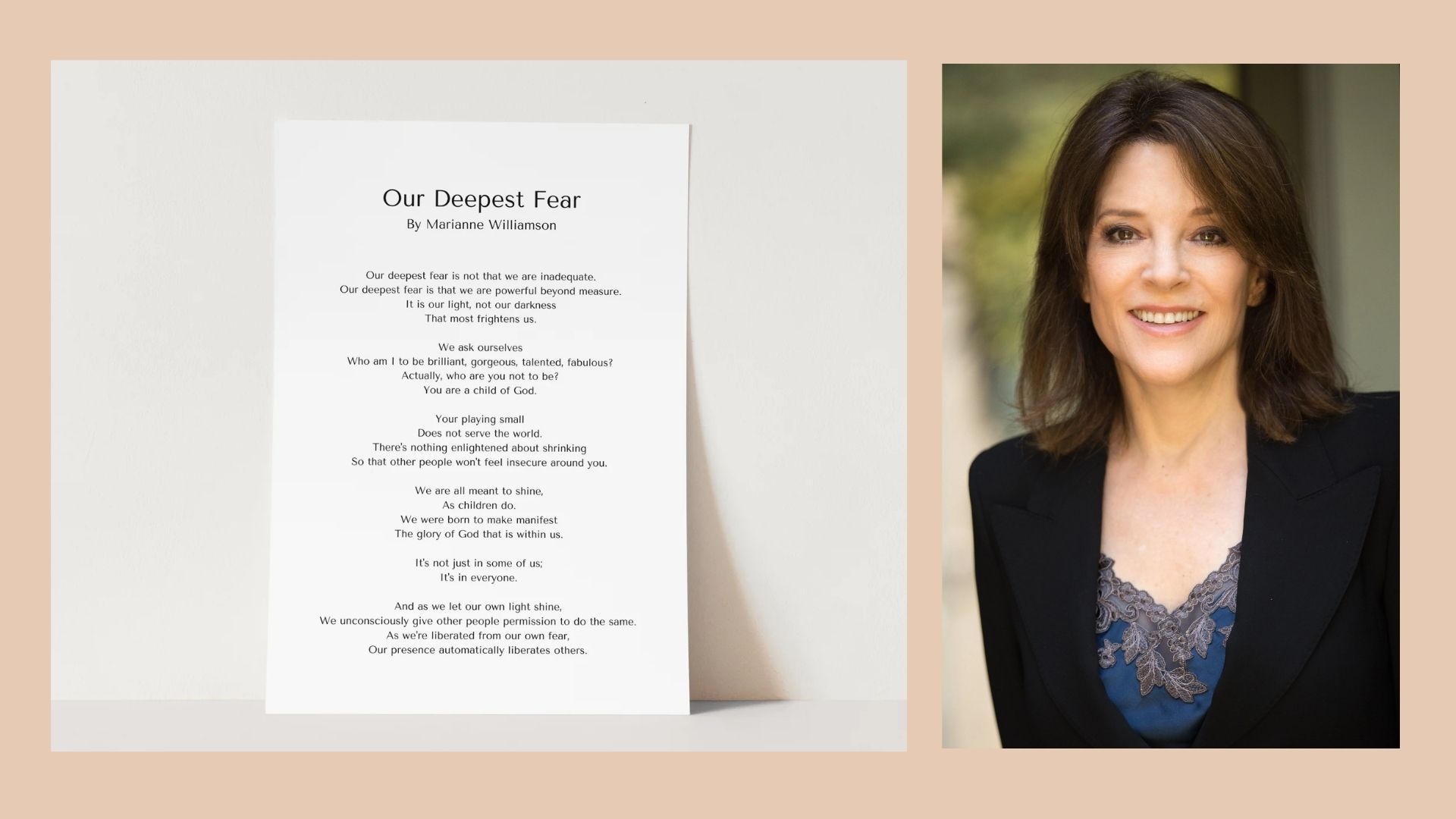
You’ve probably read the line “Our deepest fear is not that we are inadequate.” It stops you mid-scroll.
It makes you think. I remember the first time I came across it, I had to read it twice. There’s something in those words that hits differently.
This blog breaks down the full meaning of the poem, its key themes, and why so many people misattribute it to Nelson Mandela.
By the end, you’ll know exactly what Marianne Williamson meant, and maybe see yourself a little differently too.
Meaning of “Our Deepest Fear”

Most people think their biggest fear is failure. Williamson says otherwise. The poem argues that what truly scares us is our own power, our brilliance, our potential, our light.
We ask ourselves, “Who am I to be great?” But Williamson flips the question: “Who are you not to be?” Shrinking yourself doesn’t protect anyone.
Your greatness, when lived fully, gives others permission to do the same.
The poem is a call to stop hiding and start showing up, fully, boldly, and without apology.
Key Themes in the Poem
The poem carries ideas that go far beyond a motivational quote. Here’s what’s really being said.
Self-Expression and Authenticity
Williamson tells us not to make ourselves small to make others comfortable. Living authentically, showing your real talents and voice, is not arrogance. It’s courage.
When you shrink yourself, you don’t protect others, you just deprive the world of what you have to offer.
Showing up fully, without fear of judgment, is one of the most honest things you can do. The poem pushes you to live out loud.
Collective Empowerment
Your growth doesn’t just help you, it helps everyone around you. When you stop hiding and start living with confidence, you become an example.
People around you see what’s possible. They start to believe in their own potential too. Inspiration is contagious.
One person choosing to show up fully can shift the energy in a room, a family, or even a community. That’s the real power of this poem.
Spiritual Perspective
Williamson refers to us as “children of God,” and this isn’t meant to be religious in a narrow sense. It’s about shared worth. Every person carries inherent value.
The spiritual lens here says that playing small goes against your very nature. You were not made to hide.
This universal connection, the idea that we are all linked through shared potential, is at the heart of what makes the poem feel so personal yet so wide-reaching.
Interpretation of the Poem
The poem works on multiple levels. Here’s how to read between the lines.
Fear of Power, Not Weakness
Williamson makes a bold claim: people fear their own potential more than failure. Self-doubt is not humility, it’s a barrier.
When you tell yourself you’re not good enough to try, you protect yourself from both failure and success. The poem asks you to look honestly at what’s holding you back.
Most of the time, it’s not the world, it’s the story you keep telling yourself about what you deserve.
Meaning of “Light” and “Darkness”
In the poem, “light” stands for your talent, confidence, and true self. “Darkness” is the fear, insecurity, and self-limitation that keeps you from living fully.
Williamson doesn’t use these as opposites in a fight, she uses them to show a choice.
You can choose to hide in the dark, or you can choose to let your light show. It’s not about being perfect. It’s about being real and present.
Self-Worth and Identity
The poem challenges one of the most common human habits, questioning your own worth.
“Who am I to be brilliant, gorgeous, talented, fabulous?” Williamson’s answer is simple and direct “Who are you not to be?” Your value is not something you earn.
It’s something you already have. The poem encourages you to stop waiting for permission to be great and start accepting that you already are.
Misattribution and Historical Context
For years, people believed Nelson Mandela quoted this poem in his 1994 inaugural speech. It spread fast, on social media, in books, even in speeches.
But it was never true. No record of Mandela using these words exists in any verified transcript or official document.
The actual source is Marianne Williamson’s 1992 book, A Return to Love. Williamson herself has publicly confirmed this multiple times, clarifying that the quote belongs to her work alone.
The mix-up is understandable, the words feel big enough for a world stage, but the credit belongs where it’s always been.
Why Read This Poem
If you’ve ever talked yourself out of something because you felt “not ready,” this poem is for you. It doesn’t just inspire, it confronts.
It asks you to look at the ways you hold yourself back and call them what they are: fear. Reading Williamson’s words is a quiet but powerful gut-check.
It won’t fix everything. But it will make you question the stories you tell yourself about your own limits.
And sometimes, that one shift in thinking is all it takes to move in a new direction.
About the Poet

Marianne Williamson is an American author, speaker, and activist born in 1952 in Houston, Texas.
She became widely known after publishing A Return to Love in 1992, which drew from A Course in Miracles, a self-study spiritual program.
The book became a bestseller, largely because Oprah Winfrey spoke about it on her show.
Williamson went on to write several more books and ran for U.S. president in 2020. Her writing sits at the crossroads of spirituality, self-worth, and social responsibility.
She has spent decades speaking about love, fear, and what it means to live with intention and purpose.
Conclusion
I first read “Our Deepest Fear” during a time I kept playing small at work. It didn’t comfort me. It challenged me.
And honestly, that’s what made it stick. Williamson isn’t asking you to be perfect. She’s asking you to stop pretending you’re less than you are.
If this poem hit home for you, share it with someone who needs to hear it.
Drop a comment below and tell me which line stayed with you. I’d genuinely love to know.
Frequently Asked Questions
What is the main message of “Our Deepest Fear”?
The poem says people fear their own greatness more than their failure, and that hiding your potential helps no one.
Who wrote “Our Deepest Fear”?
Marianne Williamson wrote it in her 1992 book, A Return to Love.
Did Nelson Mandela say “Our Deepest Fear”?
No, this is a widely spread myth, and Williamson has confirmed the words are hers, not Mandela’s.
What does “light” mean in the poem?
“Light” represents your talent, confidence, and true self, the parts of you that you’re afraid to show the world.
Why is “Our Deepest Fear” so popular?
The words speak to a feeling most people carry quietly, the fear of their own potential, which makes it deeply relatable.