


“The Tyger” looks simple. Six stanzas, short lines, a steady beat. But every line Blake wrote is carrying a question that gets harder to sit with as you go.
Most readers feel like they are missing something when they read it. They are.
This breakdown goes line by line through the full poem, the blacksmith imagery, the theology Blake was wrestling with, and the one word in the final stanza that changes everything.
Before you start, know this:“The Tyger” is not a standalone poem. Blake wrote it as a direct response to “The Lamb.” That contrast is the whole argument.
Full Text of “The Tyger” by William Blake
Tyger Tyger, burning bright,
In the forests of the night;
What immortal hand or eye,
Could frame thy fearful symmetry?
In what distant deeps or skies,
Burnt the fire of thine eyes?
On what wings dare he aspire?
What the hand, dare seize the fire?
And what shoulder, and what art,
Could twist the sinews of thy heart?
And when thy heart began to beat,
What dread hand? and what dread feet?
What the hammer? what the chain,
In what furnace was thy brain?
What the anvil? what dread grasp,
Dare its deadly terrors clasp!
When the stars threw down their spears,
And water’d heaven with their tears:
Did he smile his work to see?
Did he who made the Lamb make thee?
Tyger Tyger burning bright,
In the forests of the night:
What immortal hand or eye,
Dare frame thy fearful symmetry?
Line by Line Explanation of “The Tyger”
Each stanza builds on the last. Blake is not repeating himself, he is tightening the same question until it has nowhere left to go.
Stanza 1: The Opening Question
“Tyger Tyger, burning bright, / In the forests of the night; / What immortal hand or eye, / Could frame thy fearful symmetry?”
“Burning bright” is not literal. Blake uses fire to show the tiger’s intense, glowing energy. Its orange stripes in a dark forest look like flames. That image alone tells you this creature is not ordinary.
“Forests of the night” sets the mood immediately. Dark, dangerous, unknown.
“What immortal hand or eye” is the poem’s first big question. Blake is asking who or what created this creature. “Immortal” points directly to a god or divine being, not a human.
“Fearful symmetry” is the phrase the whole poem hinges on. The tiger is perfectly shaped and balanced. But that perfection is frightening.
Blake is not admiring the tiger the way you admire a sunset. He is unsettled by it. Something this powerful and this perfect makes a hard question about whoever made it.
Stanza 2: Where Did the Creator Come From?
“In what distant deeps or skies, / Burnt the fire of thine eyes? / On what wings dare he aspire? / What the hand dare seize the fire?”
“Distant deeps or skies” means hell below or heaven above. Blake is asking where the creator originated. But notice he never answers. That is deliberate.
If the creator came from the deep, the tiger could be a dark or demonic creation. If he came from the skies, then God himself made something terrifying. Blake keeps both options open because either answer is unsettling. He will not let you pick the comfortable one and move on.
“What the hand, dare seize the fire?” connects to the Greek myth of Prometheus, who stole fire from the gods. Blake is asking who had the boldness to take that kind of power and use it to create something as fierce as this.
Stanza 3: Building the Tiger’s Body
“And what shoulder, and what art, / Could twist the sinews of thy heart? / And when thy heart began to beat, / What dread hand? and what dread feet?”
These lines focus on the physical act of creation. Blake is not describing God speaking something into existence. He imagines a creator straining with effort, using shoulders and skill to twist muscle fibers into place.
“Sinews” are the tough fibers in muscles. The image of twisting them into a heart is deliberately physical and a little violent. This was not a gentle act.
“Dread” appears twice. It means fear mixed with awe. The creator is powerful, yes. But making this creature was not a simple or comfortable thing.
Stanza 4: The Blacksmith’s Forge
“What the hammer? what the chain, / In what furnace was thy brain? / What the anvil? what dread grasp, / Dare its deadly terrors clasp!”
This is where Blake’s imagery gets most intense. Hammer, chain, furnace, anvil. These are a blacksmith’s tools, not a painter’s or a sculptor’s.
Blake chose a blacksmith deliberately. He was writing during the Industrial Revolution, when forges and factories were reshaping England, the same world he interrogated through Industrial Revolution Imagery in “The Chimney Sweeper.” He saw that kind of power as something that could produce extraordinary things and terrible things at the same time.
By making God a blacksmith, Blake removes the idea of effortless divine creation. This creator does not speak the tiger into existence. He hammers it. He struggles with it. And that makes the tiger a choice, not an accident. Someone decided to make this. That matters.
“In what furnace was thy brain?” is the sharpest line in the stanza. The tiger’s mind was forged in fire. Its intelligence and instinct are as dangerous as its claws.
Stanza 5: The Heavens React
“When the stars threw down their spears, / And water’d heaven with their tears: / Did he smile his work to see? / Did he who made the Lamb make thee?”
“Stars threw down their spears” refers to the fall of the rebel angels. In Christian tradition, Satan and his followers were defeated and cast out of heaven. Throwing down spears means surrendering. The stars wept as they conceded.
Blake places this cosmic defeat right before the poem’s central question. The tiger’s creation did not happen in a peaceful universe. It happened against a backdrop of rebellion, loss, and grief. That context makes the tiger feel even more morally heavy.
“Did he smile his work to see?” is unsettling in a quiet way. Did the creator feel satisfaction after making something this terrifying? Blake does not say. He just lets the question sit.
“Did he who made the Lamb make thee?” This is the heart of the entire poem.The Lamb, from Blake’s earlier collection, is gentle, innocent, and connected to God’s love.
The tiger is the opposite. Blake is asking whether one God, one creator, is responsible for both. He never answers. That silence is the point.
Stanza 6: One Word Changes Everything
“Tyger Tyger burning bright, / In the forests of the night: / What immortal hand or eye, / Dare frame thy fearful symmetry?”
The final stanza is almost identical to the first. Almost.
In stanza 1, Blake wrote:“Could frame thy fearful symmetry?”
In stanza 6, he writes:“Dare frame thy fearful symmetry?”
That single word swap is the whole poem’s conclusion.
“Could” asks whether it was even possible to create the tiger. It is a question about ability.
“Dare” asks whether anyone would have the boldness to do it. It is a question about moral choice.
By the end, Blake has moved past wondering whether such a creator exists. Now he is asking whether any being would knowingly, deliberately create something this terrifying.
The creator knew what the tiger was going to be. And they made it anyway. That shift from ability to audacity is what the entire poem builds toward.
The Tyger and The Lamb: Why the Contrast Matters
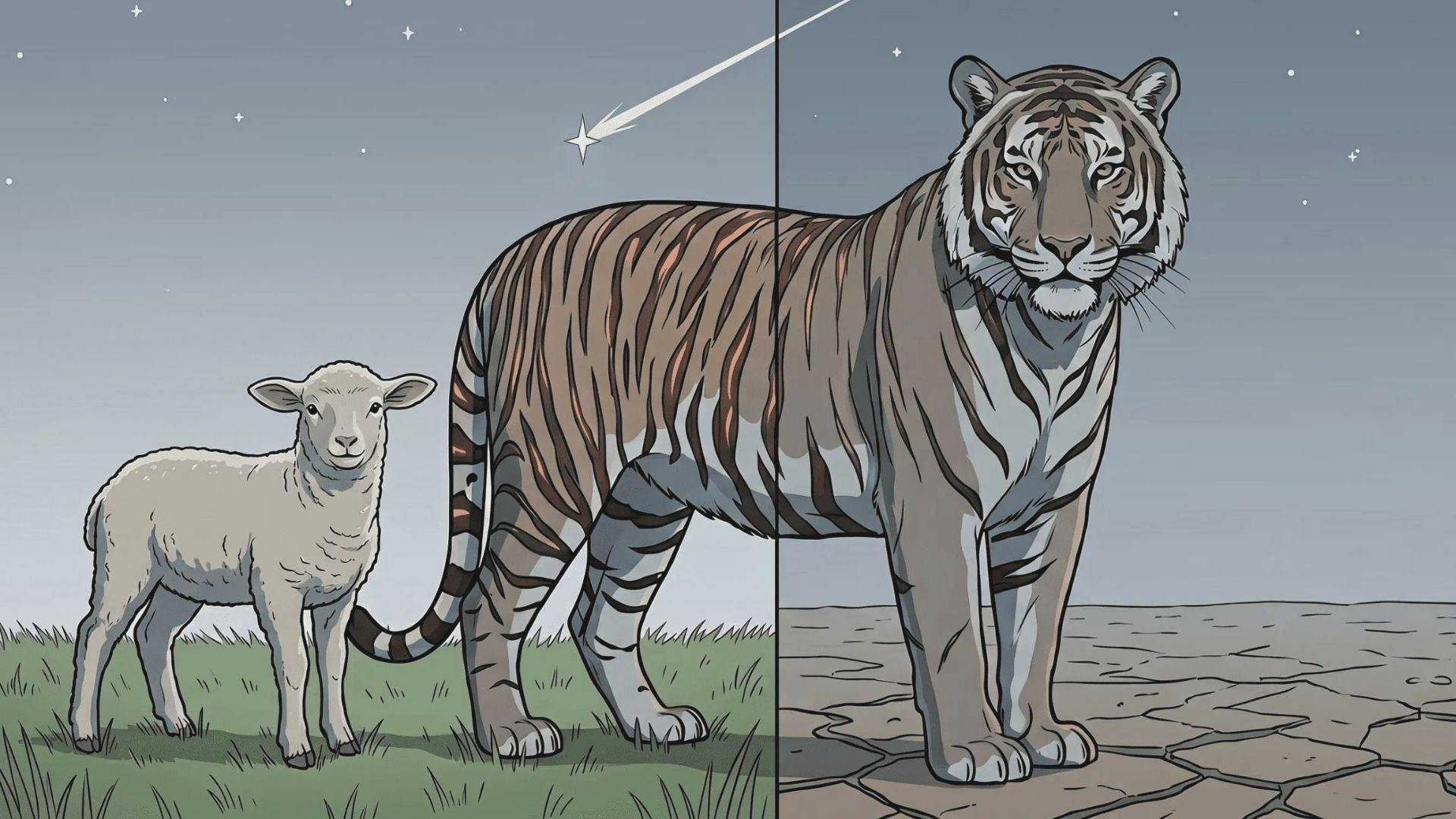
You cannot fully understand “The Tyger” without “The Lamb.”
“The Lamb” presents a gentle creator and a gentle creation in complete harmony. The lamb knows its maker. The relationship is tender and warm.
“The Tyger” presents the opposite. Creation as violent labour. A creature that does not know its maker. A creator whose intentions are unknowable.
Together, they form one argument. If the same God made both creatures, what does that tell you about the nature of creation? Blake does not resolve it. He is not trying to. He is pointing at a contradiction that sits at the centre of faith and asking you to sit with it.
Themes in “The Tyger”
- Good and evil in the same creation: If God is good, why make something dangerous? Blake raises this without answering it. The tiger exists. That is the fact. What it means about the creator is left open.
- Creation requires force, not just love:The blacksmith imagery makes clear that making something powerful is not a soft act. Real creation, Blake suggests, involves effort, risk, and intention.
- Innocence and experience are two sides of the same world: The Lamb and the Tiger are not opposites that cancel each other out. They are both real, both made by the same hand, and both necessary to understand life fully.
Final Thoughts
Blake was not writing about a tiger. He was asking whether the same God who made innocence also made terror, and whether that is something we can make peace with.
The poem never answers that. That is the point.
If this breakdown helped you read it differently, share it with someone studying it. Drop a comment below with your take on the “could” vs “dare” shift.
And if you want to go further, read “The Lamb” right after. The two poems together say something neither one says alone.
Frequently Asked Questions
What is the central idea of the poem “The Tyger”?
Blake uses the tiger to ask whether a good God could create something fierce and terrifying. The poem raises that question and deliberately leaves it unanswered.
What does “Tyger Tyger burning bright” mean?
It opens the poem by addressing the tiger directly, using fire to show its raw intensity and power. The burning describes the tiger’s energy, not literal flames.
Can you explain the poem “The Tyger” by William Blake?
Blake asks who created the tiger and what that says about the creator, using blacksmith imagery to show creation as forceful and deliberate. The poem sits in direct conversation with “The Lamb” to highlight the tension between innocence and experience.
What is the most famous quote from the poem “The Tyger”?
“Tyger Tyger, burning bright, in the forests of the night” is the most recognised line, opening and closing the poem in near-identical stanzas. That repetition shows Blake’s central questions remain unanswered by the end.