Looking for autumn poems worth reading? Most lists just repeat the same famous names. But not every fall poem feels the same.
Some are warm and happy. Some are sad and quiet. Some are fun to read out loud with kids.
Here’s a surprising fact:Keats and Shelley wrote about autumn in the same year, 1819. Yet one poem feels like a calm, sunny afternoon, and the other feels like a wild storm.
That’s what makes autumn special. Below, you’ll find great classics, short poems you can read in a minute, and easy picks for kids
Why Autumn Inspires More Poetry Than Any Other Season
Autumn holds two opposite truths at the same time: Beauty and ending, warmth and the coming cold, and that’s exactly why poets keep returning to it.
No other season does this.
Spring is one clear note:Renewal.
Winter is another:Stillness.
But autumn plays both at once, and that tension is where poetry lives. A poem doesn’t need to resolve contradictions. It just needs to make you feel them.
There’s a sensory reason too. Autumn is specific in a way other seasons aren’t. The colours are vivid and immediate. The smell of cold air and wet leaves is unmistakable.
All of that gives a poet something concrete to build an emotion out of, and once you have a real image, you have a real poem.
Classic Autumn Poems Every Reader Should Know
Some poems earn their place in the conversation by getting something exactly right, a feeling, a way of looking at the season, an image that nobody else quite matches.
These five did that. They also show how differently great poets can use the same season, which is worth noticing before you read any of them.
To Autumn – John Keats
Season of mists and mellow fruitfulness,
Close bosom-friend of the maturing sun;
Conspiring with him how to load and bless
With fruit the vines that round the thatch-eaves run;
To bend with apples the moss’d cottage-trees,
And fill all fruit with ripeness to the core;
To swell the gourd, and plump the hazel shells
With a sweet kernel; to set budding more,
And still more, later flowers for the bees,
Until they think warm days will never cease,
For summer has o’er-brimm’d their clammy cells.
Who hath not seen thee oft amid thy store?
Sometimes whoever seeks abroad may find
Thee sitting careless on a granary floor,
Thy hair soft-lifted by the winnowing wind;
Or on a half-reap’d furrow sound asleep,
Drows’d with the fume of poppies, while thy hook
Spares the next swath and all its twined flowers:
And sometimes like a gleaner thou dost keep
Steady thy laden head across a brook;
Or by a cyder-press, with patient look,
Thou watchest the last oozing hours by hour.
Where are the songs of spring? Ay, Where are they?
Think not of them, thou hast thy music too,
While barred clouds bloom the soft-dying day,
And touch the stubble-plains with rosy hue;
Then in a wailful choir the small gnats mourn
Among the river sallows, borne aloft
Or sinking as the light wind lives or dies;
And full-grown lambs loud bleat from hilly bourn;
Hedge-crickets sing; and now with treble soft
The red-breast whistles from a garden-croft;
And gathering swallows twitter in the skies.
Keats wrote this after a September walk through harvest fields in 1819, and it shows.
The poem moves through autumn as a process: the weight of harvest, the drowsy afternoon warmth, the sounds of the season settling in. Most people expect autumn poems to be sad.
This one isn’t. The emotional register is grateful, even celebratory. Keats isn’t mourning the season passing. He’s insisting you pay attention to it while it’s still here.
Fall, Leaves, Fall – Emily Brontë
Fall, leaves, fall; die, flowers, away;
Lengthen night and shorten day;
Every leaf speaks bliss to me
Fluttering from the autumn tree.
I shall smile when wreaths of snow
Blossom where the rose should grow;
I shall sing when night’s decay
Ushers in a drearier day.
Brontë isn’t resigned to the falling leaves; she’s welcoming them. That’s what most readers miss.
She wrote this around 1838 and it reads like someone who finds genuine comfort in the coming dark, not a threat.
Where Keats is full and grateful, Brontë is about release. The end of things, for her, is freedom.
It’s a short poem, but it carries a specific emotional truth that most of the canon tends to skip right over.
Ode to the West Wind – Percy Bysshe Shelley
I
O wild West Wind, thou breath of Autumn’s being,
Thou, from whose unseen presence the leaves dead
Are driven, like ghosts from an enchanter fleeing,
Yellow, and black, and pale, and hectic red,
Pestilence-stricken multitudes: O thou,
Who chariotest to their dark wintry bed
The wingèd seeds, where they lie cold and low,
Each like a corpse within its grave, until
Thine azure sister of the Spring shall blow
Her clarion o’er the dreaming earth, and fill
(Driving sweet buds like flocks to feed in air)
With living hues and odours plain and hill:
Wild Spirit, which art moving everywhere;
Destroyer and Preserver; hear, O hear!
II
Thou on whose stream, ’mid the steep sky’s commotion,
Loose clouds like Earth’s decaying leaves are shed,
Shook from the tangled boughs of Heaven and Ocean,
Angels of rain and lightning: there are spread
On the blue surface of thine airy surge,
Like the bright hair uplifted from the head
Of some fierce Maenad, even from the dim verge
Of the horizon to the zenith’s height,
The locks of the approaching storm. Thou dirge
Of the dying year, to which this closing night
Will be the dome of a vast sepulchre
Vaulted with all thy congregated might
Of vapours, from whose solid atmosphere
Black rain, and fire, and hail will burst: O hear!
III
Thou who didst waken from his summer dreams
The blue Mediterranean, where he lay,
Lulled by the coil of his crystalline streams
Beside a pumice isle in Baiae’s bay,
And saw in sleep old palaces and towers
Quivering within the wave’s intenser day,
All overgrown with azure moss and flowers
So sweet, the sense faints picturing them! Thou
For whose path the Atlantic’s level powers
Cleave themselves into chasms, while far below
The sea-blooms and the oozy woods which wear
The sapless foliage of the ocean, know
Thy voice, and suddenly grow grey with fear,
And tremble and despoil themselves: O hear!
IV
If I were a dead leaf thou mightest bear;
If I were a swift cloud to fly with thee;
A wave to pant beneath thy power, and share
The impulse of thy strength, only less free
Than thou, O Uncontrollable! If even
I were as in my boyhood, and could be
The comrade of thy wanderings over Heaven,
As then, when to outstrip thy skiey speed
Scarce seemed a vision; I would ne’er have striven
As thus with thee in prayer in my sore need.
Oh! lift me as a wave, a leaf, a cloud!
I fall upon the thorns of life! I bleed!
A heavy weight of hours has chained and bowed
One too like thee: tameless, and swift, and proud.
V
Make me thy lyre, even as the forest is:
What if my leaves are falling like its own!
The tumult of thy mighty harmonies
Will take from both a deep, autumnal tone,
Sweet though in sadness. Be thou, Spirit fierce,
My spirit! Be thou me, impetuous one!
Drive my dead thoughts over the universe
Like withered leaves to quicken a new birth!
And, by the incantation of this verse,
Scatter, as from an unextinguished hearth
Ashes and sparks, my words among mankind!
Be through my lips to unawakened Earth
The trumpet of a prophecy! O Wind,
If Winter comes, can Spring be far behind?
Shelley wrote this in a single afternoon in Florence in 1819, the same year as Keats’s ToAutumn, though the two poems feel nothing alike. Where Keats is still, Shelley is in motion.
The west wind is both destroyer and preserver, and Shelley writes from exhaustion and envy, wanting the wind’s force for himself.
The emotional register is urgent, almost desperate. If Keats gives you October afternoon, Shelley gives you a November storm.
After Apple-Picking – Robert Frost
My long two-pointed ladder’s sticking through a tree
Toward heaven still,
And there’s a barrel that I didn’t fill
Beside it, and there may be two or three
Apples I didn’t pick upon some bough.
But I am done with apple-picking now.
Essence of winter sleep is on the night,
The scent of apples: I am drowsing off.
I cannot rub the strangeness from my sight
I got from looking through a pane of glass
I skimmed this morning from the drinking trough
And held against the world of hoary grass.
It melted, and I let it fall and break.
But I was well
Upon my way to sleep before it fell,
And I could tell
What form my dreaming was about to take.
Magnified apples appear and disappear,
Stem end and blossom end,
And every fleck of russet showing clear.
My instep arch not only keeps the ache,
It keeps the pressure of a ladder-round.
I feel the ladder sway as the boughs bend.
And I keep hearing from the cellar bin
The rumbling sound
Of load on load of apples coming in.
For I have had too much
Of apple-picking: I am overtired
Of the great harvest I myself desired.
There were ten thousand thousand fruit to touch,
Cherish in hand, lift down, and not let fall.
For all
That struck the earth,
No matter if not bruised or spiked with stubble,
Went surely to the cider-apple heap
As of no worth.
One can see what will trouble
This sleep of mine, whatever sleep it is.
Were he not gone,
The woodchuck could say whether it’s like his
Long sleep, as I describe its coming on,
Or just some human sleep.
Frost wrote this in 1914, and it’s one of those poems that feels simple on the surface and gets heavier the longer you sit with it.
The speaker is done with the harvest apples picked, ladder put away, but can’t quite let the season go.
It reads like tiredness that’s more than physical.
Autumn here is the end of effort, the strange blurred state between finishing and rest.
It’s the most honest poem about what completing something actually feels like.
The Wild Swans at Coole – W.B. Yeats
The trees are in their autumn beauty,
The woodland paths are dry,
Under the October twilight the water
Mirrors a still sky;
Upon the brimming water among the stones
Are nine-and-fifty swans.
The nineteenth Autumn has come upon me
Since I first made my count;
I saw, before I had well finished,
All suddenly mount
And scatter wheeling in great broken rings
Upon their clamorous wings.
I have looked upon those brilliant creatures,
And now my heart is sore.
All’s changed since I, hearing at twilight,
The first time on this shore,
The bell-beat of their wings above my head,
Trod with a lighter tread.
Unwearied still, lover by lover,
They paddle in the cold,
Companionable streams or climb the air;
Their hearts have not grown old;
Passion or conquest, wander where they will,
Attend upon them still.
But now they drift on the still water
Mysterious, beautiful;
Among what rushes will they build,
By what lake’s edge or pool
Delight men’s eyes, when I awake some day
To find they have flown away?
Yeats wrote this between 1916 and early 1917, standing at an autumn lake watching swans. If the quiet sadness here pulls you in, another Yeats poem takes that unease somewhere much louder.
That gap between something wild and permanent and a man who feels himself diminishing is what the poem is really about.
The autumn setting isn’t decoration; it’s the whole point. The season of change makes the swans’ constancy feel almost unbearable.
It’s a quiet poem, but the sadness accumulates slowly. By the last line, it lands hard.
Short Autumn Poems You Can Read in a Minute
Not every poem needs five stanzas. Sometimes one image is enough. These short autumn poems do exactly that to land a feeling quickly and get out of the way.
The Morns Are Meeker Than They Were – Emily Dickinson
The morns are meeker than they were,
The nuts are getting brown;
The berry’s cheek is plumper,
The rose is out of town.
The maple wears a gayer scarf,
The field is a scarlet gown.
Lest I should be old-fashioned,
I’ll put a trinket on.
Dickinson notices autumn the way you notice a friend changing their look quietly, with affection. Eight lines, and you feel the whole season shift.
November Night – Adelaide Crapsey
Listen…
With faint dry sound,
Like steps of passing ghosts,
The leaves, frost-crisp’d, break from the trees
And fall.
Crapsey invented the cinquain, a five-line form, and this is her best use of it. The pause after “Listen” is the whole poem.
Nothing Gold Can Stay – Robert Frost
Nature’s first green is gold,
Her hardest hue to hold.
Her early leaf’s a flower;
But only so an hour.
Then leaf subsides to leaf.
So Eden sank to grief,
So dawn goes down to day.
Nothing gold can stay.
Eight lines that cover the whole arc of autumn and everything else that fades. Frost packs more into a short poem than most poets manage in ten stanzas.
Autumn – T.E. Hulme
A touch of cold in the Autumn night
I walked abroad,
And saw the ruddy moon lean over a hedge
Like a red-faced farmer.
I did not stop to speak, but nodded,
And round about were the wistful stars
With white faces like town children.
Seven lines, one perfect image. The moon as a red-faced farmer is the kind of comparison that once read, you can never unsee.
Autumn Fires – Robert Louis Stevenson
In the other gardens
And all up the vale,
From the autumn bonfires
See the smoke trail!
Pleasant summer over
And all the summer flowers,
The red fire blazes,
The grey smoke towers.
Everywhere I go
Sing and dance, little maiden,
Skip and leap, little maiden,
October’s over!
Simple, rhythmic, and joyful, the only poem on this list that treats autumn as a party. Works well read aloud.
Autumn Poems for Kids and Classrooms
Kids don’t need a poem about endings or loss. They need one that sounds good out loud and paints a picture they already know.
The best autumn poems for children lean on rhythm, rhyme, and simple sensory detail.
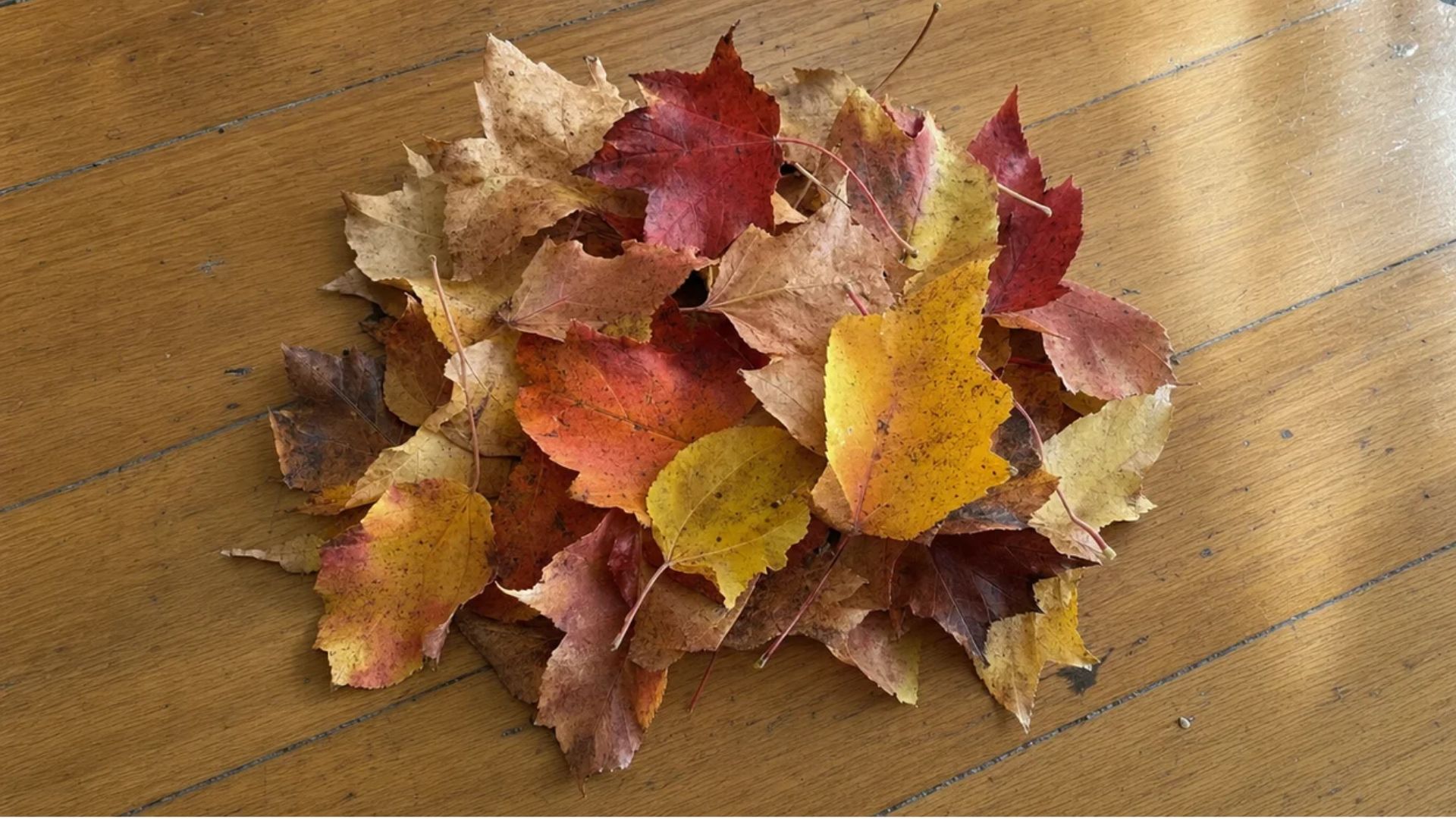
Think crunchy leaves, pumpkins on the step, and that first chilly walk back to school.
Where you read the poem matters just as much. A poem that gets a class of 25 on its feet can feel too loud at bedtime.
Poems That Work in the Classroom
Classroom poems need a strong beat that a group can chant together. The ones below are easy to act out and give kids something to talk about afterwards:
- “Come, Little Leaves” by George Cooper: The wind calls the leaves out to play, so kids can twirl and drop on cue.
- “Something Told the Wild Geese” by Rachel Field: Short and a little mysterious. It opens a natural chat about why birds fly south.
- “Autumn Fires” by Robert Louis Stevenson: Three quick stanzas about garden bonfires, perfect for a first try at memorising.
If a poem makes kids want to move or ask a question, it’s working.
For bedtime, pick something softer, like Emily Dickinson’s “The morns are meeker than they were.”
Older students, around 11 and up, can handle Keats’s “To Autumn” too.
First, tell them it moves from ripe fruit to a sleepy harvest day to evening sounds.
Final Takeaway
The right autumn poems depend on how you feel today. Keats fits a grateful afternoon. Brontë suits a day when you want the dark to come early.
A short poem works when you only have a minute. That’s what I hope you take from this list: you don’t need to study a poem to enjoy it. You just need to let it name a feeling you already have.
Autumn is a season of mixed feelings, so it makes sense that poems help. Pick one today and read it aloud. Then leave a comment with the one that stayed with you, or check out my other poem articles for more.
Frequently Asked Questions
What is a famous Mary Oliver poem about autumn?
“In Blackwater Woods” is her best-known autumn-set poem. It uses a fall forest to talk about loving something and still letting it go.
What is Rilke’s poem ‘Autumn Day’ about?
It captures the loneliness of autumn the season is ending, and whoever is homeless or alone by now will stay that way, restlessly wandering city streets as the leaves fall.
Are there autumn poems that rhyme?
Yes. Emily Brontë’s “Fall, Leaves, Fall” rhymes in neat couplets. Dickinson’s “The Morns Are Meeker Than They Were” also rhymes, and both are easy to remember.
How do you write a poem about autumn?
Start with one real detail you can see, smell or hear, like wet leaves or cold air. Then let that image lead you to the feeling.
Is there a difference between “autumn” and “fall” in poetry?
Not in meaning. “Autumn” sounds more formal and literary, while “fall” is the everyday word in American English. Poets use both.