You’ve probably heard this line even if you’ve never read the poem. For over 100 years, writers and journalists have used it whenever the world feels out of control.
“The Second Coming” (1919) is a modernist poem by W. B. Yeats about a civilization collapsing into disorder. Based on Yeats’s idea that history moves in 2,000-year cycles, it predicts a frightening new age, pictured as a “rough beast” slouching toward Bethlehem.
Below, you’ll find the full text, the history behind it, a stanza-by-stanza breakdown, its key themes and symbols, what the title really means, and why it still feels so relevant today.
What Is “The Second Coming” About?
At its core, this poem is about a world losing control and something dark rising up to fill that gap. Yeats wrote it in 1919 after World War I had torn everything apart.
The war didn’t just shake him. He genuinely believed civilization itself was ending.
The poem splits into two parts. The first part is about collapse: order breaks down, sensible people go silent, and extremists take over.
The second part is where it gets unsettling. Yeats sees a vision of something ancient and monstrous slowly making its way toward Bethlehem.
Not Christ returning Something completely different. Something that has been waiting 2,000 years for this exact moment.
The chaos isn’t the main event. It’s a birth announcement.
Historical Context: Why 1919 Mattered
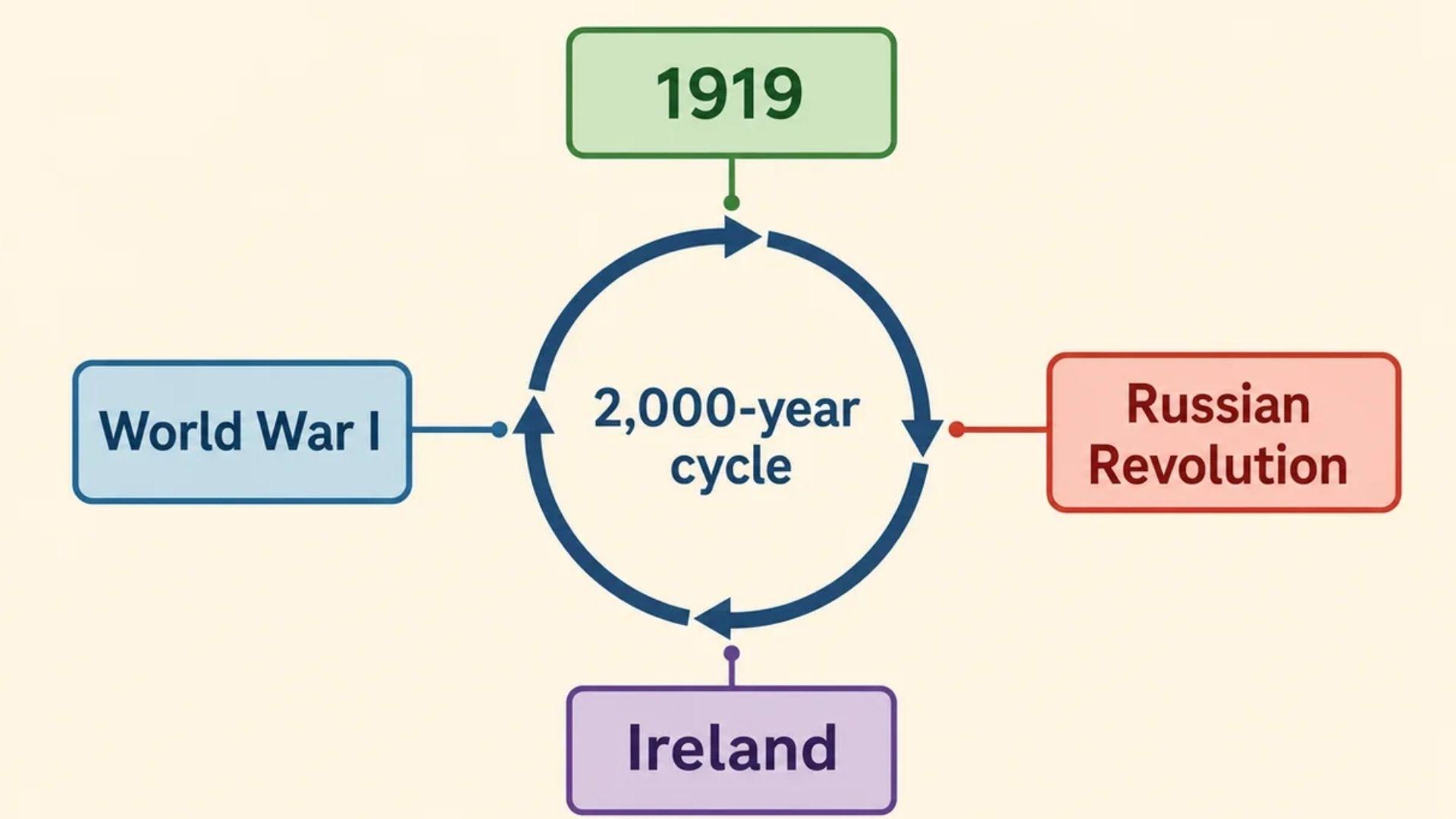
Yeats wrote this poem in 1919, right after World War I had killed over 15 million people and left the world in shock.
Before the war, most people believed humanity was improving, getting smarter, safer, more civilized. The war killed that idea completely.
And it didn’t stop there. Russia was in mid-revolution, and Yeats’s own Ireland was at war with British forces. Everywhere he looked, old structures were falling, and angry groups were grabbing power.
On top of all that, Yeats personally believed history moved in 2,000-year cycles and by his thinking, the Christian era was ending right on schedule. The poem is what he saw coming next.
The Full Text of “The Second Coming”
By William Butler Yeats (1919)
Turning and turning in the widening gyre
The falcon cannot hear the falconer;
Things fall apart; the centre cannot hold;
Mere anarchy is loosed upon the world,
The blood-dimmed tide is loosed, and everywhere
The ceremony of innocence is drowned;
The best lack all conviction, while the worst
Are full of passionate intensity.
Surely some revelation is at hand;
Surely the Second Coming is at hand.
The Second Coming! Hardly are those words out
When a vast image out of Spiritus Mundi
Troubles my sight: somewhere in sands of the desert
A shape with lion body and the head of a man,
A gaze blank and pitiless as the sun,
Is moving its slow thighs, while all about it
Reel shadows of the indignant desert birds.
The darkness drops again; but now I know
That twenty centuries of stony sleep
Were vexed to nightmare by a rocking cradle,
And what rough beast, its hour come round at last,
Slouches towards Bethlehem to be born?
Stanza-by-Stanza Breakdown
The poem has two distinct parts and understanding where one ends and the other begins makes everything click.
Stanza 1: The World in Freefall
The first eight lines describe a world losing its grip on itself. Yeats opens with a falcon that has flown so far out it can no longer hear its falconer, something once controlled has drifted too far to return. He then describes anarchy spreading, innocence disappearing, and chaos taking over.
The line that hits hardest is this the thoughtful, reasonable people have gone quiet, while the loudest and most extreme ones have never been more confident.
Yeats wasn’t just imagining this. He was watching it happen around him in real time.
Stanza 2: The Vision of What Replaces It
The second part shifts from describing collapse to seeing what comes next. Yeats has a vision rising from Spiritus Mundi, a shared pool of human memory of a creature with a lion’s body and a human head, moving slowly across the desert with a blank, pitiless stare.
It has been sleeping for twenty centuries, and what woke it up was the birth of Christ, the very event that started the Christian era.
Now that era is ending, and this ancient thing is returning to take its place. It isn’t new. It’s old. And it has been waiting the whole time.
Core Themes Explained
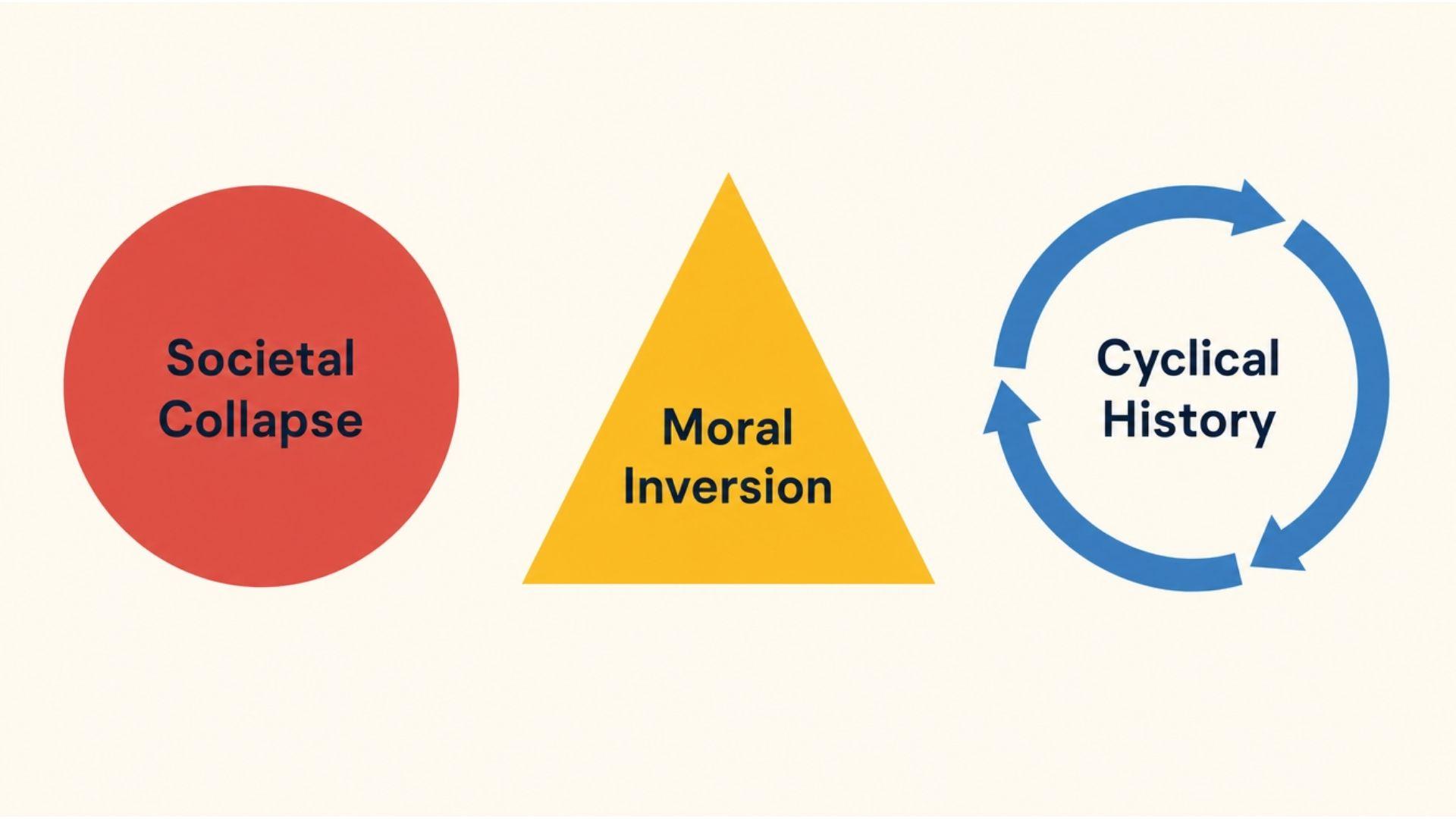
Yeats packed a lot into 22 lines. Here are the three big ideas running through the poem and what they actually mean.
1. Societal Collapse
When Yeats says “the centre cannot hold” he means the shared values and beliefs that hold a society together are gone. Not bending gone.
When that happens, governments stop working, communities break down, and people stop trusting each other. Yeats was watching exactly that happen across Europe in 1919.
2. Moral Inversion
The reasonable, thoughtful people went quiet while the loud, extreme ones got louder and more confident. Good people hesitate. Extreme people don’t.
And in a crisis, the ones who act with total confidence even when they’re wrong end up taking control. It was true in 1919 and it’s still uncomfortable to read today.
3. Cyclical History
Yeats believed history moved in giant circles each era rising, peaking, then collapsing so a new one could begin. In his view, 2,000 years of Christian civilization had run its course.
What replaces it won’t carry those same values forward. The rough beast isn’t the next chapter of the same story. It’s an entirely new book.
Symbolism Every Major Image Broken Down
Every image in this poem is doing a specific job. Here’s what each one actually means in plain terms.
1. The Widening Gyre :Picture a spinning top losing control, its circles getting wider and wilder until it falls over. That’s the gyre. Yeats believed civilizations spin the same way. The falcon flying in a “widening gyre” means the system has lost its grip and is moments away from total collapse.
2. The Falcon and the Falconer :A falcon always returns when its trainer calls. When it can’t hear that call anymore, the bond is broken forever. Yeats uses this to show humanity losing its connection to whatever kept it grounded God, tradition, shared values. Once that connection breaks, there’s no calling it back.
3. The Rough Beast and the Sphinx :A lion’s body, a human head, a blank pitiless stare and it’s slouching, not rushing. That slowness is the point. It knows nothing can stop it. Yeats never names it exactly, and that’s deliberate. Whatever your era’s greatest threat looks like, that’s the rough beast.
4. Bethlehem The Sacred Location as Horror :Bethlehem is where Christ was born the starting point of an entire civilization. Yeats places his monster there deliberately. Same cradle, completely different creature. It takes the most hopeful place in the Christian world and turns it into the birthplace of something that carries no hope at all.
5. Spiritus Mund The World Spirit :Think of it as a shared dream library all of humanity carries unconsciously. Yeats believed the vision of the rough beast didn’t come from his own imagination, it rose from this collective human memory. That’s what makes it feel less like a poem and more like a warning that was always already there.
Why is “The Second Coming” Still Relevant Today?
What makes this poem impossible to put down is that it never gives you a clean answer. Every generation reads it and sees something different: their own crisis, their own rough beast, their own collapsing centre.
That ambiguity isn’t a weakness. It’s exactly why the debate never ends. Yeats left the door open deliberately, and a hundred years later, we’re still walking through it arguing about what’s on the other side.
Wrapping Up
“The Second Coming poem has lasted a hundred years because it tells the truth about how things fall apart not all at once, but gradually, then completely.
Yeats gave us the widening gyre, the rough beast, the silenced moderates, and then left the ending as a question. Because he knew the answer changes depending on when you’re reading it.
That’s what keeps people coming back. If this breakdown helped you see the poem differently, share it with someone who only knows the famous lines. And if you want to go deeper into Yeats, “Sailing to Byzantium” is a great next read.
Frequently Asked Questions
What is “The Second Coming” poem referring to?
It refers to the Christian belief that Jesus will return at the end of time, but Yeats twists it into the arrival of a dark new age instead.
Was Yeats Catholic or Protestant?
Yeats was raised Protestant but moved away from organized religion, developing his own personal mystical belief system.
What does the Bible say about the Second Coming?
The Bible describes Christ’s triumphant return to judge the living and the dead Yeats deliberately inverts this hope by replacing it with a dark, monstrous figure.