


Book at a Glance
- Author: Emily Brontë (published as Ellis Bell)
- Published: 1847
- Genre: Gothic fiction
- Pages: Varies by edition
- Series: Standalone novel
- Rating: 3.89/5 (Goodreads)
Some family dinners are awkward. The ones in Wuthering Heights are on another level, with love, revenge, and a few ghosts at the table.
A Wuthering Heights family tree shows how everyone is connected, whether by blood, marriage, or adoption, and it saves you from flipping back through the book every few chapters.
I’m happiest with a good book and a cup of tea, working out why characters act the way they do.
With this one, the answer is almost always found in who they’re related to. A grudge here, a marriage there, and suddenly the whole story makes sense.
Below, you’ll find everyone mapped out, with a spoiler note before any section that gives away the ending.
First, here is the whole tree in one view.
Wuthering Heights Family Tree at a Glance
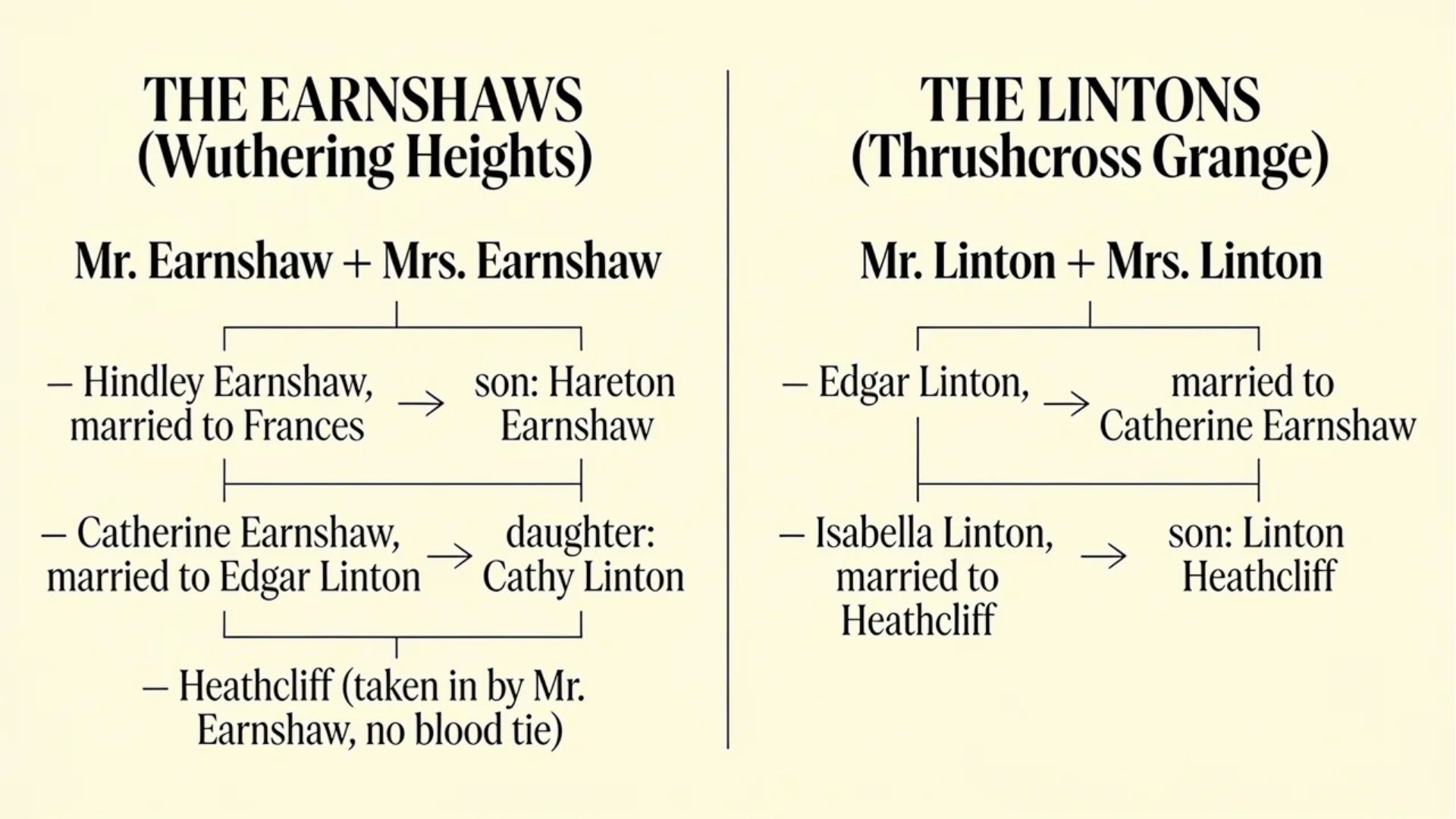
If you searched for a Wuthering Heights family tree with no spoilers, this version is the safest.
It shows parentage and the first-generation marriages only, and it holds the later marriages for the section marked with a spoiler note.
Characters in Wuthering Heights by Family
This character list groups everyone by household, because the novel itself divides its world that way.
Wuthering Heights is a rough farmhouse on the moor, while Thrushcross Grange is a lighter, more orderly home, and that contrast shapes how each family behaves.
The Earnshaws of Wuthering Heights
Mr. Earnshaw is the master of the Heights and the man who brings Heathcliff home.
His wife distrusts the boy and dies early in the story.
Their son Hindley resents Heathcliff, later marries Frances, and has a son, Hareton.
Their daughter Catherine grows up alongside Heathcliff but chooses to marry Edgar Linton.
The Lintons of Thrushcross Grange
Mr. and Mrs. Linton are the neighboring gentry at the Grange.
Their son Edgar is gentle and refined, and he marries Catherine.
Their daughter Isabella is sheltered and romantic, and she marries Heathcliff.
The Grange passes only through male heirs, which matters in the estates section below.
Heathcliff, the Outsider Between Both Houses
Heathcliff is the character the whole tree bends around.
Mr. Earnshaw finds him starving on the streets of Liverpool and gives him the name of an Earnshaw child who died young.
In Nelly’s account in chapter four, she admits she doesn’t know who his parents were, so he stays outside both bloodlines while marrying into one and fathering the next generation.
Nelly, Lockwood, and Joseph, Who Link the Houses
Nelly Dean grew up at the Heights, later keeps house at the Grange, and narrates most of the story, so every family detail reaches us through her.
Mr. Lockwood, the Grange’s tenant, frames the story.
Joseph and Zillah are servants at the Heights.
None of them are relatives, but they shape what we know about everyone who is.
How the Two Families Connect Through Marriage
Spoiler note: this section reveals marriages that happen late in the book.
Three marriages join the first generation: Hindley and Frances, Catherine and Edgar, and Isabella and Heathcliff.
The Earnshaws and Lintons first connect through Catherine and Edgar, then again through Isabella and Heathcliff.
In the next generation, Cathy marries her cousin Linton and later plans to marry her cousin Hareton.
Hindley’s marriage to Frances comes first and produces Hareton.
Catherine’s marriage to Edgar in 1783 joins the two families for the first time, and Isabella’s marriage to Heathcliff in early 1784 joins them again through the man Edgar least wants in his family.
Catherine dies in March 1784, hours after giving birth to Cathy, and Linton is born that September, so the next generation arrives almost on top of the last.
Cathy’s first marriage, to Linton in 1801, is forced by Heathcliff, who wants control of the Grange.
After Linton’s death, Cathy and Hareton grow close, and the novel closes with their wedding planned for New Year’s Day 1803, which would unite the descendants of both households.
Those marriages are what turn ordinary relatives into cousins, so the next section lays out the connections pair by pair.
Wuthering Heights Family Tree Cousins & Other Relationships
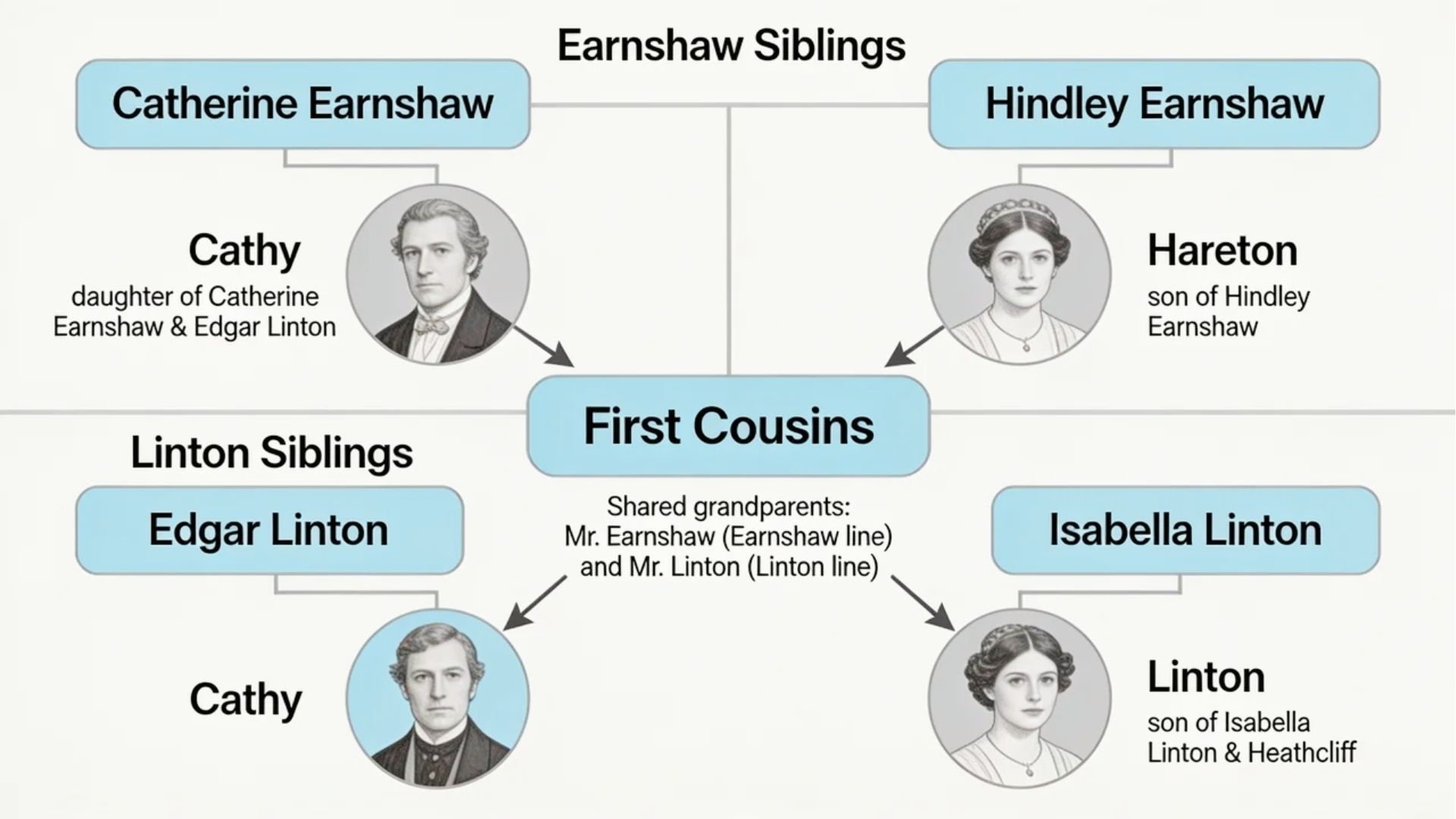
Cathy is first cousin to both Hareton and Linton, because her mother Catherine was Hindley’s sister and her father Edgar was Isabella’s brother.
Hareton and Linton share no known blood tie.
Heathcliff is related to the Earnshaws and Lintons only by adoption and marriage, never by blood, according to the text.
| Pair | Relationship | Why |
| Cathy and Hareton | First cousins | Their parents, Catherine and Hindley, were siblings |
| Cathy and Linton | First cousins | Their parents, Edgar and Isabella, were siblings |
| Hareton and Linton | No known blood tie | One is Hindley’s son, the other Isabella and Heathcliff’s |
| Heathcliff and Catherine | Raised as siblings, no blood tie | Mr. Earnshaw took him in as a boy |
| Heathcliff and Edgar | Brothers-in-law twice over | Edgar married Heathcliff’s adoptive sister, and Heathcliff married Edgar’s sister |
| Heathcliff and Cathy | Uncle by marriage, then father-in-law | Isabella was Cathy’s aunt, and Cathy marries Heathcliff’s son |
| Heathcliff and Hareton | Uncle in all but blood | He was raised as Hindley’s brother |
Readers often ask whether Heathcliff and Catherine are related, and the novel’s answer is no, though it leaves room for speculation.
Because Heathcliff’s parentage is never stated, some readers have wondered whether Mr. Earnshaw might have been his father, but nothing in the text confirms it, so it stays a theory rather than part of the tree.
What the book does confirm is that Nelly calls Cathy’s husband Linton her cousin, on one side through each parent, which is the first hint of how closely these families overlap.
Why the Two Catherines Confuse Readers
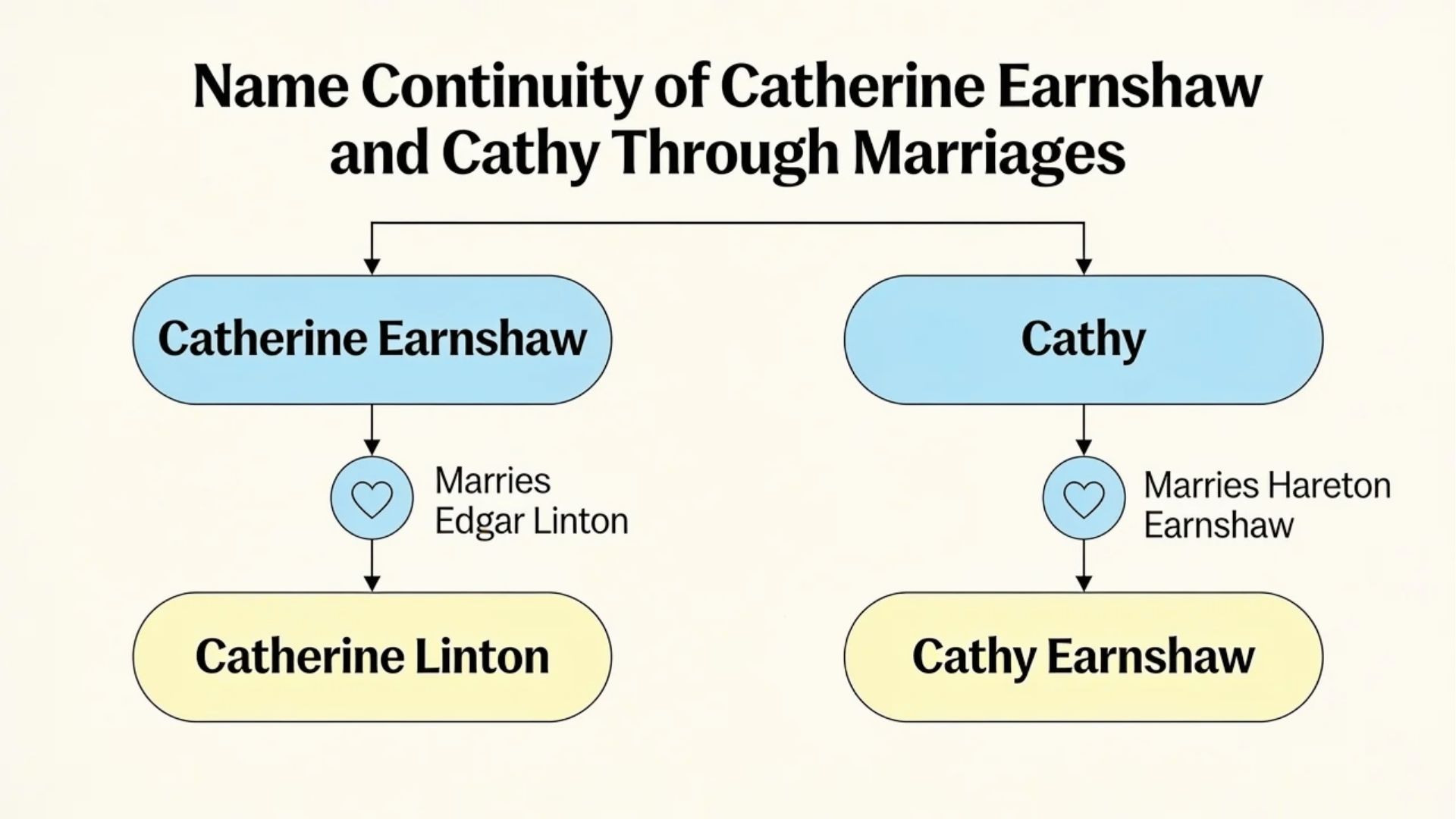
The mother is Catherine Earnshaw, who becomes Catherine Linton when she marries Edgar.
Her daughter is born Catherine Linton too, and Edgar calls her Cathy, which is the habit most readers adopt to tell them apart.
A simple memory aid is that Catherine is the mother and Cathy is the daughter, a convention also used in scholarly work on the novel’s chronology.
Spoiler note: the rest of this section covers Cathy’s later names.
Cathy’s name changes twice more.
She is Catherine Heathcliff after marrying Linton, and she will be Catherine Earnshaw again after marrying Hareton, which returns her to her mother’s maiden name.
The repetition is part of the design, since the story ends by closing a circle the first Catherine opened.
It also explains why Lockwood stumbles early in the book, when he misjudges how the people at the Heights are connected, and why Nelly spends chapter four straightening it out.
Who Owns Wuthering Heights and Thrushcross Grange
Spoiler note: this section explains how the houses change hands.
Wuthering Heights belongs to the Earnshaws and Thrushcross Grange to the Lintons, but Heathcliff controls both for years.
By the end of the novel, Hareton Earnshaw inherits the Heights, and Cathy inherits the Grange, as EBSCO’s setting analysis confirms.
Heathcliff gains the Heights through Hindley’s debts, then pushes Cathy into marrying his son Linton so that the Grange, which passes through male heirs, ends up in his hands.
His death returns each house to the family line it belonged to, which is why Cathy and Hareton’s wedding matters to the tree.
Birth and Death Years in the Wuthering Heights Family Tree
The novel gives very few calendar dates, so every family tree rebuilds its years from clues like ages, seasons, and moon phases.
The two most widely used chronologies come from Charles Sanger in 1926 and Stuart Daley in 1974, and the table below follows them.
A 2020 scholarly study of the timelines by Michael Weber compares those chronologies with others, and some years shift by about one depending on the source.
His version, for example, places Heathcliff’s death in 1801 rather than 1802.
That is why printed texts sometimes disagree about Mr. Earnshaw’s death or Heathcliff’s final year, though the order of events holds steady even when a year moves.
| Character | Born | Died |
| Mrs. Earnshaw | Not given | Spring 1773 |
| Mr. Earnshaw | Not given | October 1777 |
| Frances Earnshaw | Not given | 1778 |
| Hindley Earnshaw | 1757 | September 1784 |
| Catherine Earnshaw | 1765 | March 20, 1784 |
| Heathcliff | c. 1764 | April 1802 |
| Edgar Linton | 1762 | August 1801 |
| Isabella Linton | October 1765 | July 1797 |
| Hareton Earnshaw | June 1778 | Alive at the end |
| Cathy Linton | March 1784 | Alive at the end |
| Linton Heathcliff | September 1784 | September 1801 |
Keeping the Characters in Wuthering Heights Straight
The Wuthering Heights family tree looks tangled mostly because two households keep trading people, names, and houses.
Keep three anchors in mind: the Earnshaws live at the Heights, the Lintons at the Grange, and Heathcliff belongs to neither bloodline but shapes both.
Remember that Catherine is the mother and Cathy is the daughter, and that every cousin pairing runs through either Hindley and Catherine or Edgar and Isabella.
If the dates differ from another chart you’ve seen, trust the novel’s clues over any single timeline.
For your next step, reread Nelly’s account in chapter four with this guide open, since it is where she lays out the households herself.
Frequently Asked Questions
Why Did Mr. Earnshaw Favor Heathcliff Over Hindley?
Mr. Earnshaw grows fonder of the orphan than of his own son, and that favoritism fuels Hindley’s resentment. Even so, Hindley still inherits Wuthering Heights when his father dies.
Is There a Printable Wuthering Heights Family Tree?
Yes. The Reader’s Guide to Wuthering Heights offers A4 color and black-and-white versions of its tree, and the Chromatics reading app offers A3 and A4 printouts.
How Old Is Heathcliff When He Arrives at Wuthering Heights?
Heathcliff is about seven when Mr. Earnshaw brings him home in 1771, based on the Sanger and Daley chronologies. That makes him roughly a year older than Catherine, who is about six.