



A gift of socks rarely starts an argument about beauty, yet one pair was lovely enough to make a Nobel Prize winner hesitate before wearing it.
That hesitation became “Ode to My Socks” (Oda a los calcetines in Spanish), the 1956 poem in which Chilean poet Pablo Neruda turns hand-knitted wool socks into animals, weapons and fire, wrestles with the urge to lock them away, and then pulls them on anyway.
The decision to wear them is what the whole poem hangs on.
Read on for the full text with translator credit, a plain retelling, an analysis of the imagery, and the background of the odes it comes from.
The Full Text of Ode to My Socks
Here is the poem in full. Neruda wrote it in very short lines, so the text falls in a narrow column down the page instead of running across it.
Maru Mori brought me
a pair
of socks
which she knitted herself
with her sheepherder’s hands,
two socks as soft
as rabbits.
I slipped my feet
into them
as though into
two
cases
knitted
with threads of
twilight
and goatskin.
Violent socks,
my feet were
two fish made
of wool,
two long sharks
sea-blue, shot
through
by one golden thread,
two immense blackbirds,
two cannons:
my feet
were honored
in this way
by
these
heavenly
socks.
They were
so handsome
for the first time
my feet seemed to me
unacceptable
like two decrepit
firemen, firemen
unworthy
of that woven
fire,
of those glowing
socks.
Nevertheless
I resisted
the sharp temptation
to save them somewhere
as schoolboys
keep
fireflies,
as learned men
collect
sacred texts,
I resisted
the mad impulse
to put them
into a golden
cage
and each day give them
birdseed
and pieces of pink melon.
Like explorers
in the jungle who hand
over the very rare
green deer
to the spit
and eat it
with remorse,
I stretched out
my feet
and pulled on
the magnificent
socks
and then my shoes.
The moral
of my ode is this:
beauty is twice
beauty
and what is good is doubly
good
when it is a matter of two socks
made of wool
in winter.
Credit: Pablo Neruda, “Oda a los calcetines” (“Ode to My Socks”), first published in Nuevas odas elementales (Losada, Buenos Aires, 1956); translated by Robert Bly (Beacon Press, 1993).
What Ode to My Socks Is About

Ode to My Socks is about a friend’s handmade gift and what to do with it.
Neruda receives wool socks knitted by Maru Mori, imagines them as animals and fire, considers locking them away, and finally wears them.
The poem argues that beautiful, useful things deserve to be used.
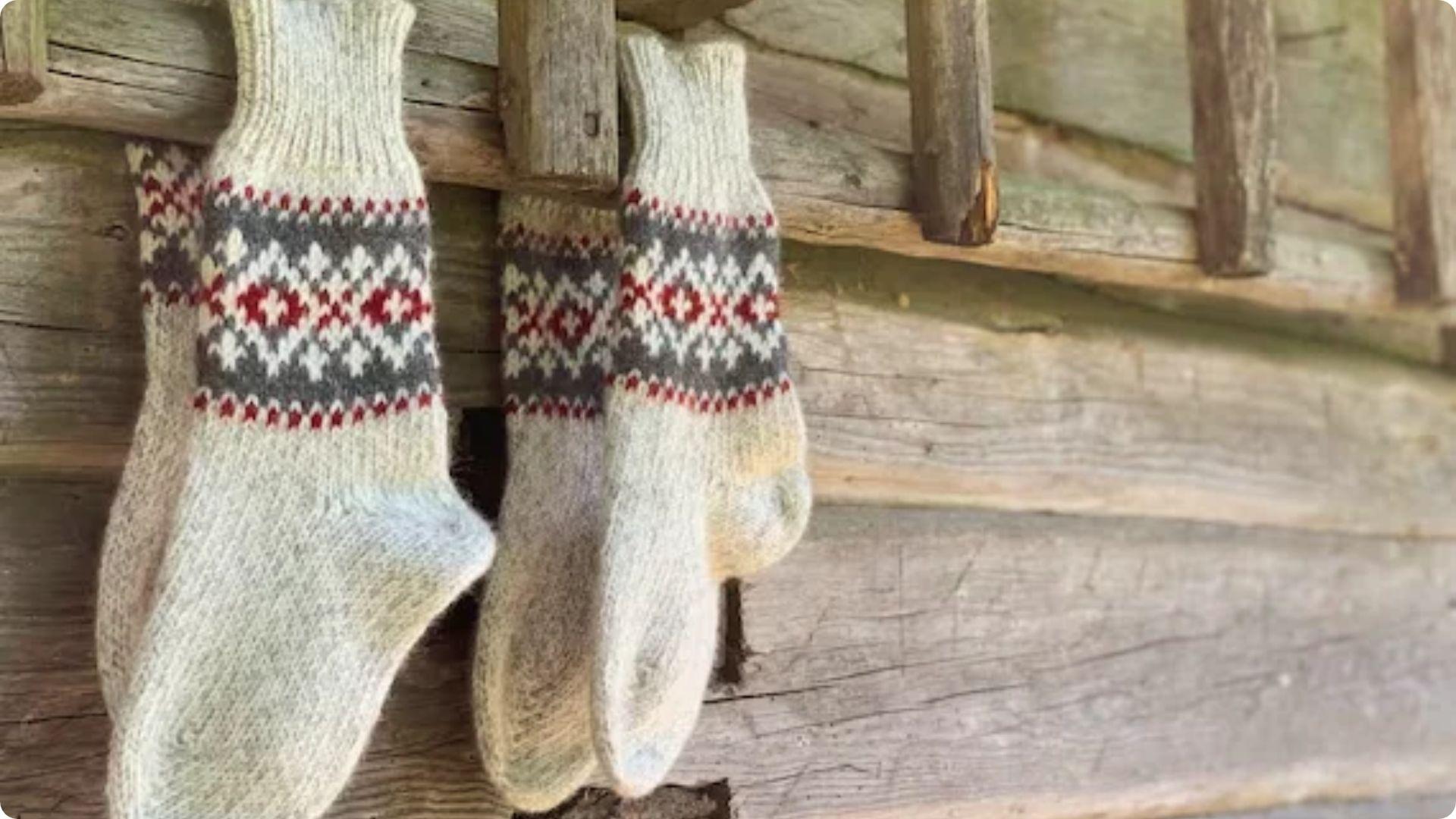
Maru Mori’s socks are so soft and glowing that Neruda’s feet start to feel like fish, sharks, blackbirds, and cannons.
He then feels unworthy of them and thinks about keeping them safe, the way schoolboys keep fireflies. In the end, he puts them on, followed by his shoes.
Readers who like everyday subjects may also enjoy William Carlos Williams’s This Is Just to Say, another short poem about an ordinary household moment.
Ode to My Socks Analysis: Reading the Imagery
On a second reading, the order of the comparisons matters more than any single image.
Neruda moves the socks from the farm to the sea, the sky and the battlefield, and finally to fire, until his own feet look inadequate.
Animals and Weapons
The images begin gently, with rabbit-soft wool and a knitter’s shepherd hands, then turn strange once the socks are on.
Fish, blackbirds and cannons have nothing in common, and that mismatch is the point: a plain pair of socks changes what the wearer’s body seems to be.
Fire and the Golden Cage
Fire takes over in the second half, and Neruda’s feet shrink into tired firefighters. The fireflies, sacred texts, and golden cage all treat something admired as too precious to use.
The explorers and the green deer admit that using something rare consumes it, which keeps the poem from being naive.
Neruda accepts that the socks will wear out and decides that is better than keeping them as a relic.
Neruda’s Elemental Odes and the Ode Tradition
Neruda published “Ode to My Socks” in Nuevas odas elementales (1956), part of a run of odes he wrote through the 1950s about ordinary things.
An ode is a poem of praise, traditionally a solemn one, so praising a pair of socks was a deliberate twist. If the form is new to you, this guide explains what an ode poem is.
Other Pablo Neruda odes address an artichoke, tomatoes, wine, and laziness.
Here is the poem in full. Neruda wrote it in very short lines, so the text falls in a narrow column down the page instead of running across it.