


Frost’s speaker has stopped climbing, but the ladder has not let go of him: His foot still aches from the rungs, and every apple he picks keeps rolling through his head.
That strange hour between finishing work and falling asleep is the whole setting of Robert Frost’s “After Apple-Picking,” a 42-line poem first published in 1914 in North of Boston.
The full text of After Apple-Picking sits right below, followed by a short note on why it ends with a question only a woodchuck could answer, and how its loosening rhyme pulls you toward sleep.
Fruit carries more weight in poetry than its size suggests.
Williams tucks an apology inside a few plums eaten from the icebox, and Heaney lets a bucket of blackberries go moldy, and both sit beside Frost’s orchard in our poems about food list.
After Apple-Picking Full Text
The poem is in the public domain. The text follows the 1915 Henry Holt edition of North of Boston, as reproduced in the Poetry Foundation.
The book first appeared in London in 1914 from David Nutt, and the poem runs as one unbroken block with no stanza breaks.
My long two-pointed ladder’s sticking through a tree
Toward heaven still,
And there’s a barrel that I didn’t fill
Beside it, and there may be two or three
Apples I didn’t pick upon some bough.
But I am done with apple-picking now.
Essence of winter sleep is on the night,
The scent of apples: I am drowsing off.
I cannot rub the strangeness from my sight
I got from looking through a pane of glass
I skimmed this morning from the drinking trough
And held against the world of hoary grass.
It melted, and I let it fall and break.
But I was well
Upon my way to sleep before it fell,
And I could tell
What form my dreaming was about to take.
Magnified apples appear and disappear,
Stem end and blossom end,
And every fleck of russet showing clear.
My instep arch not only keeps the ache,
It keeps the pressure of a ladder-round.
I feel the ladder sway as the boughs bend.
And I keep hearing from the cellar bin
The rumbling sound
Of load on load of apples coming in.
For I have had too much
Of apple-picking: I am overtired
Of the great harvest I myself desired.
There were ten thousand thousand fruit to touch,
Cherish in hand, lift down, and not let fall.
For all
That struck the earth,
No matter if not bruised or spiked with stubble,
Went surely to the cider-apple heap
As of no worth.
One can see what will trouble
This sleep of mine, whatever sleep it is.
Were he not gone,
The woodchuck could say whether it’s like his
Long sleep, as I describe its coming on,
Or just some human sleep.
After Apple-Picking Summary and Meaning
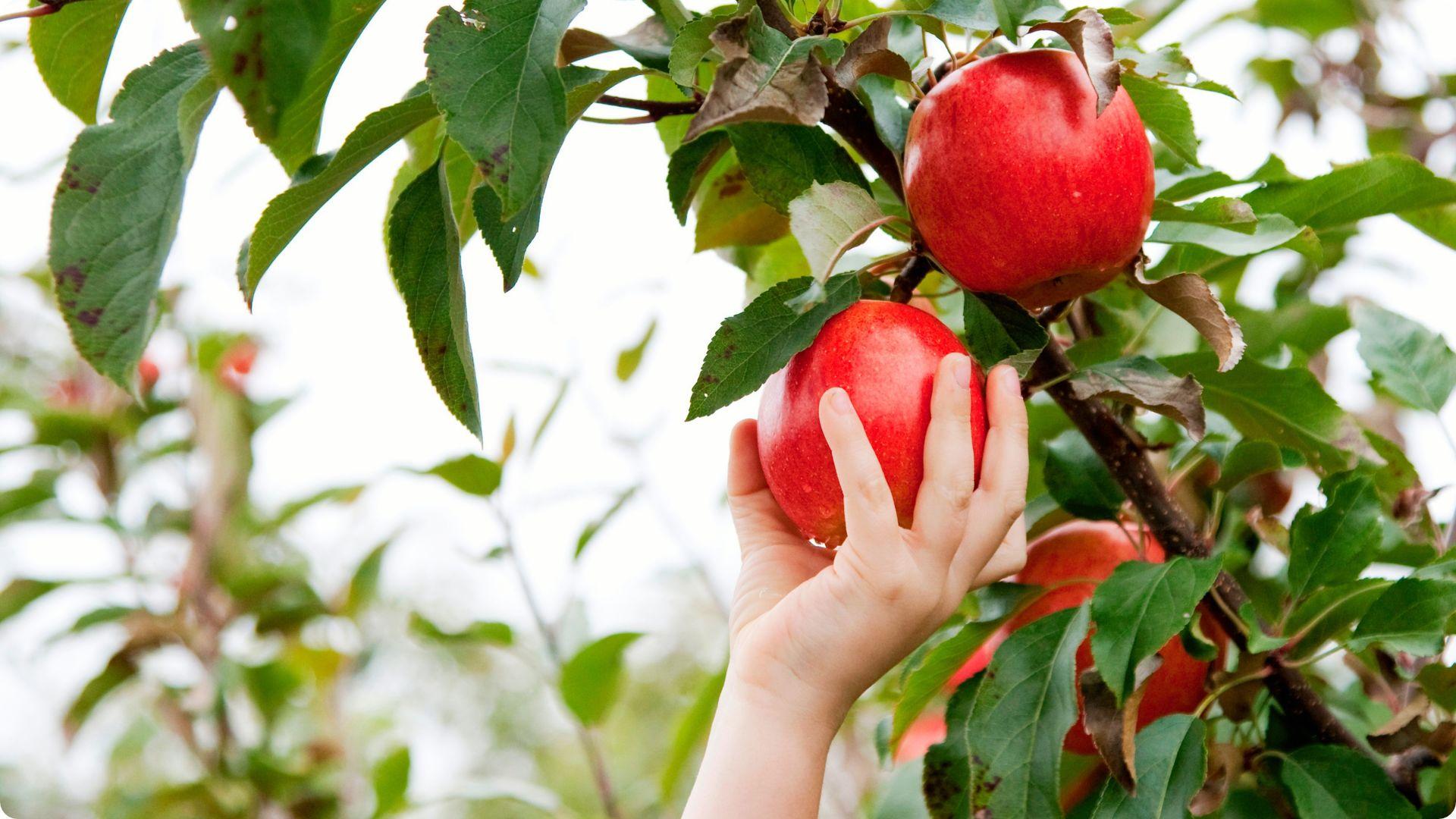
In “After Apple-Picking,” an orchard worker finishes a long harvest and drifts toward sleep, but his body and mind keep replaying the work.
He still feels the ladder rung and sees every apple, and he ends by asking whether his sleep is ordinary or like a woodchuck’s long winter sleep.
A pane of glass he skimmed from the drinking trough, usually read as thin ice, blurs his sight and starts the dream, in which a ladder sways and apples appear magnified.
Frost never says what the apples stand for, so readers have found three meanings. The plainest is the aftereffect of a hard day, when the body keeps working in the dark.
The woodchuck suggests a second, that the speaker is nearing death.
A third, in an article in The Robert Frost Review, calls the poem a hypnagogic vision, the half-waking state before sleep.
The last line fits all three. For more of the rural New England he wrote about, see our Robert Frost poems guide.
Rhyme Scheme and Literary Devices
After Apple-Picking has no fixed rhyme scheme. Its 42 lines form a single stanza of uneven lengths, with rhymes that appear and then fade, and the meter mixes iambic rhythms instead of holding one steady beat.
Frost lets the sound loosen as the speaker gets drowsier.
Where “Mending Wall,” the leading poem in the book, keeps to a steadier, conversational iambic pentameter, this poem is looser, and our guide to Mending Wall makes the contrast easy to see.
The first six lines rhyme a b b a c c (tree, still, fill, three, bough, now), then the pattern keeps shifting, with night and sight in lines 7 and 9, glass and grass in lines 10 and 12, and a tight run of well, fell, and tell in lines 14 through 16.
Line length shifts too. The opening line runs twelve syllables, while “For all” in line 32 has two, and short lines like “As of no worth” cut the sentences up the way thoughts break near sleep.
Repetition and imagery carry the rest.
The word sleep appears six times, in lines 7, 15, 38 (twice), 41, and 42, and the central passage stacks the senses: smell in “the scent of apples,” sight in “every fleck of russet,” touch in the aching instep, and sound in the rumbling cellar bin.
“Ten thousand thousand fruit” is an exaggeration that suits a dream better than an orchard.
Read After Apple Picking aloud once, slowly, and stop wherever a short line makes you.