
Lizzie Borden was a Fall River, Massachusetts woman tried for the August 4, 1892, hatchet murders of her father, Andrew Borden, and her stepmother, Abby Borden.
A jury acquitted her in June 1893. No one else was ever charged, so the case is still officially unsolved, and Lizzie lived the rest of her life under suspicion.
That is the short answer to who was Lizzie Borden. The longer answer involves a tense household, a morning of changing stories, a trial the newspapers covered like a serial, and a four-line rhyme that convicted her in public memory anyway.
Below you will find her life story, the evidence, the main theories, what happened after the trial, and how the new Netflix series compares with the record.
Who Was Lizzie Borden? Quick Facts

| Detail | Fact |
| Full name | Lizzie Andrew Borden (later used “Lizbeth”) |
| Born | July 19, 1860, Fall River, Massachusetts |
| Died | June 1, 1927, Fall River, age 66 |
| Parents | Andrew Jackson Borden and Sarah Morse Borden |
| Stepmother | Abby Durfee Gray Borden |
| Sister | Emma Lenora Borden |
| Known for | Being tried for the 1892 murders of her father and stepmother |
| Verdict | Not guilty, June 20, 1893 |
| Buried | Oak Grove Cemetery, Fall River |
Lizzie Borden? Her Early Life and Family
Lizzie Borden grew up in a wealthy but strict household. She was the youngest of three daughters born to Andrew and Sarah Borden.
Her sister Alice died as a baby, and her mother died when Lizzie was a toddler. Andrew then married Abby Durfee Grey, and the family later settled at 92 Second Street in Fall River.
Andrew Borden made his money in furniture, caskets, and property. He also served as president of the Union Savings Bank.
According to the biography entry in Britannica, he was a well-to-do businessman, yet the family home was known for its plain, frugal style.
As a young woman, Lizzie taught Sunday school, served in the Christian Endeavour Society, and joined the Woman’s Christian Temperance Union.
She did not get along with her stepmother. She called Abby “Mrs Borden” and believed Abby had married her father for his money.
By 1892, the sisters also resented property gifts Andrew had made to Abby’s relatives.
What Happened on August 4, 1892
On the morning of August 4, 1892, Abby Borden was killed in the upstairs guest room, and Andrew Borden was killed about 90 minutes later on the sitting room sofa.
Only Lizzie and the family’s Irish maid, Bridget Sullivan, were known to be home.
The day unfolded roughly like this:
| Time (approx.) | Event |
| Around 9:00 a.m. | Andrew leaves for his morning walk; Abby goes upstairs to tidy the guest room |
| 9:00 to 10:30 a.m. | Abby is attacked with a hatchet and killed in the guest room |
| About 10:30 a.m. | Andrew returns home; Bridget lets him in |
| About 11:00 a.m. | Andrew is killed while lying on the sofa |
| About 11:10 a.m. | Lizzie calls Bridget downstairs and says her father has been killed |
Neighbour Adelaide Churchill and Bridget later found Abby’s body upstairs. Sources disagree slightly on the number of blows.
Most accounts say Abby was struck 18 or 19 times and Andrew 10 or 11 times.
The trial archive at Famous Trials, run by law professor Douglas O. Linder, puts the total at 29, far fewer than the 81 the rhyme suggests.
The Evidence Against Lizzie Borden
The case against Lizzie was strong in shape but thin in proof. Prosecutors had no bloody clothing, no confession, and no weapon they could firmly tie to the killings. They relied on her behaviour and her words.
Her Changing Story
Lizzie said she was in the barn when her father was killed. Her account of what she was doing shifted between interviews.
At the inquest, she gave different versions of where she was when Andrew came home: the kitchen, the dining room, and the stairs.
The Burned Dress
A few days after the murders, family friend Alice Russell saw Lizzie burn a dress in the kitchen stove. Lizzie said it was stained with paint.
Prosecutors said it was stained with blood. The defence never challenged Russell’s account at trial.
The Hatchet Head in the Basement
Police found a hatchet head with a freshly broken handle in the basement. It was coated in ash, which looked to some officers as if it had been rubbed on to make the blade seem old. The prosecution never proved it was the murder weapon.
The Prussic Acid Visit
A local druggist, Eli Bence, said Lizzie tried to buy prussic acid (a cyanide poison) the day before the murders. She said she wanted it to clean a sealskin cape. The judge kept this evidence out of the trial.
The Trial and Acquittal of Lizzie Borden
Lizzie Borden was arrested on August 11, 1892, indicted that December, and tried in New Bedford starting June 5, 1893.
After about two weeks of testimony, the jury found her not guilty on June 20, 1893.
The trial had heavyweight lawyers. Hosea M. Knowlton led the prosecution with William H. Moody, who later became a U.S. Supreme Court justice. Former Massachusetts governor George D. Robinson led the defence.
Two rulings helped Lizzie the most. The court excluded her inquest testimony, the contradictory statements most people now cite as proof of guilt. It also excluded the prussic acid story.
Newspapers at the time reported a verdict in about 40 minutes on a single ballot, while later accounts say 90 minutes.
You can read original 1892 and 1893 coverage through the Library of Congress Chronicling America guide.
What readers commonly miss is this gap between the evidence we discuss today and the evidence the jury actually heard.
Much of the modern case for her guilt rests on material those twelve men never saw.
Did Lizzie Borden Do It? The Main Theories
Law professor Douglas O. Linder notes that most historians today find the prosecution’s evidence convincing, but no theory has been proven. Here are the suspects writers have proposed over the years.
| Suspect or Theory | The Idea | The Problem |
| Lizzie alone | Motive over money and her stepmother; opportunity; changing story | No blood on her, no proven weapon, very short time to clean up |
| Lizzie in a fugue state | Writer Victoria Lincoln (1967) suggested an altered mental state during an attack | No medical record from the time confirms it |
| Lizzie and Bridget | Ed McBain’s 1984 novel Lizzie imagined a secret affair discovered by Abby | Fiction; no evidence of a relationship or an accomplice |
| Bridget Sullivan | Resentment over hard chores in the August heat | No clear motive to kill both, and no physical evidence tied her to the killings |
| John Morse (uncle) | He stayed the night and had an unusually detailed alibi | He could account for his whole morning away from the house |
| Emma Borden | Frank Spiering (1984) proposed a secret trip home from Fairhaven | Emma had a confirmed alibi about 15 miles away |
| William Borden | Arnold Brown claimed he was Andrew’s illegitimate son | Researcher Leonard Rebello showed he was not Andrew’s son |
Read side by side, every theory wrestles with the same puzzle: how anyone killed twice, 90 minutes apart, in a small house, and left no trace.
Life After the Trial
So who was Lizzie Borden after 1893? A wealthy woman living apart from the town that judged her.
After her acquittal, she inherited a large share of her father’s estate and stayed in Fall River.
She and Emma bought a large house on French Street in the wealthy Hill district and named it Maplecroft. Lizzie began calling herself Lizbeth.
Fall River society shunned her. In 1897, she was accused of shoplifting in Providence, Rhode Island, which put her name back in the papers.
In 1905, after a quarrel over a party Lizzie held for the actress Nance O’Neil, Emma moved out. The sisters never saw each other again.
How Did Lizzie Borden Die?
Lizzie Borden died of pneumonia on June 1, 1927, at age 66, in Fall River. She had been ill for much of her last year after having her gallbladder removed.
Few people attended her funeral. Emma died nine days later in Newmarket, New Hampshire. The sisters are buried side by side in the family plot at Oak Grove Cemetery.
Did Lizzie Borden Have Kids?
No, Lizzie Borden never married and had no children. Emma never married either, so Andrew Borden has no direct descendants.
In her will, Lizzie left $30,000 to the Fall River Animal Rescue League and money for the care of her father’s grave.
The Lizzie Borden Rhyme
The Lizzie Borden rhyme is an anonymous four-line verse that begins “Lizzie Borden took an axe” and claims 40 and 41 blows.
It spread as a skipping-rope chant, often sung to the tune of “Ta-ra-ra Boom-de-ay,” and it treats her as guilty despite the verdict.
The rhyme gets the numbers and the weapon wrong, yet it shaped her reputation more than the trial did. For the full text, its variants, and where it came from, see our breakdown of the Lizzie Borden poem.
The Lizzie Borden House Today
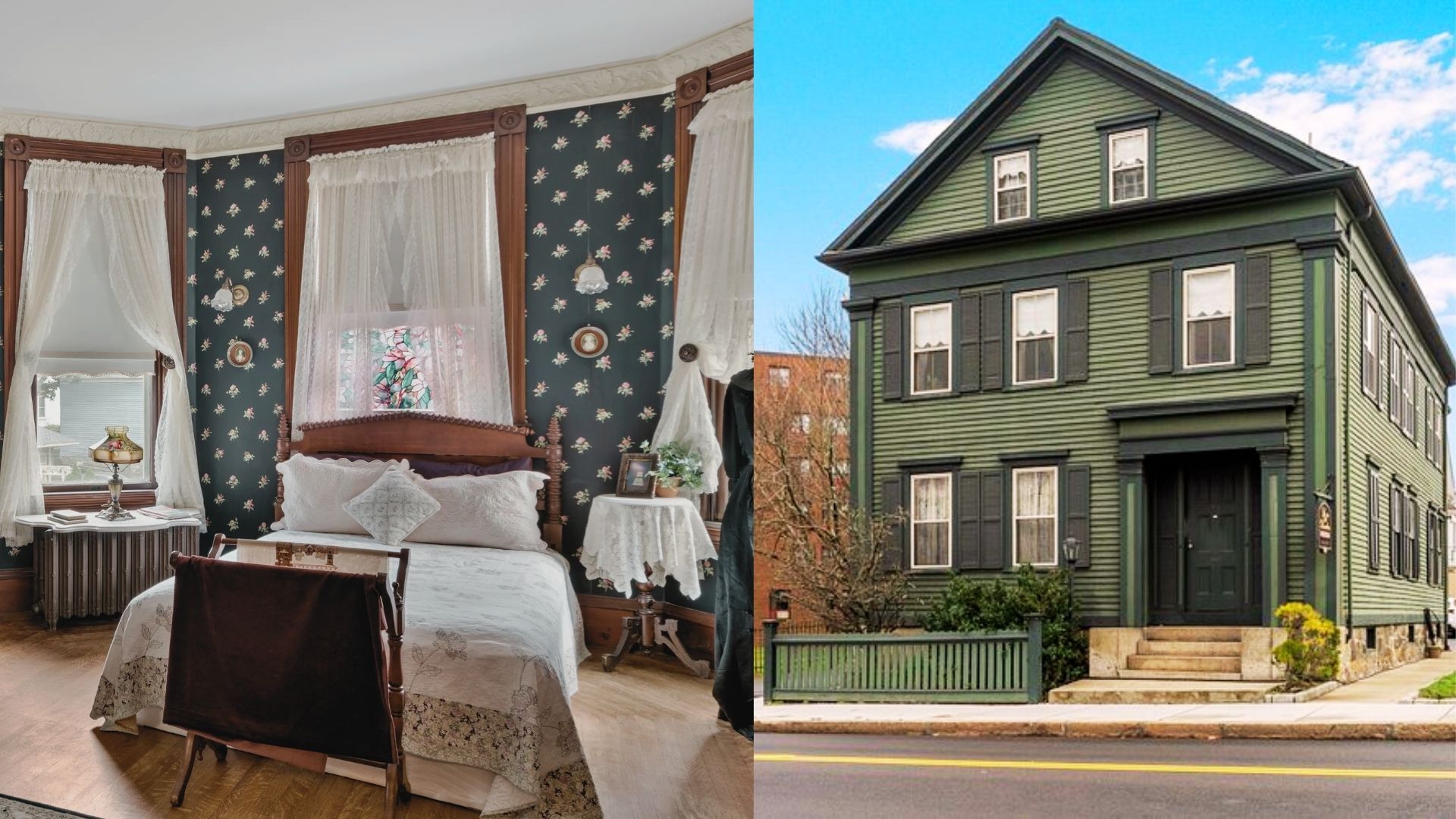
The Lizzie Borden House still stands on Second Street in Fall River and now runs as a museum and bed and breakfast.
Its address changed from 92 to 230 Second Street when the city renumbered the street in 1896, but the building never moved.
This is why older books and newer travel guides give two different addresses for the same house.
The house opened to overnight guests on August 4, 1996, the 104th anniversary of the murders. US Ghost Adventures bought it in 2021.
According to the official Lizzie Borden House site, it is open daily, with 90-minute house tours by day and ghost tours and hunts at night.
Guests can book the rooms where the family slept, including the guest room where Abby died.
Lizzie Borden on Netflix: Fact vs. Fiction

Monster: The Lizzie Borden Story is the fourth season of Ryan Murphy and Ian Brennan’s Netflix anthology series.
All eight episodes premiered on September 17, 2026. Ella Beatty plays Lizzie, with Vicky Krieps as Bridget, Rebecca Hall as Abby, and Charlie Hunnam as Andrew.
The Lizzie Borden Netflix series is a dramatisation, and it takes large liberties with the record:
- Lizzie as the killer: The show presents her guilt as fact. A jury acquitted her, and no one was ever convicted.
- An affair with Bridget: There is no historical evidence of a romantic relationship or that Bridget helped with the murders.
- The birds: In the series, Abby kills Lizzie’s birds. In real life, Andrew killed pigeons in the barn in May 1892, believing they carried disease.
- Nance O’Neil at the trial: The show has the actress coach Lizzie. In reality, O’Neil had no part in the trial; their friendship came years later, around the time Emma moved out in 1905.
As of late September 2026, the season debuted at number one on Netflix’s global chart with 12.1 million views in four days, while critics were far less kind, giving it a 39% on Rotten Tomatoes.
If the show sent you here, the record is stranger and less tidy than anything on screen.
What Lizzie Borden’s Story Still Tells Us
So, who was Lizzie Borden? She was a churchgoing daughter of a rich, tight-fisted father who was tried for a double murder, found not guilty, and never escaped the charge.
My own reading is that her story lasts because it has no ending.
The evidence points one way, the verdict points another, and rhymes, plays, novels have filled the gap between them, and now a streaming series.
The Borden case also belongs to a long line of dark rhymes about death and blame.
If that side of it interests you, the old nursery rhyme Who Killed Cock Robin turns a killing into a question-and-answer verse in much the same way, and more of these readings sit in our literature collection.
Frequently Asked Questions
Is Anyone Related to Lizzie Borden Still Alive?
There are no direct descendants, since neither Lizzie nor Emma had children. Distant relatives through the wider Borden and Morse family lines do exist. One surprising connection: genealogist Rhonda McClure found that actress Elizabeth Montgomery, who played Lizzie in the 1975 TV film The Legend of Lizzie Borden, was her sixth cousin once removed.
How Much Was Lizzie Borden Worth When She Died?
Lizzie Borden was worth over $250,000 when she died in 1927, which is roughly $6 million in today’s money. Her estate included office buildings, utility shares, two cars, and a large amount of jewellery. Her will spread bequests among friends, cousins, and the Fall River Animal Rescue League.
What Happened to Bridget Sullivan After the Trial?
Bridget Sullivan left Fall River and eventually moved to Butte, Montana. She married there and died in 1948. A story claims she made a deathbed confession that she changed her testimony to protect Lizzie, but researchers have found no reliable evidence that this happened.