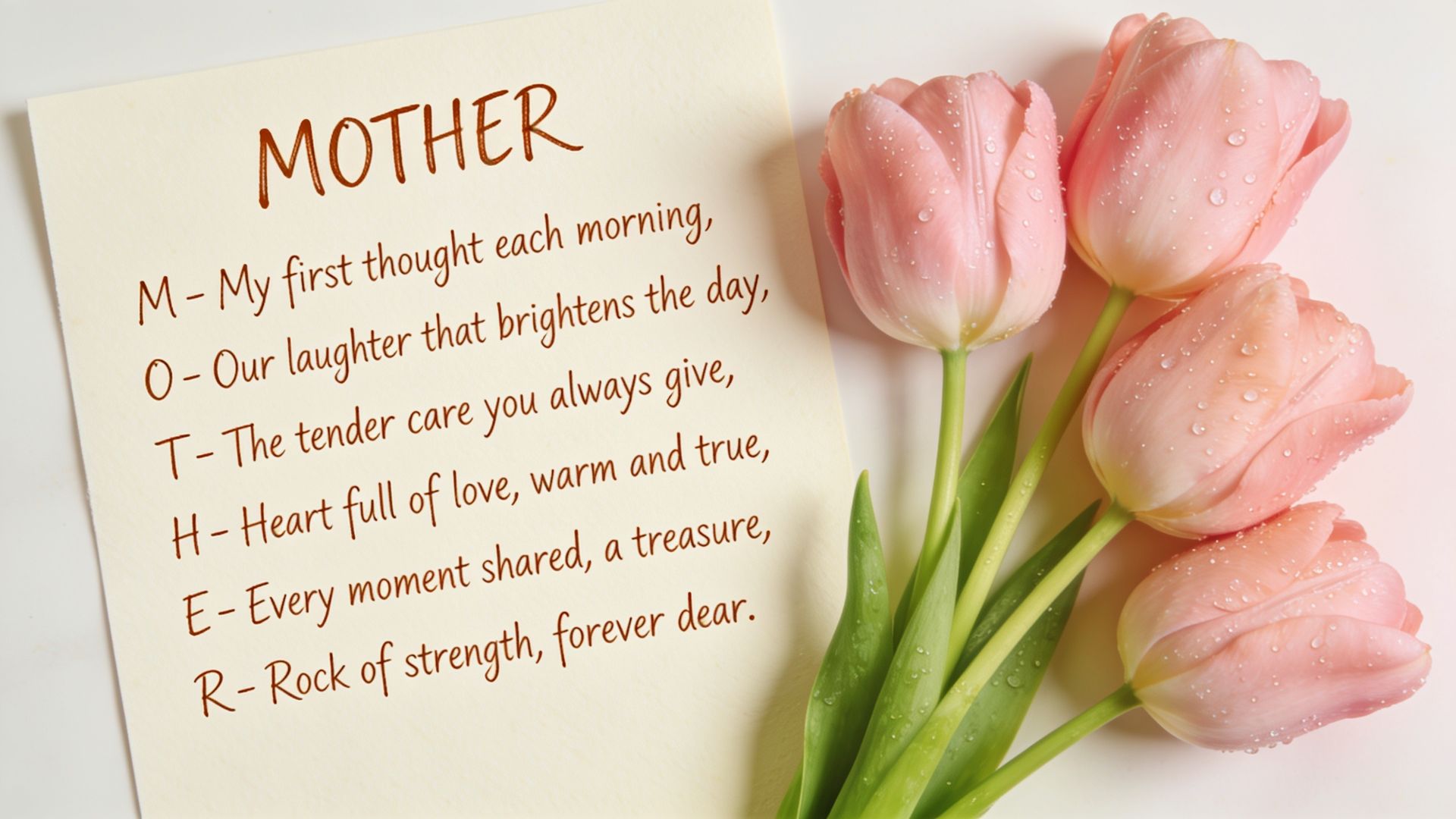



A good Mother’s Day poem says one true thing about your mom in words she will recognize.
The right one depends on where it is going: a card, a child’s recital, a church service, or a quiet tribute to a mom who has passed.
The 21 picks below run from Kipling and Rossetti to original verses you can copy straight into a card, each sorted by the moment it suits.
As a former English teacher, I choose a poem the way you would plan a toast, by thinking about the room, the reader, and the time you have to deliver it.
Every pick here comes with a note on where it works best. The guide starts with a quick matching table and ends with practical ways to share the poem once you have chosen it.
How to Choose a Mother’s Day Poem That Fits the Moment
The right poem fits three things: the setting where it will be read, the person reading it, and the tone your mom enjoys.
A rhyming verse suits a young child, a classic suits a formal reading, and a gentle remembrance poem suits a day of missing her.
How well a poem fits matters more than how famous it is, because a famous poem in the wrong setting falls flat.
Use this table to jump to the poems that match your plans.
| If you want a poem for… | Choose… | Start with |
| A Mother’s Day card | A short, heartfelt verse | No. 1 or No. 14 |
| A child to recite | Simple rhyme with easy wording | No. 13 |
| A church celebration | A faith-based poem | No. 16 |
| A mom with a sense of humor | A funny poem | No. 15 |
| A mom who has passed away | A remembrance poem | No. 6 or No. 7 |
| A first-time mom | A poem about new motherhood | No. 19 |
| A son or daughter to read aloud | A mother-child poem | No. 4, No. 11, or No. 17 |
| A social media post | A brief four-line verse | No. 14 |
Once you know the setting, the classics are a good place to start. They carry the weight of a published poem without needing any explanation.
Classic Poems About Mothers Worth Reading Aloud

The best-known classic poems about mothers come from Robert Louis Stevenson, Rudyard Kipling, Christina Rossetti, Langston Hughes, and Edgar Allan Poe.
Each one is in the public domain in the United States. The shorter ones appear in full below, and you can copy them into a card or print them for a reading without permission.
1. “To My Mother” by Robert Louis Stevenson
Stevenson placed this four-line poem in the Envoys section of A Child’s Garden of Verses (1885), his book of childhood rhymes.
He invites his mother to reread his verses and hear, once more, the sound of the small child he used to be. That makes it a tender fit for a card from an adult child. The full public domain text:
You too, my mother, read my rhymes
For love of unforgotten times,
And you may chance to hear once more
The little feet along the floor.
2. “Mother o’ Mine” by Rudyard Kipling
Kipling’s poem first appeared as the dedication to the 1891 book edition of his novel The Light That Failed.
Its message is that a mother’s love follows a child no matter how badly things go.
The refrain repeats after nearly every line, which gives a nervous reader a steady rhythm to lean on at a family gathering. The full public domain text:
If I were hanged on the highest hill,
Mother o’ mine, O mother o’ mine!
I know whose love would follow me still,
Mother o’ mine, O mother o’ mine!
If I were drowned in the deepest sea,
Mother o’ mine, O mother o’ mine!
I know whose tears would come down to me,
Mother o’ mine, O mother o’ mine!
If I were damned of body and soul,
I know whose prayers would make me whole,
Mother o’ mine, O mother o’ mine!
3. “Sonnets Are Full of Love” by Christina Rossetti
Rossetti wrote this sonnet as the dedication to A Pageant and Other Poems (1881) and addressed it to her mother, who was about 80 at the time.
The poem is untitled and known by its first line, which is how the Academy of American Poets’ collection lists it.
It calls her mother her “first Love” and credits her with teaching the poet’s earliest lessons in love. It takes under a minute to read aloud. The full public domain text:
Sonnets are full of love, and this my tome
Has many sonnets: so here now shall be
One sonnet more, a love sonnet, from me
To her whose heart is my heart’s quiet home,
To my first Love, my Mother, on whose knee
I learnt love-lore that is not troublesome;
Whose service is my special dignity,
And she my loadstar while I go and come.
And so because you love me, and because
I love you, Mother, I have woven a wreath
Of rhymes wherewith to crown your honoured name:
In you not fourscore years can dim the flame
Of love, whose blessed glow transcends the laws
Of time and change and mortal life and death.
4. “Mother to Son” by Langston Hughes
Hughes first published this poem in The Crisis in December 1922, during the Harlem Renaissance. Unlike most tributes, the mother does the talking here.
She tells her son that “life for me ain’t been no crystal stair” (a public domain line) and describes a staircase full of tacks, splinters, and dark landings that she keeps climbing.
At 20 lines, it works better as a reading than a card, especially when a son reads it for a mom who raised him through hard years. The full public domain text:
Well, son, I’ll tell you:
Life for me ain’t been no crystal stair.
It’s had tacks in it,
And splinters,
And boards torn up,
And places with no carpet on the floor—
Bare.
But all the time
I’se been a-climbin’ on,
And reachin’ landin’s,
And turnin’ corners,
And sometimes goin’ in the dark
Where there ain’t been no light.
So boy, don’t you turn back.
Don’t you set down on the steps
’Cause you finds it’s kinder hard.
Don’t you fall now—
For I’se still goin’, honey,
I’se still climbin’,
And life for me ain’t been no crystal stair.
5. “To My Mother” by Edgar Allan Poe
Poe published this sonnet in 1849, the year he died, and addressed it to Maria Clemm, his aunt and mother-in-law.
It opens with the idea that angels can find no word of love “so devotional as that of ‘Mother’” (a brief public domain excerpt).
It then turns to the death of his wife, Virginia, which makes it a reflective choice for an evening reading rather than a cheerful card.
The classics honor a mother from a respectful distance. The next three move closer to the hard parts, which is why they tend to reach readers who are grieving or looking back. The full public domain text:
Because I feel that, in the Heavens above,
The angels, whispering to one another,
Can find, among their burning terms of love,
None so devotional as that of “Mother,”
Therefore by that dear name I long have called you—
You who are more than mother unto me,
And fill my heart of hearts, where Death installed you
In setting my Virginia’s spirit free.
My mother—my own mother, who died early,
Was but the mother of myself; but you
Are mother to the one I loved so dearly,
And thus are dearer than the mother I knew
By that infinity with which my wife
Was dearer to my soul than its soul-life.
Mother’s Day Poems That Make You Cry

Mother’s Day poems that make you cry usually work through one concrete detail, such as a habit or a sacrifice nobody counted, rather than through big statements about love.
These suit remembrance services, a visit to her grave, or a card for a mom who carried more than anyone saw at the time.
6. “Rock Me to Sleep” (Opening Stanza) by Elizabeth Akers Allen
Allen’s poem first appeared in 1860 and became one of the most widely read poems of its era.
The speaker longs to be a child again in her mother’s arms, if only for one night, which makes it a gentle choice for a remembrance reading or a card for a mom who is far away.
Elizabeth Akers Allen, “Rock Me to Sleep” (1860). Public domain.
Backward, turn backward, O Time, in your flight,
Make me a child again just for to-night!
Mother, come back from the echoless shore,
Take me again to your heart as of yore;
Kiss from my forehead the furrows of care,
Smooth the few silver threads out of my hair;
Over my slumbers your loving watch keep;—
Rock me to sleep, mother,—rock me to sleep!
7. “Remember” by Christina Rossetti
Rossetti’s sonnet was published in 1862, and the speaker asks a loved one not to grieve too long.
She would rather be remembered with a smile than with sadness. It isn’t written about a mother specifically, but it suits a remembrance reading on Mother’s Day, especially when a family wants to say something gentle together.
Christina Rossetti, “Remember,” from Goblin Market and Other Poems (1862). Public domain.
Remember me when I am gone away,
Gone far away into the silent land;
When you can no more hold me by the hand,
Nor I half turn to go yet turning stay.
Remember me when no more day by day
You tell me of our future that you plann’d:
Only remember me; you understand
It will be late to counsel then or pray.
Yet if you should forget me for a while
And afterwards remember, do not grieve:
For if the darkness and corruption leave
A vestige of the thoughts that once I had,
Better by far you should forget and smile
Than that you should remember and be sad.
8. “Nobody Counted” (Original Poem About a Mother’s Strength)
This original verse suits a mom whose strength showed up in quiet work that nobody saw. It names that labor without turning it into a complaint.
Nobody counted what she gave
or wrote it anywhere,
the nights she nursed a fevered child,
the weight she chose to bear.
She made the hard work look like rest,
the long days look like play,
and only looking back I see
what it cost her every day.
Remembrance poems look back. Contemporary poets often write about mothers while the relationship is still unfolding, which gives the next group a frank, lived-in quality.
Modern Poems That Tell the Truth About Motherhood

Contemporary poems about mothers trade greeting-card language for specific memories, mixed feelings, and everyday acts of care.
They suit adult children, readers who find sentiment uncomfortable, and moms who would rather be understood than praised.
Each poem below is under copyright, so read the full text at its source before sharing.
9. “My Mother” by Ann Taylor
Taylor’s poem comes from Original Poems for Infant Minds (1804).
Each stanza asks who cared for the child, answers “My Mother,” and the poem ends with a promise to repay that care.
The refrain makes it easy to memorize, so it suits a child’s recital or a family reading.Ann Taylor, “My Mother,” from Original Poems for Infant Minds (1804). Public domain:
Who fed me from her gentle breast,
And hush’d me in her arms to rest,
And on my cheek sweet kisses prest?
My Mother.
When sleep forsook my open eye,
Who was it sung sweet lullaby,
And rock’d me that I should not cry?
My Mother.
Who sat and watched my infant head,
When sleeping on my cradle bed,
And tears of sweet affection shed?
My Mother.
When pain and sickness made me cry,
Who gazed upon my heavy eye,
And wept for fear that I should die?
My Mother.
Who ran to help me when I fell,
And would some pretty story tell,
Or kiss the place to make it well?
My Mother.
Who taught my infant lips to pray,
And love God’s holy Word and day,
And walk in Wisdom’s pleasant way?
My Mother.
And can I ever cease to be
Affectionate and kind to thee,
Who wast so very kind to me,
My Mother?
Ah no, the thought I cannot bear,
And if God please my life to spare
I hope I shall reward thy care,
My Mother.
When thou art feeble, old and gray,
My healthy arm shall be thy stay,
And I will soothe thy pains away,
My Mother.
And when I see thee hang thy head,
‘Twill be my turn to watch thy bed,
And tears of sweet affection shed,
My Mother.
For God, who lives above the skies,
Would look with vengeance in his eyes,
If I should ever dare despise
My Mother.
10. “Love Me, I Love You” by Christina Rossetti
This is one of the shortest poems about a mother’s love in English, and it fits a card or a caption. Rossetti gives it as a lullaby in which a mother’s arms and eyes are all the baby needs.
Christina Rossetti, from Sing-Song (1872). Public domain:
Love me,—I love you,
Love me, my baby:
Sing it high,
Sing it low,
Sing it as it may be.
Mother’s arms under you,
Her eyes above you;
Sing it high,
Sing it low,
Love me,—I love you.
11. “Sweet and Low” by Alfred, Lord Tennyson
Tennyson’s lullaby has a rocking rhythm that suits reading aloud.
A mother soothes her baby while she waits for the father to sail home, which makes it a good pick for new mothers or a quiet evening reading.
Alfred, Lord Tennyson, “Sweet and Low,” from The Princess (1847). Public domain:
Sweet and low, sweet and low,
Wind of the western sea,
Low, low, breathe and blow,
Wind of the western sea!
Over the rolling waters go,
Come from the dying moon, and blow,
Blow him again to me;
While my little one, while my pretty one, sleeps.
Sleep and rest, sleep and rest,
Father will come to thee soon;
Rest, rest, on mother’s breast,
Father will come to thee soon;
Father will come to his babe in the nest,
Silver sails all out of the west
Under the silver moon:
Sleep, my little one, sleep, my pretty one, sleep.
12. “Lullaby, Oh, Lullaby” by Christina Rossetti
Rossetti’s evening lullaby is short and soft, and its repeated line makes it easy for a child or a nervous reader to deliver. It pairs well with a first Mother’s Day card.Christina Rossetti, from Sing-Song (1872). Public domain:
Lullaby, oh, lullaby!
Flowers are closed and lambs are sleeping;
Lullaby, oh, lullaby!
Stars are up, the moon is peeping;
Lullaby, oh, lullaby!
While the birds are silence keeping,
(Lullaby, oh, lullaby!)
Sleep, my baby, fall a-sleeping,
Lullaby, oh, lullaby!
Short Rhymes and Verses for Kids, Cards, and Church

A short Mother’s Day poem works best when space is tight, or the reader is young.
Regular rhyme, everyday words, and a single clear feeling make a verse easy to memorize and easy to deliver.
One practice run out loud is usually enough to turn a nervous reader into a confident one.
13. “Wherever You Call Home” (Original Mother’s Day Poem for Kids)
A Mother’s Day poem for kids should use short lines a child can say in one breath. This one centers on feeling safe.
You make my lunch and fix my hair,
you tuck me in at night.
You know exactly what I need
to make things feel all right.
Today I want to tell you, Mom,
the thing I’ve always known:
there’s nowhere I feel safer
than wherever you call home.
14. “From It All” (Original Short Mother’s Day Poem)
This four-line verse carries its full meaning on its own, so it fits a gift tag, a text message, or a photo caption.
The first face that I ever knew,
the name I’ll always call.
Whatever love is made of,
you made me from it all.
15. “Only One” (Original Funny Mother’s Day Poem)
Humor suits moms who find sentiment a bit much. Tease her habits with affection rather than complaint.
She texts me in all caps, then adds
a thumbs-up just to say
she meant it nicely, then she calls
to check it came my way.
She hunts for glasses on her head,
she calls the dog her son,
but ask us who runs this whole house,
and there is only one.
16. “Her First Word” (Original Christian Mother’s Day Poem)
For church services and faith-based gatherings, this verse links a mother’s care to a child’s first lessons in prayer.
Before I learned to form a word
or bow my head to pray,
my mother’s hands were folded first
to start and end my day.
She showed me where to look for grace
and how a prayer is heard,
and all the faith I carry now
began with her first word.
Short verses do their job quickly. The final group is written for specific relationships, where a single shared memory can carry the whole poem.
Personal Poems for Daughters, Grandmas, and New Moms

Relationship-specific poems land harder because they name what only that pair shares.
A habit a daughter inherited, a tin a grandmother kept, or the sleepless weeks of a first baby.
Choose the one closest to your own story, then swap in a detail from your life.
17. “Before I Think” (Original Mother’s Day Poem From a Daughter)
Mother’s Day poems from a daughter often work best as recognition rather than praise. They show what she received and what she now carries forward.
I catch myself the way you stood
beside the kitchen sink;
I use the words you used for things
before I stop to think.
The way I love, the way I grieve,
the things I can’t explain,
I learned them all from watching you,
and I’d learn them all again.
18. “The Keeping Tin” (Original Poem for Grandma)
A poem for Grandma should honor decades of presence. This one centers on the small things she saved.
She kept a tin of cards and photos
no one else would save,
the little proofs a life leaves behind
of all the love she gave.
She knew that love lives in the keeping,
not the grand display,
and every time I lift that lid,
I understand her more each day.
19. “First Mother’s Day” (Original Poem for a New Mom)
A first Mother’s Day poem should match the wonder and exhaustion of the early months. A partner, friend, or parent can sign this one.
You’ve learned the sounds a house makes at night,
each murmur and its need;
you’re writing all the rules by hand
with only love to lead.
No one has loved this child like you,
and no one ever will.
Happy first Mother’s Day,
from all of us, with hearts this full.
20. “Still Here” (Original Poem About a Mother’s Love)
This verse treats a mother’s love as something she does rather than something she feels, which suits a mom who showed up every day.
She didn’t ask for easy days
or children who behaved;
she asked for nothing in return
for all the times she stayed.
Her love was never only feeling,
it was staying near,
and choosing, every single time,
to still be standing here.
21. “Two Languages” (Original Modern Poem About Mom)
This free verse poem suits families shaped by immigration or two cultures, and it treats inherited language as a form of love.
She carried two languages at once,
the one she brought and the one she built,
and in the space between them
she made everything I have.
Some of what she gave
I’m only finding now,
in the way I ask for help without apologizing,
in the way I say her name
in rooms she has never seen
and feel the floor hold steady.
Once you have your poem, the way you hand it over shapes how she receives it, so a little planning helps.
Ways to Share the Poem You Pick
If you will see her in person, copy the poem into a card by hand, since your handwriting adds something a printed message cannot.
You can also slip it inside a book she has wanted or fold it into a bouquet.
A short poem framed beside a family photo gives it a permanent place in the home.
If you plan to read it aloud at breakfast or dinner, run through it once beforehand. When a child is delivering it, gather everyone first.
If you live far apart, record a voice note or short video of yourself reading it, because hearing your voice carries more than a copied text.
Siblings in different cities can each send the same poem on the morning of Mother’s Day, which connects every household with one shared poem.
For social media, pair a four-line verse with one personal photo. A specific picture and four lines say more than a long paragraph.
Choosing Words She Will Keep
The hardest part of finding a poem is trusting that a few chosen lines can say what a bigger gift cannot. Classics like Stevenson’s and Kipling’s bring history to a card.
Remembrance poems give grieving families something to say together. Original verses let a child, daughter, or grandchild speak in plain words.
Whichever Mother’s Day poem you choose, match it to the setting first.
Then make it personal by adding one detail only your mom would recognize, such as a nickname, a kitchen habit, or a line she always said.
Pick your poem from the table at the top, copy it out by hand tonight, and practice it once before the day arrives.
Frequently Asked Questions
What’s the best Mother’s Day quote?
No single quote wins, but a line from a public domain poem is safe to print. Elizabeth Akers Allen’s 1860 plea, “Make me a child again just for to-night!” works on cards and captions.
What is a good Mother’s Day poem for a stepmother or mother figure?
Look for a poem centered on chosen love rather than biology. Poe’s “To My Mother” fits well, since Poe tells Maria Clemm, who was not his birth mother, that she is “more than mother unto me.”
Should I write my own Mother’s Day poem or use a published one?
Either works. A published poem brings literary weight and saves time. A personal one lands harder when it names something only she would recognize, like a habit, a phrase, or a shared memory.
How long should a Mother’s Day poem be?
It depends on where it’s going. Two to four lines suit a gift tag or caption, and four to eight fit a card. Up to fourteen lines works for a reading, and anything longer needs a strong reason to hold attention.