

I have read hundreds of old nursery rhymes, but the Who Killed Cock Robin poem always stood out to me. It feels different. It feels heavier.
Most people first hear it as kids and never think twice about it. But once you start digging, you realize there is a lot more going on beneath the surface.
If you have ever wondered what this poem actually means, who wrote it, or why it has stuck around for centuries, you are in the right place.
This guide covers the full poem text, its meaning, symbolism, literary devices, and historical background. By the end, you will have a clear picture of why this little rhyme still matters today.
About the Who Killed Cock Robin Poem

The Who Killed Cock Robin poem is one of the oldest nursery rhymes in the English language.
It first appeared in print around 1744 in “Tommy Thumb’s Pretty Song Book,” though most scholars believe it existed in oral tradition long before that.
The poem follows a simple question-and-answer structure. Different animals each claim a role in Cock Robin’s death and funeral.
The sparrow kills him, the fly witnesses it, and the remaining creatures handle the burial and mourning. This repetitive structure made it easy for children to memorize long before it was ever written down.
What makes the poem last is its range. Young children enjoy the rhythm and animal characters. Older readers find themes of guilt, responsibility, and community woven into the same short verses.
That combination of simplicity and depth is rare, and it is exactly why this rhyme has stayed relevant for centuries.
Who Killed Cock Robin Poem (Full Text)
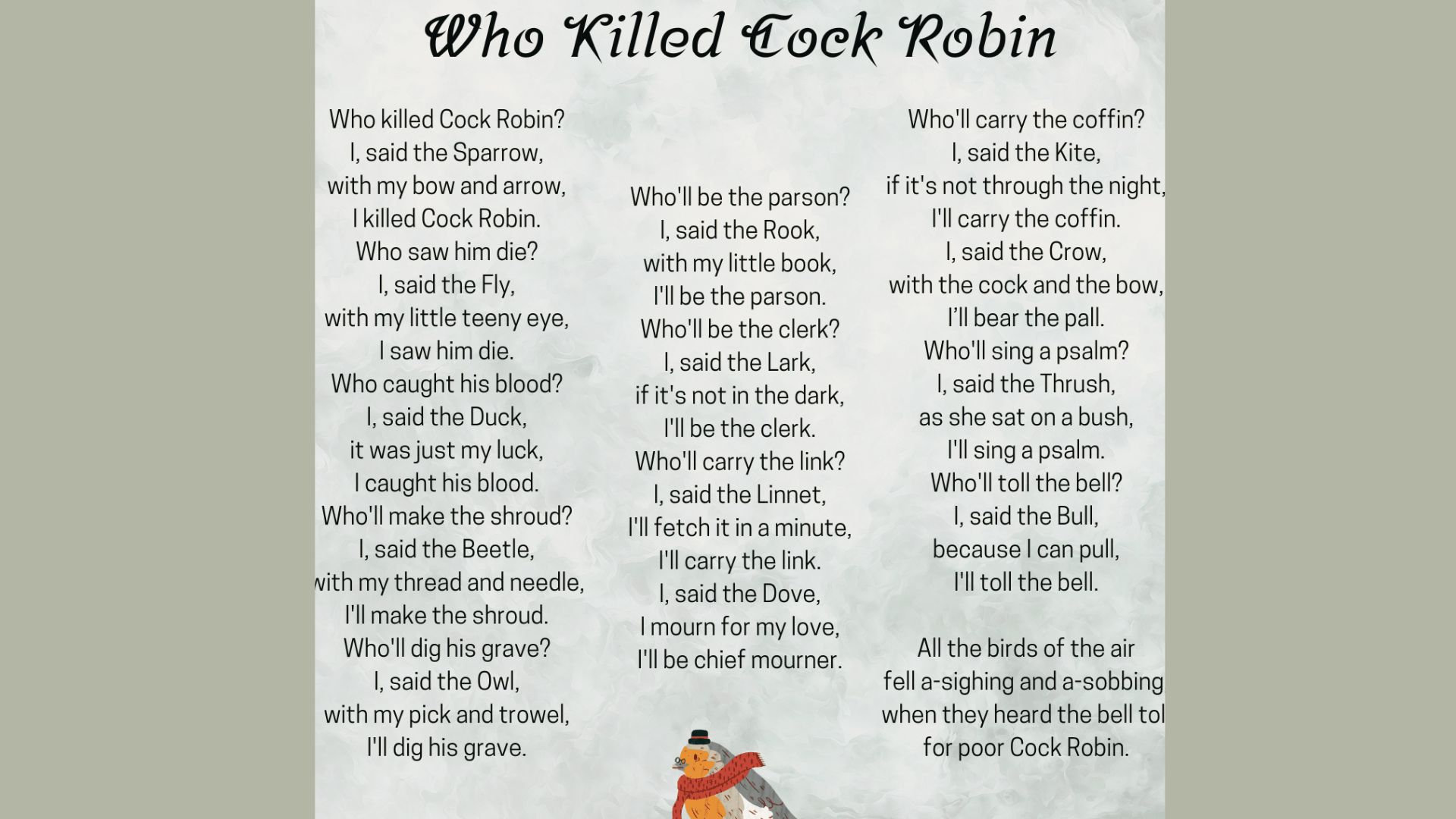
Here is the full text of the poem so you can read it yourself before we break it down.
Who killed Cock Robin? “I,” said the Sparrow, “With my bow and arrow, I killed Cock Robin.”
Who saw him die? “I,” said the Fly, “With my little eye, I saw him die.”
Who caught his blood? “I,” said the Fish, “With my little dish, I caught his blood.”
Who’ll make his shroud? “I,” said the Beetle, “With my thread and needle, I’ll make his shroud.”
Who’ll dig his grave? “I,” said the Owl, “With my pick and shovel, I’ll dig his grave.”
Who’ll be the parson? “I,” said the Rook, “With my little book, I’ll be the parson.”
Who’ll be the clerk? “I,” said the Lark, “If it’s not in the dark, I’ll be the clerk.”
Who’ll carry the link? “I,” said the Linnet, “I’ll fetch it in a minute, I’ll carry the link.”
Who’ll be chief mourner? “I,” said the Dove, “I mourn for my love, I’ll be the chief mourner.”
Who’ll carry the coffin? “I,” said the Kite, “If it’s not through the night, I’ll carry the coffin.”
Who’ll bear the pall? “I,” said the Wren, “Both the cock and the hen, We’ll bear the pall.”
Who’ll sing a psalm? “I,” said the Thrush, “As she sat on a bush, I’ll sing a psalm.”
Who’ll toll the bell? “I,” said the Bull, “Because I can pull, I’ll toll the bell.”
All the birds of the air Fell a-sighing and a-sobbing, When they heard the bell toll For poor Cock Robin.
A Simple Interpretation
Strip away the history and analysis, and the poem tells a simple story.
A sparrow kills a robin. The animal world comes together to mourn and bury him properly. Each creature takes on a role. The funeral is organized. The bell is tolled. Everyone grieves.
But even that simple version carries weight. The poem shows that even small deaths matter. Even a robin deserves a proper goodbye.
Symbolism in the Poem
Every creature in this poem carries symbolic meaning.
The Sparrow represents a killer who acts fast and does not think twice. The arrow is cold and direct. The Fish catching the blood is a symbol of life being drained away.
Blood in literature almost always points to sacrifice or violence.
The Owl digging the grave is interesting. Owls are often linked to wisdom and death in folklore. Putting the owl in charge of the grave feels very intentional.
The Dove as the chief mourner is the most powerful symbol of all. Doves represent peace and love. Having the dove mourn deepest tells us that love itself is grieving.
Cock Robin, the victim, is often seen as a symbol of innocence. A small, harmless bird taken down without cause. That is what makes the poem feel so uncomfortable even today.
Why the Poem Is Considered Dark
On paper, it is a children’s nursery rhyme. In practice, it is a murder ballad.
The poem opens with a direct question: Who killed Cock Robin? That is not a gentle start. It forces the reader into an investigation before they are even ready.
Then it methodically walks through every detail of the death and burial. The blood, the shroud, the grave, the coffin. Nothing is left out.
For a rhyme aimed at children, it covers death in a very complete and unflinching way.
That is why many literary scholars treat it as a dark text. It does not soften death. It walks you through every step. And the cheerful rhyme scheme makes the content even more unsettling.
The contrast between the sing-song rhythm and the dark subject is exactly what makes it linger in your memory.
Literary Devices Used in Who Killed Cock Robin
The poem is a masterclass in simple but effective writing techniques.
Repetition
The phrase “Who killed Cock Robin?” and the structure of question and answer repeat throughout the entire poem. This is not lazy writing.
It creates a ritual feeling, like a chant or a ceremony. Each repetition builds the weight of the moment.
Dialogue
Almost the entire poem is written as dialogue. Each animal speaks directly. This makes the poem feel alive and dramatic.
It pulls the reader in because someone is always answering a question. It mimics a courtroom, a confession, or a formal proceeding.
Rhyme Scheme
The poem uses a tight AABB or ABAB rhyme structure throughout. The rhymes are short and punchy. Sparrow and arrow. Fly and die. Fish and dish.
These simple rhymes make the poem easy to remember, which is partly why it survived so long.
Personification
Every creature in the poem behaves like a human. They carry links, read books, toll bells, and sew shrouds. This technique is called personification, and it is used heavily here to make the story relatable.
You are not watching animals. You are watching a community of people deal with loss.
Imagery
The poem is full of sharp, clear images. The blood caught in a dish. The beetle with a needle. The bell tolling over the air.
These images are simple but they stick. Good imagery does not need to be complex. It just needs to land clearly, and this poem does that every single time.
Historical Background of the Poem
The poem has a murky past, and that mystery has only added to its appeal.
The earliest known printed version appeared in 1744, but the language and style suggest it is much older. Some scholars believe it dates back to the 15th century.
Others think it may have roots in even older oral traditions from across Europe.
One popular theory links the poem to the fall of Robert Walpole, Britain’s first Prime Minister, who lost power in 1742.
In this reading, Cock Robin is Walpole and the animals represent the political figures who brought him down. This theory is interesting but not confirmed.
Another theory connects the poem to pagan rituals around the death of a robin in winter, symbolizing the end of the season.
Robins were sacred birds in many European folk traditions, and their deaths carried spiritual meaning.
What all these theories share is the idea that the poem is about more than a bird. It was always pointing at something bigger. Something real.
Why Is Who Killed Cock Robin Still Popular?
After nearly three centuries, this poem still gets read, studied, and taught. That is not an accident.
The poem works on multiple levels. Children enjoy the rhyme and the animal characters. Adults see the darker themes. Scholars find the historical and symbolic layers. That kind of range is rare, especially in a poem this short.
It also taps into something universal. Death, community, responsibility, and grief are not topics that go out of style. Every generation understands them.
Every culture has rituals around loss. This poem captures all of that in about 200 words.
The murder mystery format helps too. There is a question at the start and a resolution at the end. That structure keeps readers engaged even when they already know how it ends.
Finally, the poem has appeared in films, books, paintings, and songs for centuries. Every adaptation keeps it alive for a new audience.
Conclusion
The Who Killed Cock Robin poem is one of those rare pieces that means something different at every stage of life. As a child, it is a catchy rhyme. As an adult, it is a sharp look at guilt, community, and grief.
Now that you know the full text, its meaning, the literary devices, and the history behind it, you can appreciate just how layered this little poem really is.
If this guide helped you, share it with someone who loves poetry or classic literature. And if you have thoughts on what Cock Robin really symbolizes, drop them in the comments below.
I would love to hear your take.
Frequently Asked Questions
Is Who Killed Cock Robin a real historical event?
No confirmed historical event matches the poem. Several theories exist, including links to political figures, but none have been proven true.
What age group is Who Killed Cock Robin meant for?
It is traditionally classified as a children’s nursery rhyme, but its dark themes make it more suitable for older readers and literary study.
Has Who Killed Cock Robin been adapted into other media?
Yes. The poem has inspired films, paintings, songs, and books across several centuries, keeping it relevant in popular culture worldwide.
What does the sparrow represent in the poem?
The sparrow represents the direct cause of harm. It acts quickly and without hesitation, making it a symbol of swift, thoughtless violence.
Why is the robin used as the victim in this poem?
Robins are small, harmless, and widely loved birds. Using one as the victim makes the death feel more unjust and emotionally affecting for readers.