


If you have ever heard the line “Thursday’s child has far to go” and wondered what it actually means, you are not alone.
Many people come across the Thursday’s Child poem explained in bits and pieces but never get the full picture.
This article covers the poem’s meaning, history, personality traits linked to Thursday’s child, literary devices, and popular references all in one place.
By the end, you will have a clear understanding of what this old nursery rhyme is really saying.
I have spent time studying classic nursery rhymes and folk poetry, and this one has layers worth exploring. Every time I read it, I find something new to think about.
Overview of Thursday’s Child Poem
This is one of the most well-known nursery rhymes in English literature, and it carries more meaning than most people expect.
The Thursday’s Child poem is part of a longer nursery rhyme called “Monday’s Child.” Each line assigns a trait or fate to a child born on a specific day of the week.
Thursday’s line stands out because it speaks of distance and effort rather than gifts or beauty. The poem has been passed down through generations and remains a popular reference in books, songs, and films.
It also belongs to a broader tradition of fortune-telling songs, rhymes that were used to predict a child’s character or future based on their birth day.
Beyond that, the poem served a very practical purpose: it helped young children learn and remember the seven days of the week through simple, rhythmic verse.
Full Thursday’s Child Poem (Monday’s Child Nursery Rhyme)
Here is the complete poem so you can see every day’s verse in one place.
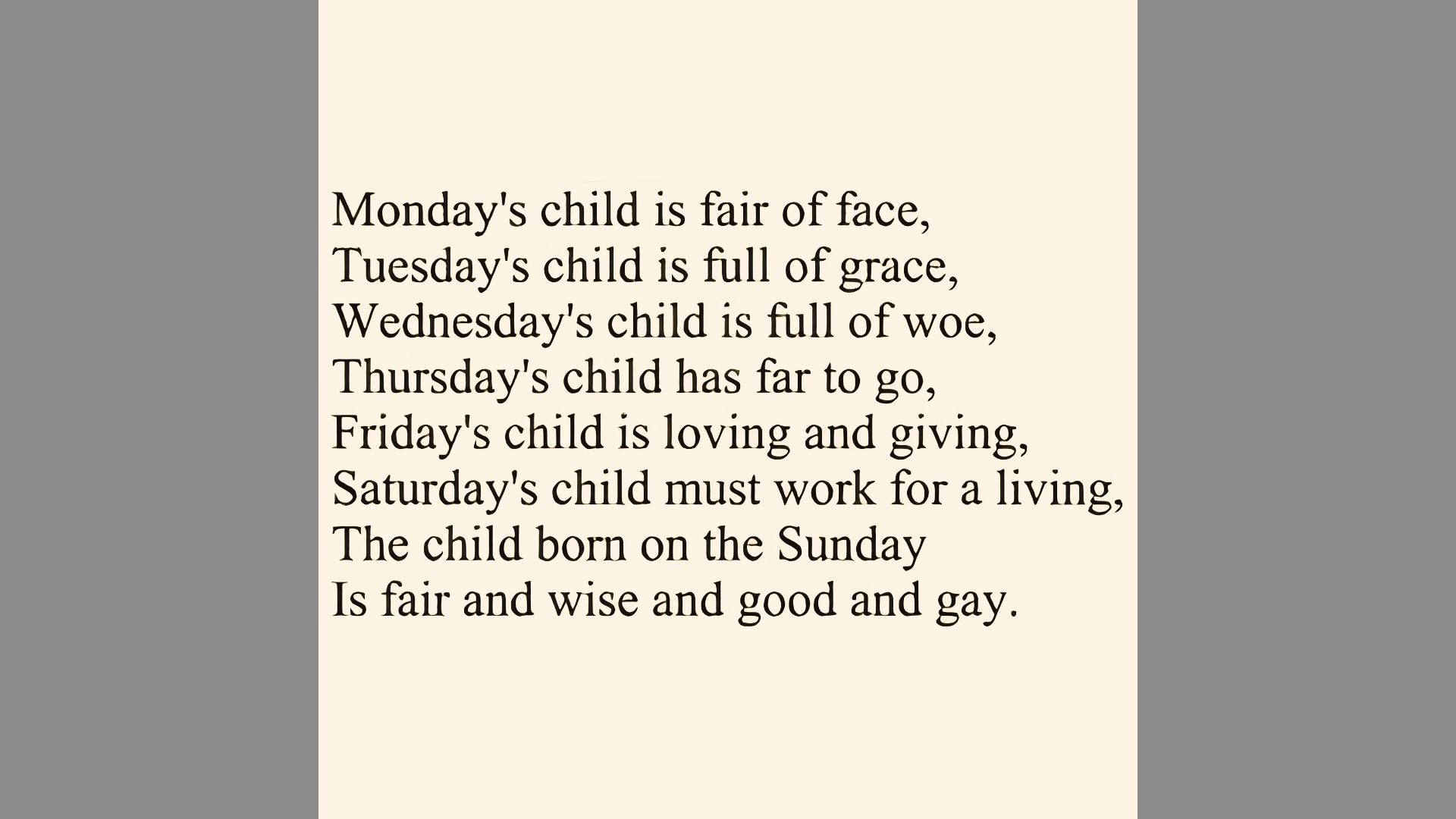
Monday’s child is fair of face, Tuesday’s child is full of grace, Wednesday’s child is full of woe, Thursday’s child has far to go, Friday’s child is loving and giving, Saturday’s child works hard for a living, And the child born on the Sabbath day Is bonny and blithe and good and gay.
This is the most widely known version. Some older and regional versions have slight differences in wording, but this is the one most people recognize today.
One alternate version, for example, describes Thursday’s child as “merry and glad” rather than “far to go,” which flips the meaning entirely. That shift shows just how much the poem changed as it moved through different regions and oral traditions before it was ever written down.
Thursday’s Child Meaning Explained
The meaning behind the Thursday line is the most debated part of the entire poem, and it is worth breaking it down carefully.
What Does “Far to Go” Really Mean?
“Far to go” can mean different things depending on how you read it. One reading is that Thursday’s child has a long road ahead, full of work and effort before reaching success.
Another reading is that this child is destined for great distance, literally or figuratively, meaning travel, growth, or a bigger life purpose. Some readers see it as a burden. Others see it as a promise.
The phrase is open-ended, which is exactly why it has stayed alive in culture for so long. It does not hand you a neat conclusion. It leaves you thinking.
Six Ways to Read “Thursday’s Child Has Far to Go”
Because the phrase is so compressed, it has gathered a range of interpretations across time.
Here are the most meaningful ones, each worth sitting with on its own.
- Ambition: This is the reading most people land on first. Thursday’s child is not content with what is nearby or easily reached. The road ahead is long because the destination is worth the distance. Far to go is a quiet compliment to people who set their sights further than most.
- Resilience: A second reading focuses not on the destination but on what the journey asks of you. Thursday’s child will face more than most, and will keep moving anyway. This interpretation resonates with anyone who has had to work harder than others just to reach a starting point that others took for granted.
- Growth and potential: In folk tradition, having far to go was sometimes considered the greatest advantage. The child who has already arrived has nothing left to discover. Thursday’s child still has everything ahead, which means the most room to change, learn, and become.
- Destiny and purpose: Some readers take a more philosophical view. Thursday’s child is not simply heading somewhere. They are moving toward something that matters, a calling or purpose that a comfortable, settled life could never contain. The distance is not incidental. It is the whole point.
- Literal travel and exploration: Historically, distance was associated with discovery. Thursday’s connection to Jupiter and Thor, both figures linked to expansive power and movement, gave the day an association with far horizons. In this reading, Thursday’s child is the wanderer, the one who ends up far from where they started, and is better for it.
- Lifelong learning: There is a quieter interpretation that has nothing to do with ambition or adventure. Far to go can mean that Thursday’s child is always growing, always aware that there is more to understand. This sits well with people who feel most alive when they are still figuring something out..
Symbolic Interpretations of the Thursday Line
Symbolically, “far to go” often represents a life path that is longer and harder than others. It can stand for ambition, the idea that Thursday’s child will not settle for what is close or easy.
It can also represent growth, suggesting that this person has the most potential for change and development.
In folk tradition, distance often symbolized possibility. A child with “far to go” was not necessarily cursed. In many readings, this child was seen as the one with the most room to grow.
Does the Poem Predict a Person’s Future?
No, the poem does not predict the future. It was never meant to be taken literally. It belongs to a tradition of folk rhymes that used birth days, seasons, and signs as playful frameworks for character and destiny.
Think of it like an old-fashioned horoscope. It is meant to be fun, poetic, and thought-provoking, not a definitive life forecast.
The History Behind the Thursday’s Child Poem
Understanding where this poem comes from helps explain why it matters beyond the nursery.
The Monday’s Child rhyme first appeared in print in 1838 in a collection called “Traditions of Devonshire” by Anna Eliza Bray. However, the rhyme is believed to be much older, rooted in English folk tradition. Before it was ever printed, the poem survived through oral tradition, passed along by word of mouth across generations. That is why so many regional versions exist today.
Days of the week held strong symbolic meaning in old European culture, often connected to planets, gods, and omens.
Thursday, for example, is named after Thor, the Norse god of thunder. In Roman tradition, it was linked to Jupiter, god of sky and power. Both figures were connected to strength, ambition, and large-scale fate.
This background adds weight to why Thursday’s child was given a trait tied to effort and distance rather than something passive.
The rhyme spread quickly through oral tradition and later through printed anthologies of children’s verse.
By the 20th century, it had become a staple of English-speaking nurseries across the world. Many people first heard it from a parent or grandparent, and that personal connection is part of what gives the poem its lasting emotional pull.
Thursday’s Child Personality Traits
The poem has influenced a whole set of personality associations for people born on Thursdays.
Based on the “far to go” line, Thursday’s child is often described as someone who is driven and goal-oriented. They are the type who does not stop at the first milestone.
People born on Thursday are sometimes seen as natural travelers, in the physical sense or in the sense of always looking ahead. They tend to be resilient, meaning they keep moving even when things slow them down.
They are also thought to be ambitious, drawn to big goals and long-term plans rather than quick wins.
In folk tradition, these traits were seen as both a blessing and a test. The road is long, but Thursday’s child is the one who keeps walking.
It is worth noting that in one older version of the rhyme, Thursday’s child is called “merry and glad.” So depending on which tradition you follow, Thursday’s child is either a tireless striver or a naturally cheerful soul, and honestly, both can be true of the same person.
Thursday’s Child Quotes and Popular References
This poem has found its way into books, music, film, and everyday conversation.
The Line Itself
Everything starts here. The original verse, first recorded in print in 1838, is:
“Thursday’s child has far to go.”
It is five words, but those five words have been carrying meaning across generations ever since.
Cultural and Literary References
From pop music to prize-winning fiction, “Thursday’s child has far to go” has inspired some surprisingly deep creative responses.
- David Bowie – “Thursday’s Child” (1999). This is the most well-known modern engagement with the poem. The song appears on Bowie’s album “Hours…” and opens with a reflective tone that mirrors the poem’s sense of a life still in motion.
- Bowie used the Thursday’s child identity to explore themes of searching, emotional distance, and the feeling of always having further to travel. It is widely considered one of his more introspective late-career works and a genuine creative response to the poem rather than a surface name-drop.
- Agatha Christie – “An Autobiography” (1977). Christie opens her memoir with a reference to the Monday’s Child rhyme, using it as a personal framework for thinking about character and fate.
- It is one of the more literary uses of the poem by a major writer, and it signals how seriously some readers took the rhyme as a lens for self-understanding.
- “Thursday’s Child” by Sonya Hartnett (2002). This Australian novel, winner of the Guardian Children’s Fiction Prize, takes its title directly from the rhyme and uses the Thursday’s child identity to shape a character defined by restlessness, endurance, and the need to move forward even when circumstances are difficult. It is one of the clearest literary uses of the poem’s themes in fiction.
- Television and film. The line has appeared in period dramas and family productions as a shorthand for a character who is ambitious, unsettled, or marked for something larger.
- It tends to show up at moments involving birth, childhood reflection, or a character reckoning with their future.
Original Inspirational Quotes
The following quotes are written in the spirit of the poem and are original. They are suitable for cards, captions, speeches, and personal messages.
“Not all roads lead quickly. Thursday’s child knows the best ones take time.”
“To have far to go is not a burden. It is an invitation.”
“The child who has far to go never runs out of reasons to keep moving.”
“Distance is not a delay. For Thursday’s child, it is the whole point.”
“Far to go means far to grow.”
“Some people are given destinations. Thursday’s child is given a direction and the will to follow it.”
Thursday’s Child in Modern Usage
The phrase has traveled far from the nursery. Today it appears in personal conversations, milestone celebrations, and everyday creative expression, often without the full rhyme attached.
The five words carry enough weight on their own.
In Everyday Conversation
People use “Thursday’s child has far to go” to describe someone who is clearly still on their way somewhere.
It fits a young person with visible potential, someone who has had a hard start and keeps going anyway, or a friend who cannot seem to settle because something is always pulling them forward.
Said with warmth, it is one of the more generous things you can say about a person.
At Birthdays and Graduations
The line has become a natural fit for milestone moments because it speaks to beginnings rather than arrivals.
It works especially well in:
- Birthday cards for 18th, 21st, or any milestone year where the road ahead feels more significant than the road behind.
- Graduation messages, where far to go is encouraging rather than daunting.
- New baby cards, where the original nursery rhyme context still applies perfectly.
- Retirement farewells, where the phrase can be reread as an open door rather than a long obligation.
On Social Media
The line travels well in short form. It appears in Instagram bios, caption text for travel photos, and posts marking personal transitions.
Its brevity makes it shareable without needing explanation. Most readers feel its meaning even if they have never heard the full rhyme.
In Motivational Contexts
Writers, coaches, and speakers reach for the phrase when talking about patience, process, and long-term goals.
It captures something that more formal language tends to flatten: the idea that not being finished yet is not a failure. It is simply where you are, and where you are is fine.
Shareable Content Inspired by Thursday’s Child
These are ready to use or adapt for cards, posts, speeches, or messages.
Birthday Wishes
“Happy birthday to a true Thursday’s child. You have always had far to go, and that is exactly what makes your journey worth watching.”
“Another year further along the road. Keep going. Thursday’s child always does.”
“For someone born on a Thursday: the distance ahead is not a warning. It is a promise. Happy birthday.”
Instagram and Social Media Captions
“Thursday’s child has far to go. Still going.”
“Born on a Thursday. The road is long and I am not in a hurry to reach the end.”
“Far to go. Good. I was never one for short trips.”
“Somewhere between where I started and where I am going. Thursday’s child energy.”
Graduation and Milestone Messages
“You have always had far to go. Today you just got a little closer. Congratulations.”
“Thursday’s child has far to go, and now the real journey begins. So proud of you.”
“The best part about having far to go is that the road keeps getting more interesting. Go well.”
Literary Devices Used in the Thursday’s Child Poem
This short poem is a strong example of how much can be packed into a few lines through careful craft.
- Symbolism: Each day of the week acts as a symbol. Thursday represents ambition, effort, and distance. “Far to go” is itself a symbol of a life that demands more, whether that is hard work, travel, or personal growth.
- Imagery: The poem creates clear mental pictures without many words. For Thursday’s child, “far to go” creates an image of a long road or a figure walking toward a distant horizon. It is a spare image, but it is memorable because of how open it is.
- Rhyme and rhythm: The poem follows an AABB rhyme scheme, where each pair of lines rhymes together. “Woe” rhymes with “go,” giving the Thursday line a finality that lands cleanly. The steady, sing-song rhythm is typical of nursery rhymes designed to be spoken aloud and memorized.
- Parallel structure: Each line follows the same structure: “[Day]’s child is/has [trait].” This creates a pattern that feels satisfying and makes each day easy to remember. The repetition also gives the poem a chant-like quality that works well when spoken aloud.
- Metaphor: “Far to go” functions as a metaphor. It does not mean the child will literally walk a long distance. It means this child’s life path will require more effort, more time, or more striving than others.
- Personification: In some older versions of the rhyme, days of the week were personified as characters with moods or intentions.
Some versions extend this further, giving each day an almost human quality, as though the day itself chooses what kind of child to send into the world.
Conclusion
The Thursday’s Child poem explained in full is a reminder that old nursery rhymes carry more meaning than they first appear to.
At its heart, this poem is about potential, effort, and the long road some people are meant to walk. Whether “far to go” feels like a burden or a calling, it is a phrase that has stayed with readers for generations.
If you were born on a Thursday, that is something worth thinking about.
Share this article with someone born on a Thursday, drop a comment below with your own interpretation of the rhyme, or check out our other poetry breakdowns to keep reading.
Frequently Asked Questions
What day of the week gives the best traits according to the poem?
Sunday’s child, born on the Sabbath, is described as bonny, blithe, good, and happy, which many readers consider the most favorable set of traits.
Is Thursday’s child the same across all cultures?
No. The Monday’s Child rhyme is rooted in English folk tradition. Other cultures have their own day-of-birth belief systems with entirely different associations for Thursday.
Is “far to go” a negative trait compared to the other days?
Not necessarily. While some days receive clearly positive traits like beauty or grace, “far to go” is more open-ended. Many readers consider it the most meaningful line because it implies potential and purpose rather than a fixed quality.