


Most people want art that makes them feel good. Housman had a different idea. “Terence, This Is Stupid Stuff” is one of those poems that sounds simple but hits hard once you sit with it.
I first read it expecting dry Victorian verse. What I got was a sharp, honest argument about pain, comfort, and what good writing is actually for.
In this post, I break down the full poem, its meaning, and why it still holds up after all these years.
Let’s get into it.
Read the Complete Poem (1896)
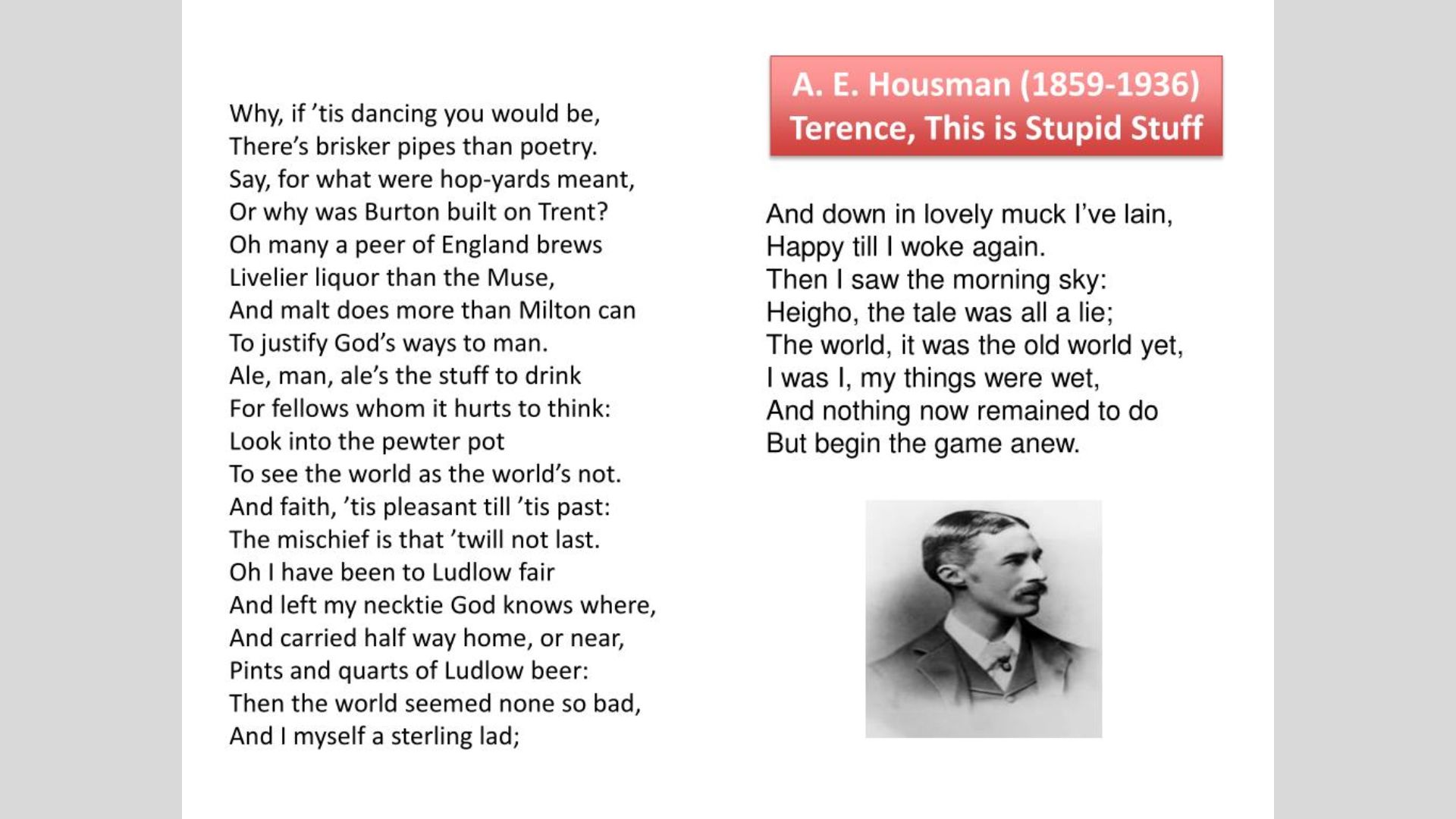
Looking for the full text of Terence, This Is Stupid Stuff? Read it below.
‘Terence, this is stupid stuff: You eat your victuals fast enough; There can’t be much amiss, ’tis clear, To see the rate you drink your beer. But oh, good Lord, the verse you make, It gives a chap the belly-ache. The cow, the old cow, she is dead; It sleeps well, the horned head: We poor lads, ’tis our turn now To hear such tunes as killed the cow. Pretty friendship ’tis to rhyme Your friends to death before their time Moping melancholy mad: Come, pipe a tune to dance to, lad.’
Why, if ’tis dancing you would be, There’s brisker pipes than poetry. Say, for what were hop-yards meant, Or why was Burton built on Trent? Oh many a peer of England brews Livelier liquor than the Muse, And malt does more than Milton can To justify God’s ways to man. Ale, man, ale’s the stuff to drink For fellows whom it hurts to think: Look into the pewter pot To see the world as the world’s not. And faith, ’tis pleasant till ’tis past: The mischief is that ’twill not last. Oh I have been to Ludlow fair And left my necktie God knows where, And carried half way home, or near, Pints and quarts of Ludlow beer: Then the world seemed none so bad, And I myself a sterling lad; And down in lovely muck I’ve lain, Happy till I woke again. Then I saw the morning sky: Heigho, the tale was all a lie; The world, it was the old world yet, I was I, my things were wet, And nothing now remained to do But begin the game anew.
Therefore, since the world has still Much good, but much less good than ill, And while the sun and moon endure Luck’s a chance, but trouble’s sure, I’d face it as a wise man would, And train for ill and not for good. ‘Tis true, the stuff I bring for sale Is not so brisk a brew as ale: Out of a stem that scored the hand I wrung it in a weary land. But take it: if the smack is sour, The better for the embittered hour; It should do good to heart and head When your soul is in my soul’s stead; And I will friend you, if I may, In the dark and cloudy day.
There was a king reigned in the East: There, when kings will sit to feast, They get their fill before they think With poisoned meat and poisoned drink. He gathered all the springs to birth From the many-venomed earth; First a little, thence to more, He sampled all her killing store; And easy, smiling, seasoned sound, Sate the king when healths went round. They put arsenic in his meat And stared aghast to watch him eat; They poured strychnine in his cup And shook to see him drink it up: They shook, they stared as white’s their shirt: Them it was their poison hurt.
I tell the tale that I heard told. Mithridates, he died old.
From A Shropshire Lad (1896) by A. E. Housman
About “Terence, This Is Stupid Stuff”
This poem has been read and studied for over a century. Here’s a quick look at why.
Poem Overview
“Terence, This Is Stupid Stuff” was written by A. E. Housman and published in 1896 as part of A Shropshire Lad. It is poem LXII in the collection.
The form is rhymed octosyllabic couplets — short, punchy lines that rhyme in pairs. It spans five stanzas and moves from a lighthearted complaint to one of the most striking endings in Victorian poetry.
Why This Poem Is Still Popular
A few reasons this poem still connects.
First, the wit. Lines like “malt does more than Milton can / to justify God’s ways to man” are sharp and a little reckless. That humor does not age.
Second, the theme. Most people know what it feels like to reach for something easy when life gets hard. Housman does not judge that. He just shows you where it leads — and then offers something better. Not comfort. Preparation.
That mix of humor and honesty keeps pulling readers back.
Summary of Terence This Is Stupid Stuff
Here is what the poem says, broken down simply.
Simple Summary in 5–6 Lines
Terence’s friends mock his sad, heavy poetry. They want fun tunes and laughter, not gloomy verse. Terence fires back. He agrees that ale and good times feel great in the moment.
But that feeling does not last. Morning comes, and life is still the same. His point is simple: life has more trouble than good.
So instead of chasing comfort, it is smarter to get used to pain. That is exactly what his poetry does. It prepares you for the hard days ahead.
Meaning and Central Message
Here is the real point Housman was making.
What Does “Terence This Is Stupid Stuff” Mean?
The title is ironic. The poem is not stupid at all. The phrase comes from Terence’s friends, who are mocking his dark, serious verse. They want something light and fun. Housman uses their complaint as a starting point to defend exactly the kind of poetry they hate.
The poem is really a case for why serious art matters more than easy entertainment.
Beer vs Poetry (Core Idea)
This is the heart of the poem.
Beer represents escape. It feels good, it numbs the mind, and for a while, the world looks better than it is. But it wears off. You wake up the next morning and nothing has changed.
Poetry, the kind Housman writes, does the opposite. It does not make you feel good. It makes you feel ready. It sits with pain, looks at it honestly, and by doing that, it builds something in you. When trouble actually comes, and Housman believes it always does, you are not caught off guard.
If Terence’s case for sad poetry speaks to you, these dark poems explore the same idea.
One offers relief. The other offers strength.
Key Themes in Terence This Is Stupid Stuff
This poem carries more weight than it first appears. Here are the four ideas running through it.
Reality vs illusion shows up early. Beer makes the world look better than it is. Poetry refuses that lie. The inevitability of suffering is Housman’s core belief.
Life has more bad than good, and pretending otherwise helps no one. Melancholy poetry is not cruelty. It is honesty. And that honesty builds emotional strength.
Like Mithridates with his poison, small doses of pain over time make you harder to break.
About the Author – A. E. Housman

- E. Housman was an English poet and classical scholar, best known for his 1896 collection A Shropshire Lad. His writing style was simple on the surface but carried real weight underneath.
He wrote about death, lost youth, the passage of time, and the pain of living. His most celebrated works include A Shropshire Lad and Last Poems.
He used traditional rhyme and meter throughout, keeping his language clean while his themes stayed quietly heavy.
Conclusion
Terence This Is Stupid Stuff is not just a poem. It is a quiet argument for why honest art matters more than easy comfort.
I have read it more than once, and every time, the Mithridates ending hits differently. Housman was not being cruel with his dark verse.
He was being kind in the only way that lasts.
Matthew Arnold’s Dover Beach shares the same late-Victorian unease about faith and happiness.
If this breakdown helped you, go read more of A Shropshire Lad. You will not regret it.
Drop your thoughts in the comments below.
Frequently Asked Questions
What is the main message of “Terence, This Is Stupid Stuff”?
The poem argues that honest, even painful art prepares us better for life than easy comfort does. Housman believed facing hardship builds real strength.
Who is Mithridates in “Terence, This Is Stupid Stuff”?
Mithridates was a real king who made himself immune to poison by taking small doses daily. Housman uses him as a symbol of building tolerance to pain over time.
What does ale represent in the poem?
Ale stands for escape and distraction. It feels good briefly but changes nothing, as Housman shows through his own night at Ludlow fair.
What is the tone of “Terence, This Is Stupid Stuff”?
The tone shifts from dry wit to honest reflection to quiet warning. Housman starts sardonic and ends with one of the most sobering closes in Victorian poetry.
Is “Terence, This Is Stupid Stuff” part of a collection?
Yes, it appears in A. E. Housman’s 1896 collection, A Shropshire Lad, as poem LXII. The collection is known for its themes of youth, loss, and mortality.