

I first read “Woodchucks” by Maxine Kumin and could not stop thinking about it for days. It looks like a simple poem about a farmer and some garden pests.
But it is so much more than that. Kumin published it in 1972, and it has been making readers uncomfortable ever since.
In this post, I break down the summary, themes, and literary devices in plain, simple terms. No complicated language.
Just an honest look at one of the most quietly disturbing poems in 20th-century American literature. Let’s get into it.
Quick Overview of “Woodchucks”
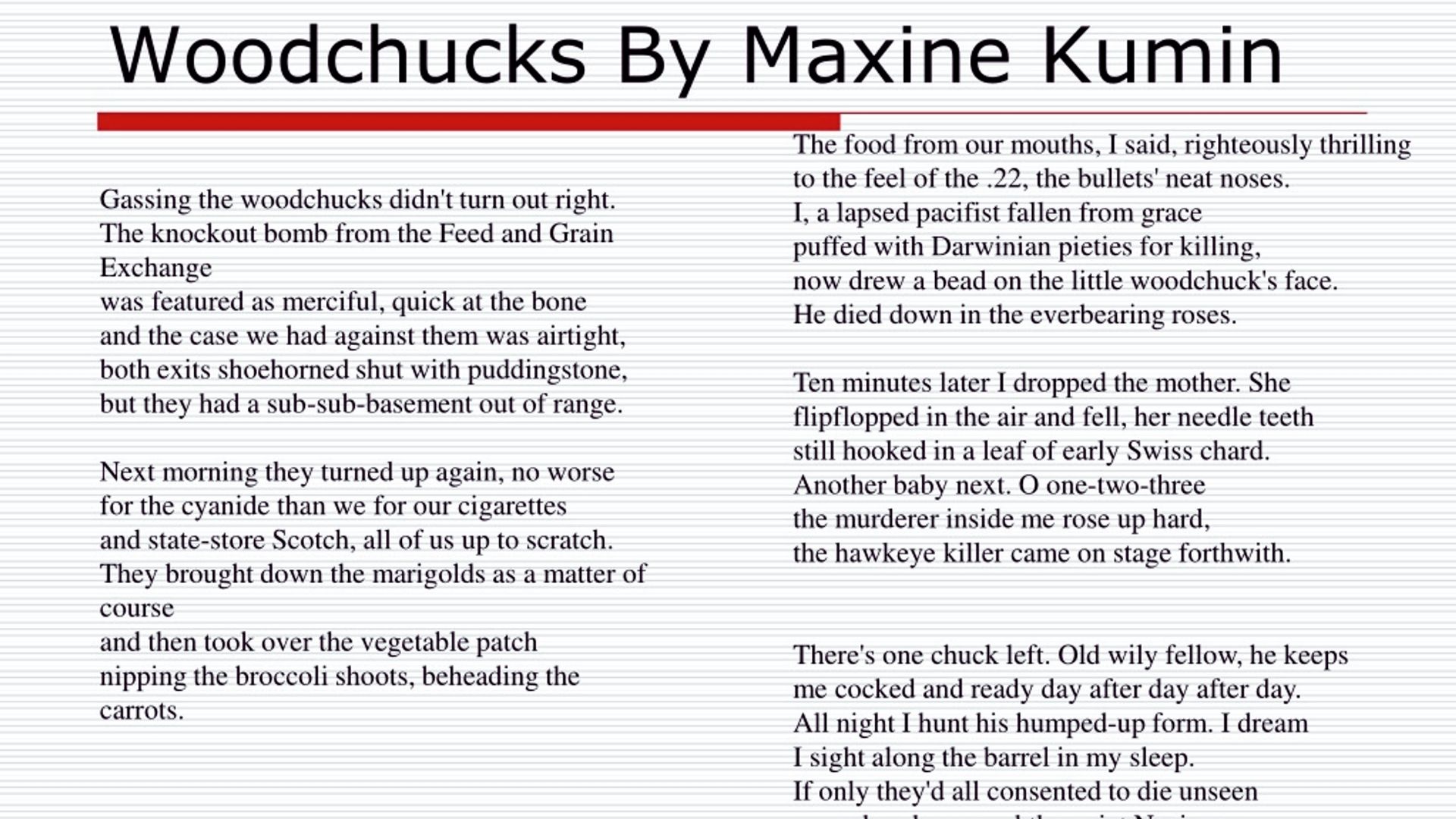
Maxine Kumin published “Woodchucks” in 1972, making it a standout piece of 20th-century American poetry.
The speaker is a farmer who sets out to get rid of woodchucks from the garden. The poem is written in free verse but follows a loose ABCACB rhyme scheme.
At its core, it tells a simple story on the surface. But underneath, it is really about how power shifts a person’s thinking and leads to moral corruption.
Summary of the Woodchucks Poem
A full breakdown of what happens in the poem, stanza by stanza.
Simple Summary (Easy Explanation)
The poem starts with a farmer trying to kill woodchucks humanely by gassing them. It does not work. Frustrated, the farmer picks up a rifle and hunts them one by one.
With each kill, something shifts inside. The hunting stops feeling like a chore and starts feeling like a thrill. By the end, the farmer is fully consumed by obsession and cruelty.
One-Paragraph Summary for Quick Revision
In “Woodchucks,” a farmer fails to kill garden pests using gas and turns to a rifle instead. Each kill feeds a growing obsession. What starts as a practical problem turns into something darker.
The farmer loses moral ground with every shot, ending the poem consumed by bloodlust. Kumin uses this simple rural scene to show how violence, once started, can take over a person completely.
Themes in “Woodchucks” Poem
The key ideas Kumin hides beneath this simple farming story.
Power and Corruption
The farmer starts with a simple goal but gains control over life and death with a rifle. That control feels good, and that is the problem. The more power the farmer holds, the less humanity remains. It is a clear nod to the idea that absolute power corrupts absolutely.
Violence and Loss of Humanity
At first, the killing is practical. But as the poem moves forward, the farmer stops killing out of need and starts killing out of want. Kumin shows how easily violence becomes enjoyable when there is no one to stop it.
War and Genocide
Kumin, who was Jewish, subtly connects the farmer’s actions to the logic of genocide. The gassing attempt mirrors gas chambers. The cold, systematic hunting mirrors how groups were targeted and killed. The poem never says this outright, but the connection is hard to ignore.
Human vs Nature Conflict
The woodchucks resist, and that resistance enrages the farmer. What begins as a human trying to control nature turns into something personal. That need for total control reflects a broader human tendency to dominate rather than coexist.
Detailed Analysis of “Woodchucks” (Stanza-wise)
A close reading of each stanza and what Kumin is really saying.
Stanza 1 – Illusion of Humane Control
The farmer opens by trying to gas the woodchucks. It feels like the “right” way to handle the problem. Clean. Distant. No blood. But the farmer still wants them dead. Kumin shows how people justify harmful actions by dressing them up as reasonable or necessary.
Stanza 2 – Growing Frustration
The gas does not work. Some woodchucks survive and the farmer’s patience runs out. The loss of control triggers anger. This frustration is what pushes the farmer toward open violence.
Stanza 3 – Justifying Violence
The farmer picks up a rifle and reframes the situation. It is now about survival and who belongs. This “survival of the fittest” thinking is a classic way people justify cruelty. Kumin shows how quickly a moral person can reframe violence as logic when challenged.
Stanza 4 – Embracing Brutality
The farmer is no longer killing out of frustration. There is excitement now. A satisfaction in the hunt. The farmer starts to identify as a killer. Kumin shows the real danger here, not just that violence happens, but that people can grow to enjoy it.
Stanza 5 – Complete Moral Collapse
By the final stanza, the farmer is fully consumed. Kumin brings in imagery that echoes Nazi ideology, wiping out an entire group, leaving none behind. The language mirrors the logic of genocide, calm, determined, and completely void of empathy.
Literary Devices in the Woodchucks Poem
A look at the tools Kumin uses to make this poem hit harder than it seems.
Extended Metaphor (Conceit)
The farmer represents anyone in power. The woodchucks represent the vulnerable with no voice. The act of hunting becomes a stand-in for systemic oppression. Kumin never breaks this metaphor, which makes it all the more unsettling.
Allusion
Kumin quietly references Social Darwinism and the Holocaust. The gassing, the systematic killing, the desire to wipe out an entire group. These are never stated directly but are clearly there for readers who look closely.
Imagery and Tone
Kumin describes brutal acts in plain, almost casual language. That contrast is what creates the most unease. The tone starts cool and practical, then slowly grows darker. By the end, it feels deeply disturbing without ever being dramatic.
Anthropomorphism
Kumin gives the woodchucks human-like qualities. They have families and a sense of innocence. This makes their deaths feel like real losses. It also forces the reader to feel for the victims, which makes the farmer’s cruelty even harder to sit with.
Tone and Mood Analysis
The tone in “Woodchucks” shifts gradually. It opens calm and practical, almost matter-of-fact. Then frustration creeps in as the gassing fails.
From there, it turns cold and violent. By the final stanza, there is a disturbing excitement in the farmer’s voice.
For the reader, this shift creates real discomfort. What starts as a simple farming story slowly builds into something deeply unsettling. The mood moves from mild anxiety to outright shock.
Critical Interpretation & Message
What the poem means beyond the surface story.
What is Kumin Trying to Say?
Kumin is warning readers about what happens when power goes unchecked. The farmer does not start out as a cruel person.
But step by step, the access to power and the absence of consequences changes that. Kumin wants readers to see how ordinary people can slide into harmful behavior without even noticing it happening.
Relevance in Modern Context
This poem was written in 1972 but feels just as sharp today. The abuse of power, the dehumanization of groups, the slow normalization of violence.
These are not old problems. They show up in politics, in systems, and in everyday human behavior. Kumin’s poem works as a quiet warning that is still very much worth hearing.
About the Poet – Maxine Kumin

Maxine Kumin was born in 1925 in Philadelphia. Her Jewish heritage deeply shaped the moral weight in her writing. She won the Pulitzer Prize in 1973 and later served as Poet Laureate.
Her work focused on nature, human morality, and social issues, often blending personal experience with broader political themes.
“Woodchucks” was inspired by her life on a farm and reflects how historical events like the Holocaust stayed with her throughout her career.
Conclusion
“Woodchucks” is not just a poem about a farmer. It is a warning. Kumin shows how moral decline happens slowly, one small step at a time.
Unchecked authority is dangerous, and empathy is what keeps us human. I think every reader walks away from this poem a little more self-aware.
If this breakdown helped you, share it with a fellow literature lover. Drop your thoughts in the comments below.
Frequently Asked Questions
What is the “Woodchucks” poem about?
“Woodchucks” by Maxine Kumin is about a farmer who tries to get rid of woodchucks and slowly turns obsessive and cruel. It uses this simple story to talk about power, violence, and moral decline.
What are the main themes in the “Woodchucks” poem?
The main themes are power and corruption, violence, genocide, and the conflict between humans and nature. Kumin layers these ideas beneath a straightforward farming story.
What literary devices does Kumin use in “Woodchucks”?
Kumin uses an extended metaphor, allusion, anthropomorphism, and stark imagery. These devices work together to give the poem its deeper, darker meaning.
What is the tone of the “Woodchucks” poem?
The tone starts calm and practical but shifts into something cold and disturbing. By the end, there is an unsettling excitement in the farmer’s voice that leaves the reader uncomfortable.
What is the significance of the Holocaust reference in “Woodchucks”?
Kumin, who was Jewish, subtly connects the farmer’s actions to the logic of genocide. The gassing and systematic killing mirror real historical horrors, adding a deeply serious layer to the poem.