


There is one song you cannot hear without thinking of a person, a place, or a bad year. You skip it, and somehow it still finds you in a taxi, a waiting room, or someone else’s wedding.
That stubborn pull is what poets have been writing about since long before anyone could press play.
They had no speakers, only language, and they made it sound like something anyway.
These poems about music, from Shelley’s “Music, When Soft Voices Die” to Langston Hughes’s “The Weary Blues,” show how.
Read on for eleven of them, spanning nearly eight centuries, each with its full text, a short note on its context, and a credit line.
How Poets Turn Sound Into Verse
Poets write about music by turning sound into structure and image.
They echo it through rhythm, repetition, and line length, name instruments and birdsong, or treat music as something that lingers in memory.
A good poem about music often behaves like music itself, so its pulse is part of its meaning.
A page cannot play a note, so every poem here solves the problem with a different tool.
Shelley leans on memory, Robert Browning on the chords of a Venetian composer that call up a vanished city, and Hughes on a syncopated beat you can feel before you can explain it.
For a closer look at how stress and beat work on the page, these rhythm examples in poetry show the mechanics.
As you read, notice where a poem repeats itself, where its lines speed up or slow down, and whether it describes music or tries to become it.
Famous Poems About Music From Shakespeare to the Victorians

The most famous poems about music from before 1900 are the song “Orpheus with His Lute” from Henry VIII, Shelley’s “Music, When Soft Voices Die,” Elizabeth Barrett Browning’s “A Musical Instrument,” and Robert Browning’s “A Toccata of Galuppi’s.”
Together they cover music’s power over nature, its life in memory, its cost to the maker, and its link to lost time.
1. “Orpheus with His Lute” by William Shakespeare
This twelve-line song comes from Henry VIII, where Queen Katherine asks an attendant to sing to her lute shortly before two cardinals arrive to press her about the king’s demand for an annulment.
It draws on the myth of Orpheus, the musician whose playing was said to move nature itself. The scene is commonly attributed to John Fletcher, so the credit below lists both names.
Keep the staging in mind as you read, since the song’s sweetness arrives just before bad news.
Orpheus with his lute made trees,
And the mountain tops that freeze,
Bow themselves when he did sing:
To his music plants and flowers
Ever sprung; as sun and showers
There had made a lasting spring.
Every thing that heard him play,
Even the billows of the sea,
Hung their heads, and then lay by.
In sweet music is such art,
Killing care and grief of heart
Fall asleep, or hearing, die.
Credit: William Shakespeare and John Fletcher (attribution debated), “Orpheus with His Lute Made Trees,” from Henry VIII, first printed in the First Folio, 1623.
2. “Music, When Soft Voices Die” by Percy Bysshe Shelley
Shelley wrote this eight-line poem in 1821, a year before he drowned, and it first appeared in 1824 in Posthumous Poems, edited by his widow, Mary Shelley, under the title “To —.”
It ranks among the shortest poems about music, and it ties music to memory through a progression of senses, moving from sound to scent to touch.
The final couplet carries that logic over to love.
Music, when soft voices die,
Vibrates in the memory—
Odours, when sweet violets sicken,
Live within the sense they quicken.
Rose leaves, when the rose is dead,
Are heaped for the belovèd’s bed;
And so thy thoughts, when thou art gone,
Love itself shall slumber on.
Credit: Percy Bysshe Shelley, “Music, When Soft Voices Die” (written 1821), first published in Posthumous Poems (London: John and Henry L. Hunt, 1824).
3. “A Musical Instrument” by Elizabeth Barrett Browning
Barrett Browning retells the myth of Pan cutting a reed from a riverbed and shaping it into a pipe.
The poem first appeared in The Cornhill Magazine in 1860 and was collected in Last Poems in 1862.
Its six-line stanzas keep returning to Pan’s name like a refrain, so the poem makes a kind of pipe music while it describes one. Watch the final stanza, where the tone shifts from play to cost.
WHAT was he doing, the great god Pan,
Down in the reeds by the river?
Spreading ruin and scattering ban,
Splashing and paddling with hoofs of a goat,
And breaking the golden lilies afloat
With the dragon-fly on the river.
He tore out a reed, the great god Pan,
From the deep cool bed of the river:
The limpid water turbidly ran,
And the broken lilies a-dying lay,
And the dragon-fly had fled away,
Ere he brought it out of the river.
High on the shore sate the great god Pan,
While turbidly flowed the river;
And hacked and hewed as a great god can,
With his hard bleak steel at the patient reed,
Till there was not a sign of a leaf indeed
To prove it fresh from the river.
He cut it short, did the great god Pan,
(How tall it stood in the river!)
Then drew the pith, like the heart of a man,
Steadily from the outside ring,
And notched the poor dry empty thing
In holes, as he sate by the river.
‘This is the way,’ laughed the great god Pan,
Laughed while he sate by the river,)
The only way, since gods began
To make sweet music, they could succeed.’
Then, dropping his mouth to a hole in the reed,
He blew in power by the river.
Sweet, sweet, sweet, O Pan!
Piercing sweet by the river!
Blinding sweet, O great god Pan!
The sun on the hill forgot to die,
And the lilies revived, and the dragon-fly
Came back to dream on the river.
Yet half a beast is the great god Pan,
To laugh as he sits by the river,
Making a poet out of a man:
The true gods sigh for the cost and pain, —
For the reed which grows nevermore again
As a reed with the reeds in the river.
Credit: Elizabeth Barrett Browning, “A Musical Instrument,” first published in The Cornhill Magazine, 1860; collected in Last Poems (1862).
4. “A Toccata of Galuppi’s” by Robert Browning
First published in Men and Women in 1855, this dramatic monologue centers on a toccata, a keyboard piece, by Baldassare Galuppi (1706 to 1785), a Venetian composer.
The speaker is an Englishman who admits he has never left England, and the music carries his imagination to Venice at carnival time.
Browning works musical terms such as suspensions and sevenths into the verse, and the poem’s mood turns on mortality. Galuppi’s name survives today partly because of it.
Oh Galuppi, Baldassaro, this is very sad to find!
I can hardly misconceive you; it would prove me deaf and blind;
But although I take your meaning, ’tis with such a heavy mind!
Here you come with your old music, and here’s all the good it brings.
What, they lived once thus at Venice where the merchants were the kings,
Where Saint Mark’s is, where the Doges used to wed the sea with rings?
Ay, because the sea’s the street there; and ’tis arched by . . . what you call
. . . Shylock’s bridge with houses on it, where they kept the carnival:
I was never out of England—it’s as if I saw it all.
Did young people take their pleasure when the sea was warm in May?
Balls and masks begun at midnight, burning ever to mid-day,
When they made up fresh adventures for the morrow, do you say?
Was a lady such a lady, cheeks so round and lips so red,—
On her neck the small face buoyant, like a bell-flower on its bed,
O’er the breast’s superb abundance where a man might base his head?
Well, and it was graceful of them—they’d break talk off and afford
—She, to bite her mask’s black velvet—he, to finger on his sword,
While you sat and played Toccatas, stately at the clavichord?
What? Those lesser thirds so plaintive, sixths diminished, sigh on sigh,
Told them something? Those suspensions, those solutions—”Must we die?”
Those commiserating sevenths—”Life might last! we can but try!”
“Were you happy?” —”Yes.”—”And are you still as happy?”—”Yes. And you?”
—”Then, more kisses!”—”Did I stop them, when a million seemed so few?”
Hark, the dominant’s persistence till it must be answered to!
So, an octave struck the answer. Oh, they praised you, I dare say!
“Brave Galuppi! that was music! good alike at grave and gay!
“I can always leave off talking when I hear a master play!”
Then they left you for their pleasure: till in due time, one by one,
Some with lives that came to nothing, some with deeds as well undone,
Death stepped tacitly and took them where they never see the sun.
But when I sit down to reason, think to take my stand nor swerve,
While I triumph o’er a secret wrung from nature’s close reserve,
In you come with your cold music till I creep thro’ every nerve.
Yes, you, like a ghostly cricket, creaking where a house was burned:
“Dust and ashes, dead and done with, Venice spent what Venice earned.
“The soul, doubtless, is immortal—where a soul can be discerned.
“Yours for instance: you know physics, something of geology,
“Mathematics are your pastime; souls shall rise in their degree;
“Butterflies may dread extinction,—you’ll not die, it cannot be!
“As for Venice and her people, merely born to bloom and drop,
“Here on earth they bore their fruitage, mirth and folly were the crop:
“What of soul was left, I wonder, when the kissing had to stop?
“Dust and ashes!” So you creak it, and I want the heart to scold.
Dear dead women, with such hair, too—what’s become of all the gold
Used to hang and brush their bosoms? I feel chilly and grown old.
Credit: Robert Browning, “A Toccata of Galuppi’s,” in Men and Women (1855).
5. Emily Dickinson’s Musical Poems
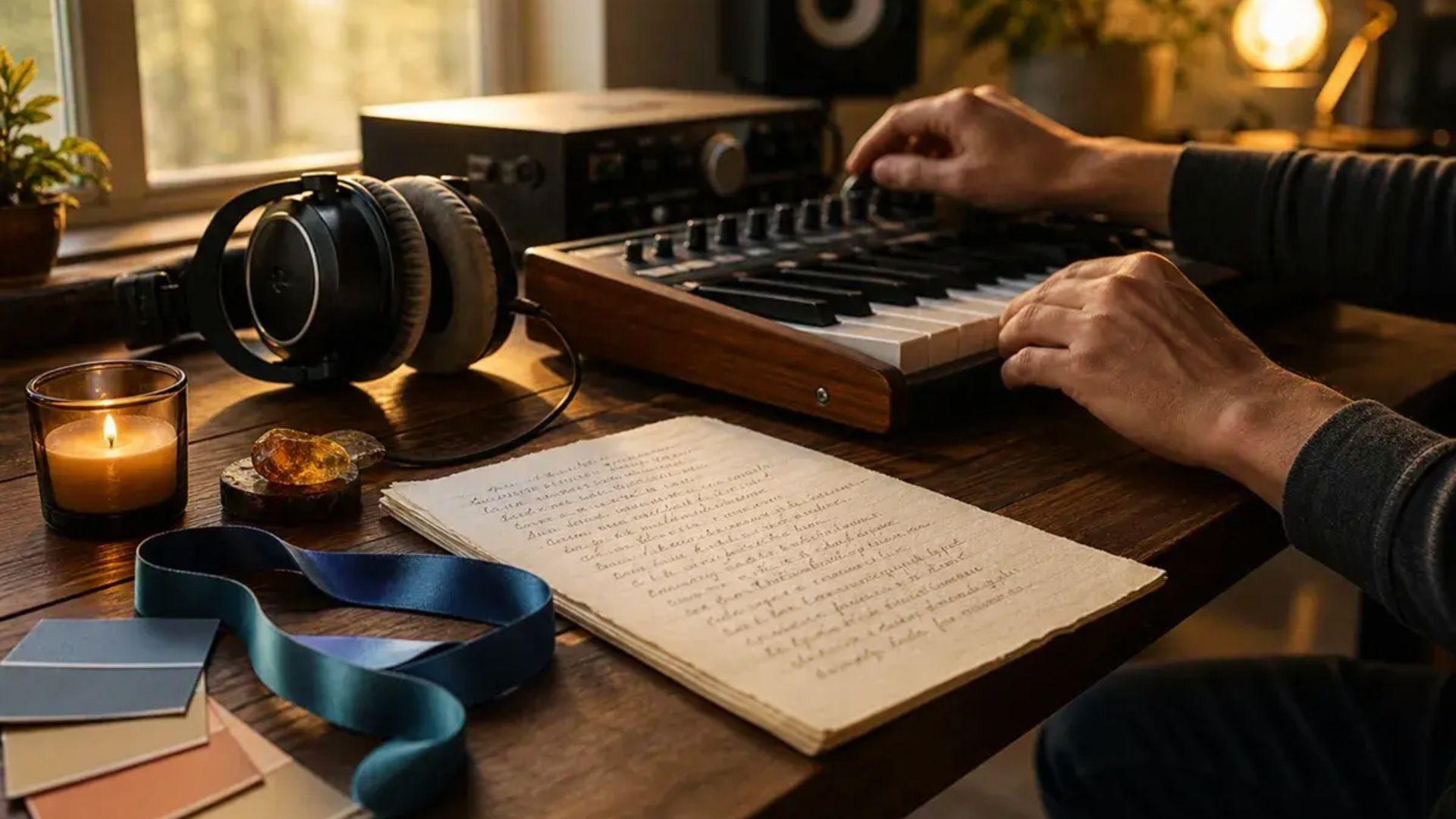
Dickinson studied piano as a young woman and had 107 pieces of published sheet music bound into a keepsake volume in the early 1850s, which helps explain why birds, instruments, and unseen sound run through her work.
Emily Dickinson’s short poems gather more of her compact verse, and the two below show how she treats music as a presence she can hear but not hold.
6. “Musicians Wrestle Everywhere” by Emily Dickinson
Dickinson wrote this poem around 1860, and a manuscript copy survives in a letter to Susan Dickinson held at Harvard’s Houghton Library.
The poem is built largely by elimination, as the speaker rules out what the sound is not before turning to what other people say it is. The speaker leaves the answer for heaven to settle.
Musicians wrestle everywhere—
All day—among the crowded air
I hear the silver strife—
And—walking—long before the morn—
Such transport breaks upon the town
I think it that “New Life”!
It is not Bird—it has no nest—
Nor “Band”—in brass and scarlet—drest—
Nor Tamborin—nor Man—
It is not Hymn from pulpit read—
The “Morning Stars” the Treble led
On Time’s first Afternoon!
Some—say—it is “the Spheres”—at play!
Some say that bright Majority
Of vanished Dames—and Men!
Some—think it service in the place
Where we—with late—celestial face—
Please God—shall Ascertain!
Credit: Emily Dickinson, “Musicians wrestle everywhere,” c. 1860 (manuscript text). First printed in an edited form in Poems, Second Series (Boston: Roberts Brothers, 1891).
7. “Split the Lark, and You’ll Find the Music” by Emily Dickinson
The poem sets up an experiment on a bird to find where its song lives, and I read the setup as a dare, since a split lark yields a bird, not a song.
Critics including Reeves (1959) and Cody (1971) have also read the lark as the poet herself, which turns the poem into a question about whether a listener can demand physical proof of an artist’s music.
Split the Lark — and you’ll find the Music —
Bulb after Bulb, in Silver rolled —
Scantily dealt to the Summer Morning
Saved for your Ear when Lutes be old.
Loose the Flood — you shall find it patent —
Gush after Gush, reserved for you —
Scarlet Experiment! Sceptic Thomas!
Now, do you doubt that your Bird was true?
Credit: Emily Dickinson, “Split the Lark, and you’ll find the Music.”
Jazz and Blues Poems by Hughes and Harper
The best-known poems about jazz and the blues are Langston Hughes’s “The Weary Blues” and Michael S. Harper’s “Dear John, Dear Coltrane.”
Each borrows from the music it honors, whether through blues repetition or a saxophonist’s refrain, and the two were written about four decades apart.
8. “The Weary Blues” by Langston Hughes
Hughes wrote this poem in 1925, and it won first prize in the poetry contest run by Opportunity magazine before becoming the title poem of his first book in 1926.
The poem is set on Lenox Avenue in Harlem, where the speaker hears a pianist play and sing deep into the night.
Hughes lets the singer’s own blues lyrics break into the narration, so the poem moves between a listener’s description and a performer’s voice, and its short, swaying lines and repeated phrases imitate the syncopation they describe.
Droning a drowsy syncopated tune,
Rocking back and forth to a mellow croon,
I heard a Negro play.
Down on Lenox Avenue the other night
By the pale dull pallor of an old gas light
He did a lazy sway. . . .
He did a lazy sway. . . .
To the tune o’ those Weary Blues.
With his ebony hands on each ivory key
He made that poor piano moan with melody.
O Blues!
Swaying to and fro on his rickety stool
He played that sad raggy tune like a musical fool.
Sweet Blues!
Coming from a black man’s soul.
O Blues!
In a deep song voice with a melancholy tone
I heard that Negro sing, that old piano moan—
“Ain’t got nobody in all this world,
Ain’t got nobody but ma self.
I’s gwine to quit ma frownin’
And put ma troubles on the shelf.”
Thump, thump, thump, went his foot on the floor.
He played a few chords then he sang some more—
“I got the Weary Blues
And I can’t be satisfied.
Got the Weary Blues
And can’t be satisfied—
I ain’t happy no mo’
And I wish that I had died.”
And far into the night he crooned that tune.
The stars went out and so did the moon.
The singer stopped playing and went to bed
While the Weary Blues echoed through his head.
He slept like a rock or a man that’s dead.
Credit: Langston Hughes, “The Weary Blues,” first published in Opportunity (May 1925); collected in The Weary Blues (New York: Alfred A. Knopf, 1926).
9. “Dear John, Dear Coltrane” by Michael S. Harper
Harper wrote this poem in 1966, a year before saxophonist John Coltrane died, and published it in 1970 as the title poem of a collection that was nominated for a National Book Award.
It is often read as an elegy even though Coltrane was alive when it was written.
Its refrain comes from Coltrane’s album A Love Supreme, recorded in December 1964 and released in 1965, and returns through the poem the way a theme returns in a jazz tune.
a love supreme, a love supreme
a love supreme, a love supreme
Sex fingers toes
in the marketplace
near your father’s church
in Hamlet, North Carolina—
witness to this love
in this calm fallow
of these minds,
there is no substitute for pain:
genitals gone or going,
seed burned out,
you tuck the roots in the earth,
turn back, and move
by river through the swamps,
singing: a love supreme, a love supreme;
what does it all mean?
Loss, so great each black
woman expects your failure
in mute change, the seed gone.
You plod up into the electric city—
your song now crystal and
the blues. You pick up the horn
with some will and blow
into the freezing night:
a love supreme, a love supreme—
Dawn comes and you cook
up the thick sin ‘tween
impotence and death, fuel
the tenor sax cannibal
heart, genitals, and sweat
that makes you clean—
a love supreme, a love supreme—
Why you so black?
cause I am
why you so funky?
cause I am
why you so black?
cause I am
why you so sweet?
cause I am
why you so black?
cause I am
a love supreme, a love supreme:
So sick
you couldn’t play Naima,
so flat we ached
for song you’d concealed
with your own blood,
your diseased liver gave
out its purity,
the inflated heart
pumps out, the tenor kiss,
tenor love:
a love supreme, a love supreme—
a love supreme, a love supreme—
Credit: Michael S. Harper, “Dear John, Dear Coltrane,” first published in Dear John, Dear Coltrane (University of Pittsburgh Press, 1970); reprinted in Songlines in Michaeltree: New and Collected Poems (2000). Copyright © 2000 by Michael S. Harper.
Modern Poems on Composers and City Sound

The two modern poems about music below treat it less as an event than as a way of seeing, one by asking what separates the composer from other artists and the other by turning a city into a love song.
10. “The Composer” by W. H. Auden
Auden wrote this sonnet in 1938, and it sets the composer apart from the painter and the poet.
As a Library of Congress Auden post notes, the poem may have been inspired by Benjamin Britten, with whom Auden collaborated on films, song cycles, and an operetta between 1935 and 1942.
I read it as a poet’s tribute to the one art that gets to skip translation.
All the others translate: the painter sketches
A visible world to love or reject;
Rummaging into his living, the poet fetches
The images out that hurt and connect.
From Life to Art by painstaking adaption,
Relying on us to cover the rift;
Only your notes are pure contraption,
Only your song is an absolute gift.
Pour out your presence, O delight, cascading
The falls of the knee and the weirs of the spine,
Our climate of silence and doubt invading;
You alone, alone, O imaginary song,
Are unable to say an existence is wrong,
And pour out your forgiveness like a wine
Credit: W. H. Auden, “The Composer” (1938).
11. “Juke Box Love Song” by Langston Hughes
This short poem belongs to Montage of a Dream Deferred (1951), a book-length sequence on Harlem life.
Hughes says in the book’s epigraph that the sequence, like bebop, is marked by broken rhythms and sudden shifts, which makes this one of its gentler moments, a place where the city’s noise becomes accompaniment instead of pressure.
I could take the Harlem night
and wrap around you,
Take the neon lights and make a crown,
Take the Lenox Avenue busses,
Taxis, subways,
And for your love song tone their rumble down.
Take Harlem’s heartbeat,
Make a drumbeat,
Put it on a record, let it whirl,
And while we listen to it play,
Dance with you till day—
Dance with you, my sweet brown Harlem girl.
Credit: Langston Hughes, “Juke Box Love Song,” from Montage of a Dream Deferred (New York: Henry Holt, 1951).
Rumi and the Mystical Side of Music
Rumi (1207 to 1273) wrote in Persian, so “Where Everything Is Music” reaches English readers through a translator, and the choice of version matters.
The widely shared text is Coleman Barks’s English rendering with John Moyne, and Barks worked from scholarly translations by Moyne, A. J. Arberry, and Reynold Nicholson, so the wording reflects his choices as much as Rumi’s.
In that version, music is less an event than a condition that surrounds us, one that continues even when the instruments are gone.
WHERE EVERYTHING IS MUSIC
Don’t worry about saving these songs!
And if one of our instruments breaks,
it doesn’t matter.
We have fallen into the place
where everything is music.
The strumming and the flute notes
rise into the atmosphere,
and even if the whole world’s harp
should burn up, there will still be
hidden instruments playing.
So the candle flickers and goes out.
We have a piece of flint, and a spark.
This singing art is sea foam.
The graceful movements come from a pearl
somewhere on the ocean floor.
Poems reach up like spindrift and the edge
of driftwood along the beach, wanting!
They derive
from a slow and powerful root
that we can’t see.
Stop the words now.
Open the window in the center of your chest,
and let the spirits fly in and out.
Credit: Rumi (1207 to 1273), “Where Everything Is Music,” translated by Coleman Barks with John Moyne, in The Essential Rumi (HarperOne).
Choosing Your Next Poem to Read
Poems about music tend to fall into three camps: those that treat music as a force acting on the world, like the Orpheus song, those that treat it as a memory, like Shelley’s, and those that borrow its rhythm to say something about a person or place, like Hughes’s and Harper’s.
Match the camp to your mood, and you will land on the right poem quickly. Pick one from this list and read it aloud twice, then notice how the second reading changes what you hear.
After that, take the song you cannot shake and write four lines about what it does to you.
If you want more contemporary poems, the Academy of American Poets collection sorts them by genre.
Frequently Asked Questions
What Are Some Poetic Words That Describe Music?
Poets often use cadence, lilt, timbre, and resonance for the sound itself, and euphony for a pleasing one, with cacophony and dissonance for harsh sound. More specialized choices include descant (a melody above the main tune), threnody (a song of mourning), and paean (a song of praise).
What Did William Shakespeare Say About Music?
Shakespeare opened Twelfth Night, written around 1602, with Duke Orsino asking his musicians to play on because music is the food of love. He wants so much of it that his appetite for love will sicken and die, but he tires of the music long before he tires of love.
What Did Victor Hugo Say About Music?
In William Shakespeare (1864), Hugo wrote that music expresses what cannot be said and what a person cannot stay silent about. English translations of the French differ slightly, so check the wording before you quote it.


