


If you love short, funny poems, you are in the right place. This article covers 15 classic limerick poem examples that readers of all ages enjoy.
You will learn what a limerick is, how the rhyme scheme works, and how to write one yourself. We have spent years studying poetry forms so you get clear, reliable information here.
We cover what a limerick is, why they are so popular, 15 classic examples with explanations, how to write your own, and clean vs. humorous limericks.
Let us get started.
What Is a Limerick Poem?

A limerick is a five-line poem that follows a set rhythm and rhyme pattern. It is almost always funny or silly, with the joke landing in the last line.
Limericks are short, punchy, and easy to remember. Most are about a person, place, or situation. The humor comes from wordplay, surprise, or absurdity.
Every limerick follows the AABBA rhyme scheme:
- Lines 1, 2, and 5 rhyme together (A)
- Lines 3 and 4 rhyme together (B)
The rhythm is called anapestic meter, which sounds like da-da-DUM. Lines 1, 2, and 5 are longer with three beats each. Lines 3 and 4 are shorter with two beats each. This gives limericks their bouncy, musical feel.
Why Limerick Poems Are So Popular
Limericks have been around for centuries. They remain popular for good reason. Here is a look at what keeps readers coming back to this simple poem form.
Humor and Wordplay
Most limericks are written to make you laugh. They use clever wordplay, silly situations, and surprise endings to deliver a punch. The joke lands in the final line, which is what makes the whole poem worth reading.
Good limericks feel playful. They twist words in ways you do not expect. That surprise is what makes them so satisfying.
Short and Easy to Remember
A limerick is only five lines long. You can read one in under 30 seconds. That makes them perfect for sharing with friends, posting online, or reciting from memory.
Because they rhyme and follow a set rhythm, they are also very easy to memorize. Kids and adults alike can recall good limerick days after reading it just once.
Wide Variety of Themes
Limericks are not limited to one topic.
They can be about:
- People and places
- Animals and nature
- Food and daily life
- Math and science
- Love, friendship, or frustration
This wide range of themes means there is a limerick for just about everyone. From silly nonsense to smart satire, the form holds it all.
15 Classic Limerick Poem Examples for Readers
Here are 15 of the most well-known limerick poems. Each one shows something different about this fun poetry form.
1. A Young Lady of Lynn – Anonymous

This is one of the oldest and most quoted limericks in English. It is short, silly, and perfectly structured.
Full Poem:
There was a young lady of Lynn,
Who was so uncommonly thin,
That when she essayed To drink lemonade,
She slipped through the straw and fell in.
Why it’s popular: The absurd ending is what makes this poem work. The image of someone slipping through a straw is ridiculous and funny.
It is a great example of how a limerick sets up a situation and then flips it completely in the last line.
2. There Was an Old Man with a Beard – Edward Lear
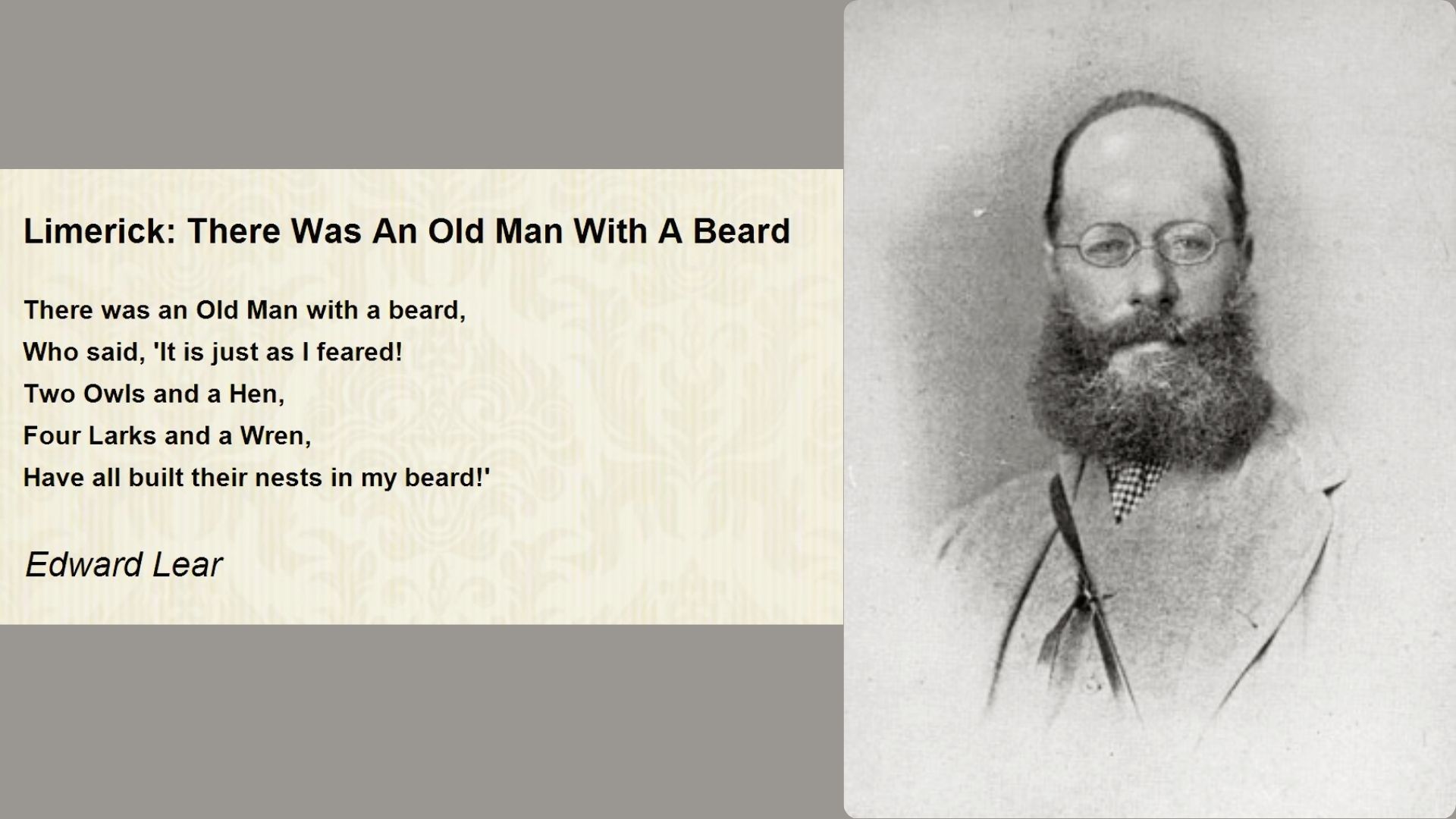
Edward Lear is often called the father of the modern limerick. He wrote hundreds of them in the 1800s and made the form famous worldwide.
Full Poem:
There was an Old Man with a beard,
Who said, “It is just as I feared!
Two Owls and a Hen, Four Larks and a Wren,
Have all built their nests in my beard!”
Key takeaway: Lear loved using animals and exaggeration. This poem shows his style clearly. The man is not upset.
He simply observes what happened with calm acceptance. That dry humor is what made Lear so beloved.
3. There Was an Old Person of Nice – Edward Lear

Poem Text:
There was an Old Person of Nice,
Whose associates were usually Geese.
They walked out together, In all sorts of weather,
That affable person of Nice.
What makes it memorable: This limerick is gentle and warm rather than sharp or biting. The word “affable” is a nice touch. It gives the subject a kind personality.
Lear often painted his characters as harmless and odd, and this poem is a perfect example of that.
4. There Was an Old Man on the Border – Edward Lear

Poem Text:
There was an Old Man on the Border,
Who lived in the utmost disorder.
He danced with the Cat, And made Tea in his Hat,
Which vexed all the folks on the Border.
Humor explanation: The comedy here comes from mixing the ordinary with the ridiculous. Dancing with a cat is strange. Making tea in a hat is even stranger.
But Lear presents it all with a straight face, which is what makes it funny. The neighbors are “vexed,” which adds a layer of social satire too.
5. There Was an Old Man of Thermopylæ – Edward Lear
Poem Text:
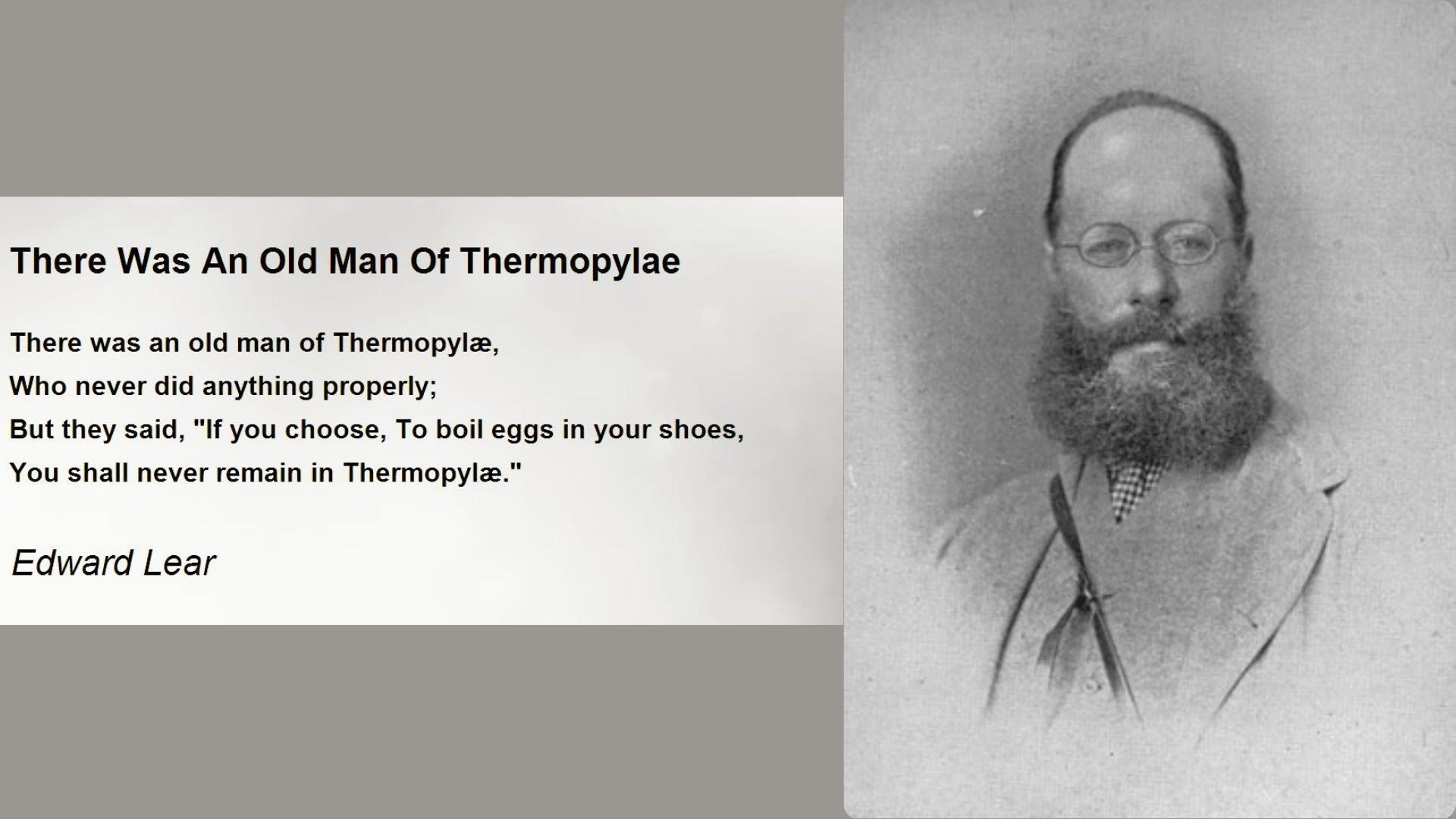
There was an Old Man of Thermopylæ,
Who never did anything properly.
But they said, “If you choose, To boil eggs in your shoes,
You shall never remain in Thermopylæ!”
Different elements: This poem plays with an unusual place name, Thermopylæ, and fits it into a rhyme scheme with skill.
The threat at the end is oddly formal, which adds to the humor. Lear was great at using location names for comic effect.
6. A Bridge Engineer, Mr. Crumpett – Anonymous
Poem Text:
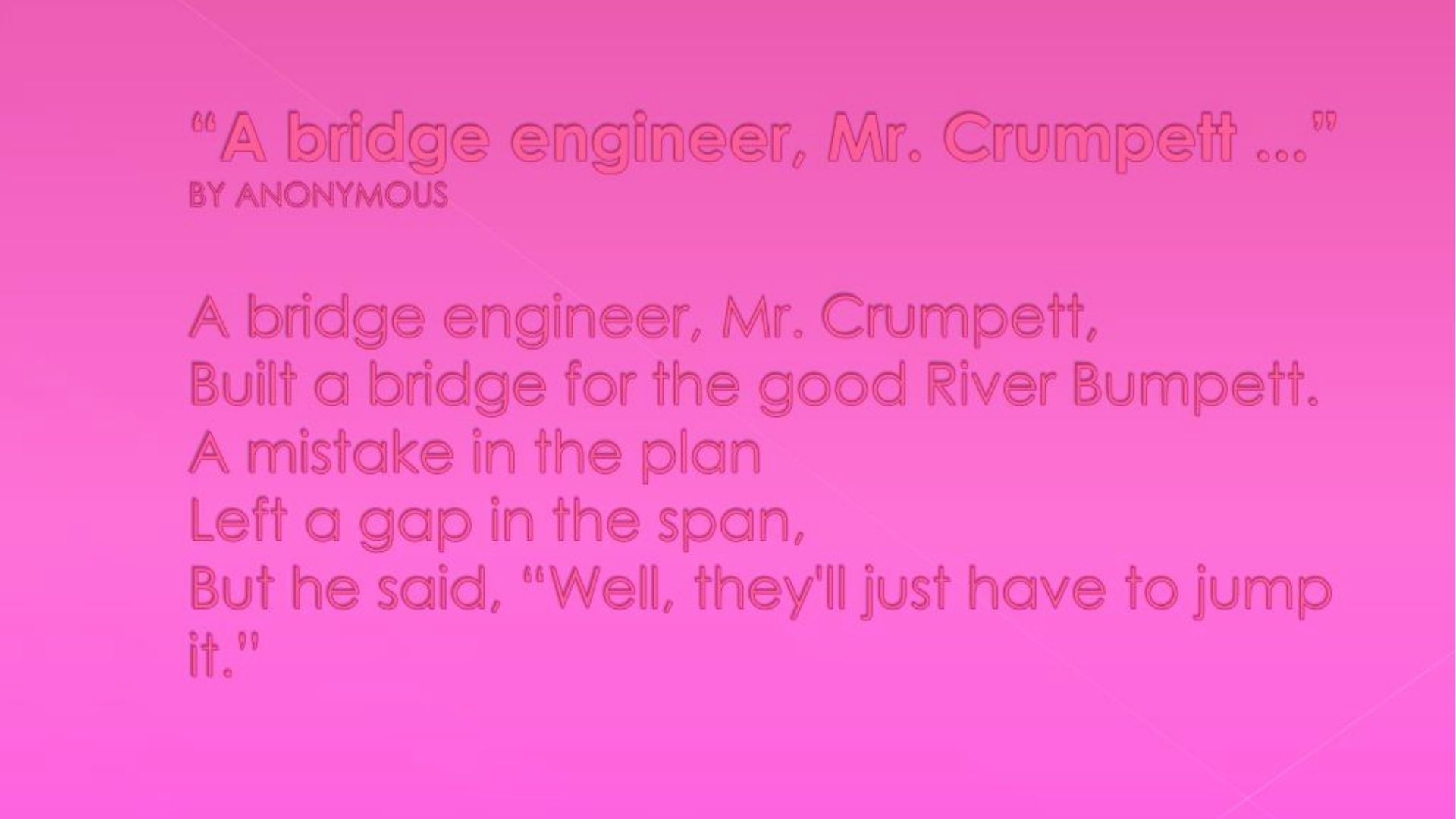
A bridge engineer, Mr. Crumpett,
Built a bridge for the good River Dumpett.
A mistake in the plan Left a gap in the span,
But he said, “Well, they’ll just have to jump it!”
Structural highlights: This limerick uses professional language to set up a practical joke. The rhyme between “Crumpett,” “Dumpett,” and “jump it” is clever and tight.
The engineer’s casual response to a major mistake is the punchline. It works because of how confident and unbothered the character sounds.
7. How Awkward When Playing with Glue – Constance Levy

Poem Text:
How awkward when playing with glue,
You find that your fingers are through.
Your hands stick together, Like birds of a feather,
And you cannot undo what you do.
Comic twist: Constance Levy wrote many poems for children, and this one shows her talent for relatable humor. Most kids have been in a sticky situation with glue.
The comparison to “birds of a feather” is both funny and fitting. The last line has a nice double meaning too, talking about glue and poor decisions at the same time.
8. A Dozen, a Gross, and a Score – Leigh Mercer

Poem Text:
A dozen, a gross, and a score,
Plus three times the square root of four,
Divided by seven, Plus five times eleven,
Is nine squared and not a bit more.
Clever mathematical wordplay: This is one of the most famous math limericks ever written. The entire poem is a hidden equation. When you work it out, the answer is 81, which is nine squared.
Leigh Mercer was known for combining language and numbers, and this poem is his best-known work. It rewards readers who love both words and math.
9. God’s Plan Made a Hopeful Beginning – Oliver Wendell Holmes Sr.

Poem Text:
God’s plan made a hopeful beginning,
But man spoiled his chances by sinning.
We trust that the story Will end in God’s glory,
But at present the other side’s winning.
Deeper meaning: This limerick moves beyond simple humor. It touches on theology and human nature. The final line delivers a wry observation about the state of the world.
Holmes uses the limerick form to say something meaningful without being heavy or preachy. It shows how versatile this poem style can be.
10. The Frequenters of Our Picture Palaces – Norman Douglas

Poem Text:
The frequenters of our picture palaces,
Have no use for this psycho-analysis.
And although Dr. Freud, Is distinctly annoyed,
They cling to their long-standing fallacies.
Satirical tone: Norman Douglas uses this limerick to poke fun at both moviegoers and psychology. The reference to Freud adds an intellectual layer.
The humor is dry and a little cutting. It shows that limericks can be used for social commentary as effectively as for silly jokes.
11. The Limerick Packs Laughs Anatomical – Roger Gordon

Poem Text:
The limerick packs laughs anatomical,
Into space that is quite economical.
But the good ones I’ve seen So seldom are clean,
And the clean ones so seldom are comical.
Commentary on limericks: This poem is a limerick about limericks. It makes a sharp observation about the form itself. Clean ones are rarely funny. Funny ones are rarely clean.
The poem is self-aware and honest, and that honesty is what makes it clever. It has become a famous piece of meta-poetry within the limerick world.
12. There Was a Young Lady of Exeter – Anonymous
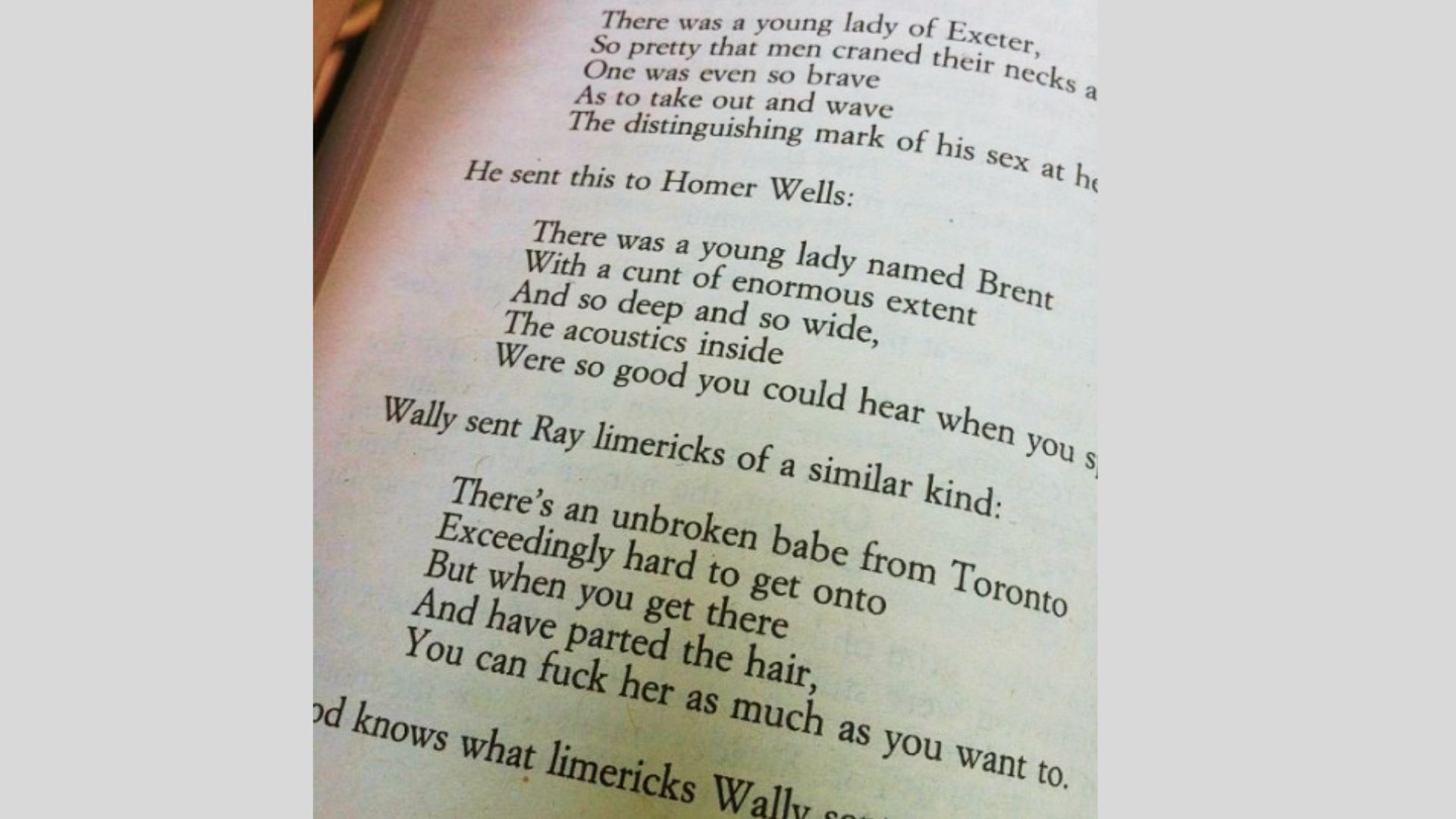
Poem Text:
There was a young lady of Exeter,
So pretty that men craned their necks at her.
One was even so brave, As to take out and wave,
The kerchief that he had in his pecks at her.
Classic humor style: This limerick uses an old-fashioned style of courtship to set up its joke. The made-up rhyme of “pecks at her” to match “Exeter” is a hallmark of the form.
The humor is mild and charming. It represents the classic anonymous limerick tradition that thrived in Victorian England.
13. There Once Was a Young Man Named Cyril – Anonymous

Poem Text:
There once was a young man named Cyril,
Who kept a pet bat in a barrel. It flew round at night,
Gave his mother a fright,
And the barrel now holds cassorel.
Absurd humor: This poem leans fully into nonsense. “Cassorel” is not a real word, which is part of the joke. The absurdity builds line by line until the ending makes no logical sense at all.
That is the point. Limericks that use invented words or illogical conclusions often land the hardest because they catch readers completely off guard.
14. The Thoughts of the Rabbit on Sex – Anonymous
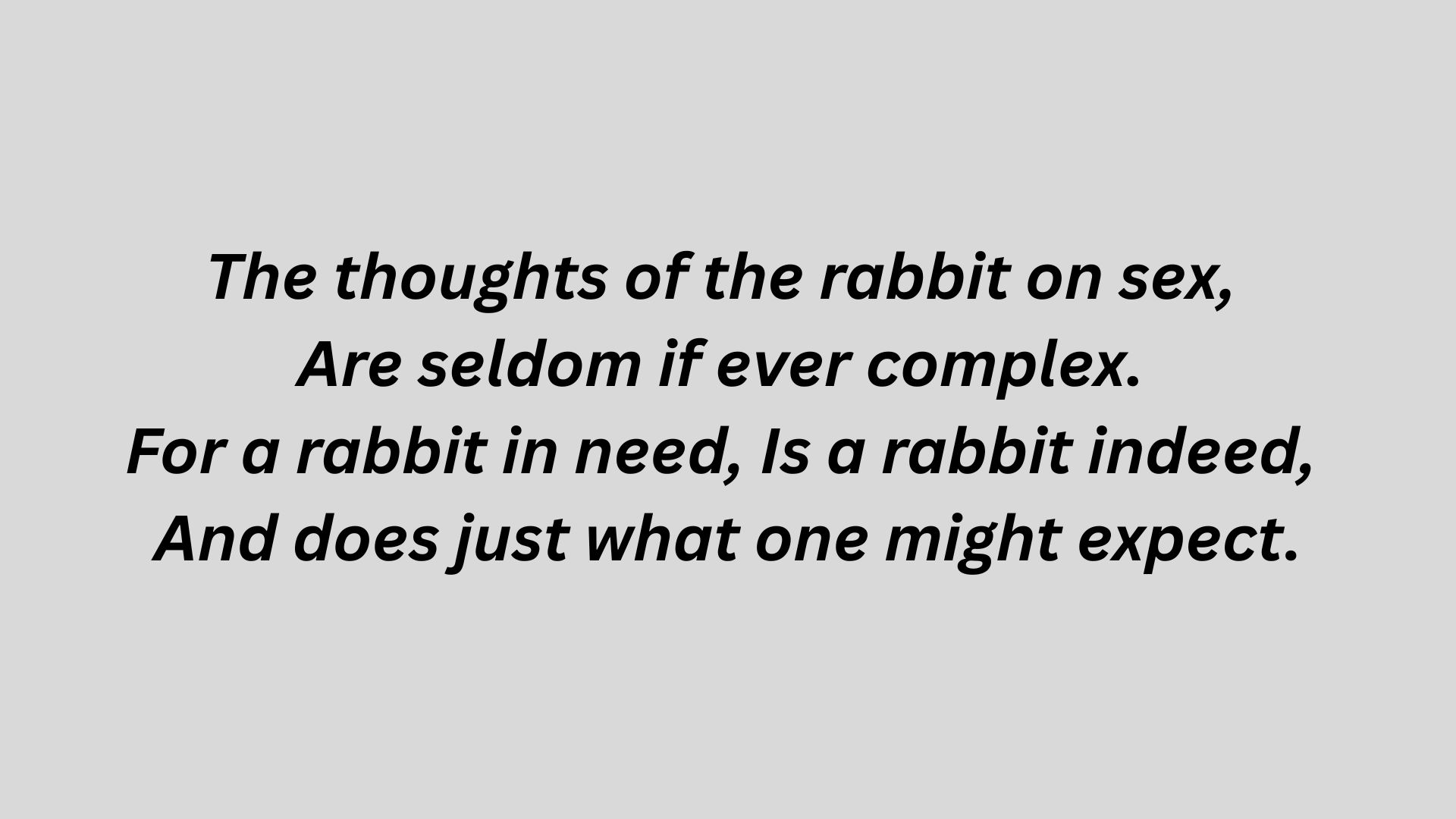
Poem Text:
The thoughts of the rabbit on sex,
Are seldom if ever complex.
For a rabbit in need, Is a rabbit indeed,
And does just what one might expect.
Simple but effective theme: This limerick works because it says a lot with very little. The humor is understated.
It builds through repetition of the word “rabbit” and ends with a line that confirms exactly what you were already thinking.
The restraint is what makes it work. Sometimes the best limerick is the one that does not try too hard.
15. I Met a Lewd Nude in Bermuda – Anonymous

Poem Text:
I met a lewd nude in Bermuda,
Who thought she was shrewd: I was shrewder.
She thought it was crude,
To be wooed in the nude, I pursued her, subdued her, and wooed her.
Advanced rhyme and rhythm: This limerick is a technical showcase. The poet fits six rhyming words into five lines without losing the rhythm. “Bermuda,” “shrewder,” “crude,” “nude,” “pursued,” “subdued,” and “wooed” all share the same sound.
The speed and flow of the poem are impressive. It is a great example of how skilled poets use the limerick form to show off wordcraft.
How to Write a Limerick Poem
Writing a limerick is one of the best ways to practice poetry. It has clear rules, so you always know where to start.
Step-by-Step Writing Process
Follow these steps to write your first limerick:
Step 1: Choose a subject. Pick a person, place, or thing.
Step 2: Write line 1. Introduce your subject. End with a word that is easy to rhyme.
Step 3: Write line 2. Add more detail. Rhyme with line 1.
Step 4: Write lines 3 and 4. Make them shorter. Rhyme with each other.
Step 5: Write line 5. This is your punchline. Rhyme with lines 1 and 2.
Step 6: Read it out loud. Fix the rhythm if it feels choppy.
That is the whole process. Practice a few and you will get the hang of it quickly.
Tips for Crafting a Strong Punchline
The last line is everything in a limerick.
Here is how to make it land:
- Surprise the reader. Do not telegraph the ending.
- Keep it short and sharp. Long punchlines lose their punch.
- Use wordplay when you can. Double meanings make endings feel smart.
- Read it aloud. If it makes you smile, it probably works.
A weak punchline makes the whole poem fall flat. Spend the most time on line 5.
Common Mistakes to Avoid
Even experienced writers make these errors with limericks:
Forcing the rhyme: Do not pick a word just because it rhymes. It has to make sense in context too.
Off-beat rhythm: If the syllable count is wrong, the poem loses its bounce. Count beats carefully.
Weak setup: Lines 1 and 2 need to build tension. If they are boring, the punchline will not land.
Over-explaining: Limericks are short for a reason. Trust the reader to get the joke.
Clean vs. Humorous Limerick Poems
Not all limericks are the same. Clean limericks work great in classrooms and family settings. Edward Lear’s poems are the best example. They focus on silly situations, animals, and lighthearted wordplay.
Playful adult limericks have been around for centuries. The short length, bouncy rhyme scheme, and surprise endings make the form a natural fit for risque humor. Same structure, very different punch.
Conclusion
Limericks are one of my favorite poetry forms. They are quick, fun, and surprisingly tricky to write well. I remember the first time I tried writing one. I spent 20 minutes on the last line alone. But when it clicked, it felt great.
I hope these 15 examples gave you something to enjoy and learn from. Now it is your turn. Try writing one today, even a silly one about your pet or your morning coffee.
Leave a comment below with your limerick. I would love to read it. Share this post if it helps you.
Frequently Asked Questions
What is the AABBA rhyme scheme in a limerick?
The AABBA scheme means lines 1, 2, and 5 rhyme together while lines 3 and 4 share a different rhyme. This pattern gives the limerick its rhythm and structure.
Who invented the limerick poem?
No single person invented the limerick, but Edward Lear made it widely popular in the 1800s. His book of nonsense verse introduced the form to readers around the world.
Can limericks be used for serious topics?
Yes, limericks can carry serious or thoughtful messages. Oliver Wendell Holmes Sr. wrote one about theology that shows the form can handle deeper ideas while still staying light in tone.
How long should a limerick be?
A limerick is always five lines long. Lines 1, 2, and 5 are longer, while lines 3 and 4 are shorter. This length is part of what makes the form so compact and effective.
Are limericks suitable for children?
Many limericks are perfectly fine for children. Edward Lear’s poems are a great starting point for young readers. However, some anonymous limericks contain adult humor and are meant for grown-up audiences only.