Looking for Elisabeth Elliot quotes that say something more than just a nice-sounding line? Most quote lists give you a collection of words without much context.
Elliot wrote about faith, suffering, obedience, and love after facing some of the hardest experiences of her life.
She came across an old poem called "Do the Next Thing", traced back to an ancient Saxon poem and it shaped the way she approached obedience in everyday life.
Her words reflect what she believed about trusting God through loss, uncertainty, and everyday struggles.
Here are Elisabeth Elliot quotes, organized by theme: trust, suffering, daily obedience, and love. Each section makes it easier to find the quotes that fit what you're looking for.
Who Was Elisabeth Elliot, and Why Do Her Quotes Carry Weight?

Elisabeth Elliot (1926–2015) was an American missionary, author, and speaker who wrote about faith, suffering, and trusting God through hardship.
She spent years as a missionary in Ecuador. Her first husband, Jim Elliot, was killed by the very tribe he was trying to reach and she went back to live among that same community anyway.
That's the story behind her words. She also lost a second husband to cancer later in life. So when she wrote about pain, surrender, and trusting God, it wasn't theory. It came from someone who had actually lived it.
That's why her quotes still land with people today. There's real weight behind them.
Elisabeth Elliot Quotes by Theme
Elisabeth Elliot's quotes fall into four recurring themes: trusting God's will, enduring suffering, daily obedience, and love and marriage because these were the questions she wrote and spoke about for over five decades, first as a young missionary widow and later as an author and radio host.
On God's Will and Trust

Elisabeth Elliot's quotes on trust centre on one idea: God's will doesn't need to make sense to be trustworthy. This was the theme she returned to more than any other: trusting God even when His plans make no sense at the moment.
- On surrendering the outcome: "God is God. Because He is God, He is worthy of my trust and obedience."
- On expectations vs. reality: "The will of God is never exactly what you expect it to be."
- On what love for God looks like: "To love God is to love His will."
- On courage in obedience: "The heart set to do the Father's will need never fear defeat."
- On the root of anxiety: "Fear arises when we imagine that everything depends on us."
- On the two things that can't coexist: "Worry is the antithesis of trust. You simply cannot do both."
- On disguised disobedience: "A whole lot of what we call struggling is simply delayed obedience."
- On what restlessness actually costs you: "Restlessness and impatience change nothing except our peace and joy."
- On being held through anything: "You are loved with an everlasting love. And underneath are the everlasting arms."
- On the unseen effect of prayer: "Things happen which would not happen without prayer."
- On provision: "God has promised to supply all our needs."
- On trustworthiness: "The man whose eye is single for the glory of Another can be trusted."
- On living for something bigger: "There is nothing worth living for, unless it is worth dying for."
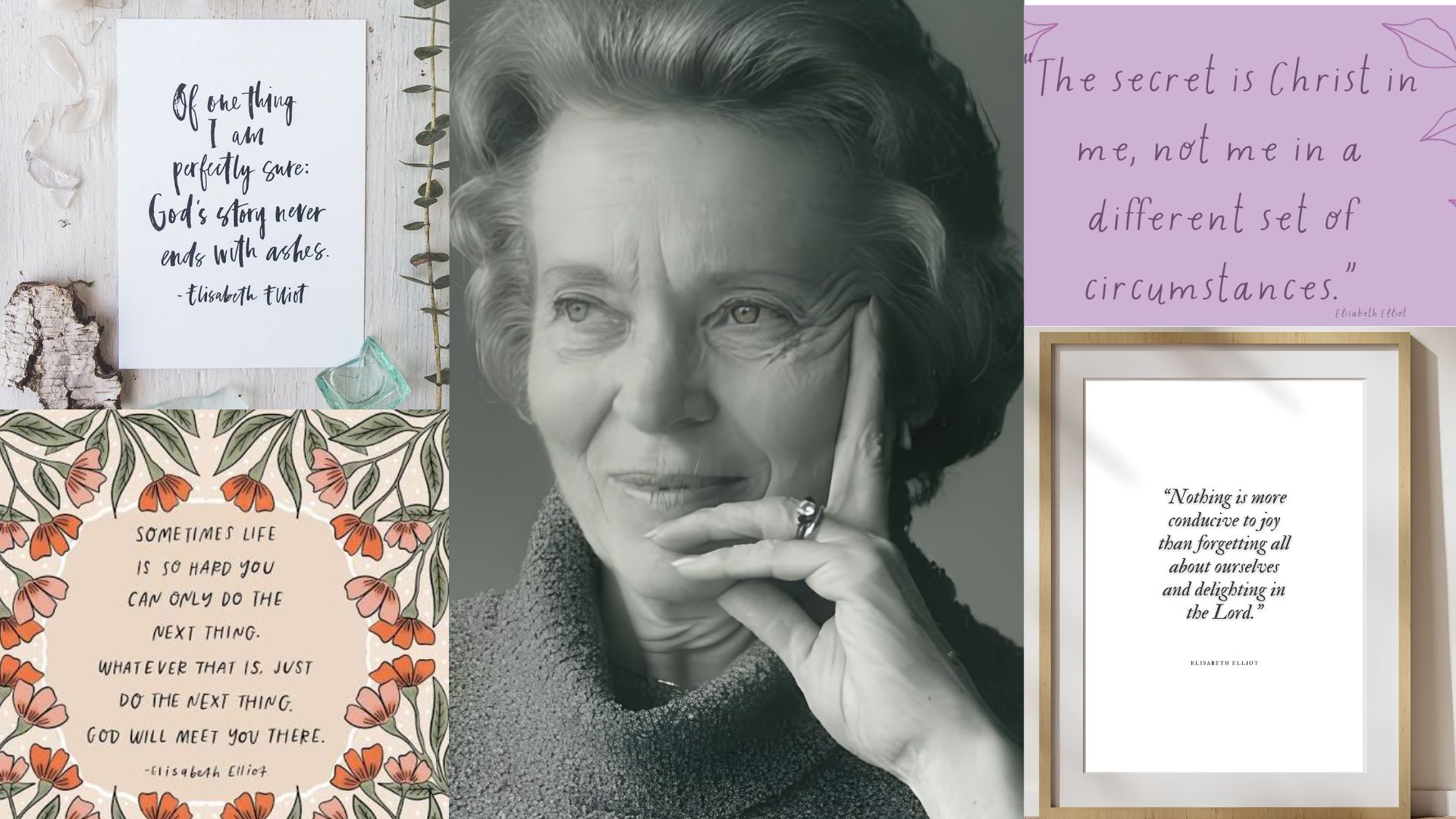
- On the ending of the story: "Of one thing I am perfectly sure: God's story never ends with ashes."
- On stillness as a discipline: "The world is full of noise. Might we not learn silence?"
- On the core conviction of her life: "Suffering is never for nothing."
- On not needing your exact story: "There have been some hard things in my life, as in yours."
- On pain as a shared condition: "Pain is necessary to all of us."
- On reframing what feels like rejection: "Sometimes God's refusals are His mercies."
- On loneliness itself: "Lonely? Give it to Jesus. The loneliness itself is material for sacrifice."
- On where her deepest knowledge of God came from: "The deepest things I have learned have come from the deepest suffering."
- On suffering's purpose: "There is in fact no redemptive work done anywhere without suffering."
- On what comfort actually stunts: "If all struggles were eliminated, the spirit would never reach maturity."
- On being shaped by trials: "God uses our trials to shape us into His image."
- On dependence: "Through suffering, we learn to depend on God."
- On where suffering and love meet: "It's only in the cross that we can harmonise suffering and love."
- On using pain instead of just surviving it: "The Christian does not simply endure suffering; he uses it."
- On not having every answer: "I know the One who knows."
- On transformation: "He can transform something terrible into something wonderful."
- On feeling unmoored: "We are not adrift in chaos."
- On pacing endurance: "Perseverance is not a long race — it is many short races."
- On protection you won't get: "God will not protect you from anything that will make you more like Jesus."
- On love's staying power: "Love bears all things and endures all things."
- Her most famous phrase: "Do the next thing."
- On the payoff of obedience: "Obedience is the surest, fastest path to my greatest joy."
- On not undercutting your own prayers: "Does it make sense to pray for guidance and then steer your own ship?"
- On measuring love honestly: "The measure of our love for God is the measure of our obedience."
- On ordinary labor: "Work is a blessing."
- On why routine isn't the enemy: "Routine is a good thing. It frees the mind for what matters."
- On starting badly: "There is nothing worth doing that is not worth doing badly at first."
- On what obedience proves: "Obedience to God is the most infallible evidence of sincere love to Him."
- On reframing the job in front of you: "This job has been given to me to do. Therefore, it is a gift."
- On withheld things: "God never withholds from His child what His love and wisdom call good."
- On her stated life goal: "The goal of my life is to consent to God's will."
- On what surrender produces: "A surrendered life is a life of peace and joy."
- On doing the next thing without gritted teeth: "Discipline yourself to do the next thing with grace."
- On what marriages actually need: "No marriage can survive without forgiveness."
- On the cost of real love: "Love means self-giving. Self-giving means sacrifice."
- On motherhood shaping the mother too: "The process of shaping the child shapes also the mother herself."
- On maturity: "Maturity starts with the willingness to give oneself."
- On embracing the calling fully: "If our calling is to be mothers, let's be mothers with all our hearts."
- On what love isn't: "Love is not possessive."
- On the strongest teacher: "Nothing trains and teaches so powerfully as love."
- On identity before role: "The fact that I am a Christian makes me a different kind of woman."
- On marriage's weight: "A wedding is a celebration of marriage, ordained by God."
On Suffering and Endurance

Elisabeth Elliot’s quotes on suffering come from real pain and loss. She didn’t shy away from how hard suffering can be, but she also found faith and hope in the middle of it.
On Daily Obedience and Work

Elliot's most practical quotes live here less theology, more instruction for the next hour of your day.
A Few Quotes on Love, Marriage, and Motherhood
Elliot wrote less here than on suffering, but what she said was direct, love as sacrifice, not sentiment.
Final Thoughts
Elisabeth Elliot's quotes are worth more than a quick read. They come from real loss, real faith, and a life that didn't take the easy road.
Pick one that speaks to where you are right now and actually sit with it.
If this helped you, share it with someone who might need it today. And if you want to go deeper, check out her books. The quotes are just the beginning.
Frequently Asked Questions
What is Elisabeth Elliot's most famous quote?
Her most celebrated quote is about doing the next thing the idea that when life feels overwhelming, you simply focus on and complete the immediate task in front of you.
What is Elisabeth Elliot's 80/20 Rule?
Elisabeth Elliot is not widely associated with an "80/20 rule" this principle is generally attributed to economist Vilfredo Pareto, and there is no well-known connection between it and Elliot's teachings or writings.
What Is Elisabeth Elliot's Best Book?
Her best and most celebrated book is Through Gates of Splendor (1957), which recounts the story of her husband Jim Elliot and four other missionaries killed by the Waorani tribe in Ecuador.