

You typed a line you heard at a funeral into a search bar, and now three pages are showing you three completely different poems. Same title, different words, different authors, and you’re not sure which one belongs to the moment you’re trying to honour.
That’s the quiet frustration sitting behind the Don’t Cry for Me poem, and it happens because several writers have used the same title.
The poems that carry this title share one voice: the person who died speaks directly to you, one last time.
Here, you’ll find out who actually wrote which version, how to tell them apart, and what the poem is really asking of the people left behind.
Who Wrote the “Don’t Cry for Me” Poem?
No one person wrote it, because there isn’t just one poem. At least six different poems share the title “Don’t Cry for Me,” and credits drift from page to page until a name ends up on the wrong text.
I found one compilation page that prints Deborah Garcia Gaitan’s name above a nature-themed poem she did not write. The title is simply shared.
The heaven version, the one search results show first, is credited to Deborah Garcia Gaitan. Family Friend Poems lists it as published in September 2015 with the author’s permission. That is the strongest credit available, because it comes with a date and a permission note.
If you need additional options beyond this one, a wider collection of sympathy poems for funerals covers many tones and lengths.
Others are credited to Ravi Sathasivam, Jon M. Nelson, David Ritter and Heather Robinson. Some widely shared versions have no confirmed author at all, appearing on funeral home pages and social media simply labelled anonymous.
“Anonymous” does not mean free to use. An unknown author is still an author, and a printed programme or an online tribute is still a copy of their work.
How to Tell the Versions Apart
| Version | Credited author | Where the credit appears | What it sounds like |
| Heaven version | Deborah Garcia Gaitan | Family Friend Poems, September 2015, with permission | Heaven, angels, Jesus, reunion |
| Farewell to a partner | Ravi Sathasivam | Poem Hunter, his own member page | A long goodbye after illness; asks a partner to live on happily |
| Legacy version | Jon M. Nelson | Poem Hunter | Asks loved ones to celebrate what he tried to build |
| Candle version | Commonly credited to Christy Ann Martine [VERIFY] | Reposts on poetry-sharing sites | Short; “still by your side”, light a candle |
| Unsigned versions | No confirmed author | Funeral director pages, video readings | Varies from page to page |
If the line you remember says “do not weep” rather than “don’t cry,” you may be after Colin Ian Jeffery’s poem instead.
Full Text of the Don’t Cry for Me Poem
This is the heaven version of the poem, credited to Deborah Garcia Gaitan and first published by Family Friend Poems in September 2015. It is the version most search results show for this title.
Don’t cry for me. I will be okay.
Heaven is my home now, and this is where I’ll stay.
Don’t cry for me. I’m where I belong.
I want you to be happy and try to stay strong.
Don’t cry for me. It was just my time,
but I will see you someday on the other side.
Don’t cry for me. I am not alone.
The angels are with me to welcome me home.
Don’t cry for me, for I have no fear.
All my pain is gone, and Jesus took my tears.
Don’t cry for me. This is not the end.
I’ll be waiting here for you when we meet again.
What Themes Run Through the Don’t Cry for Me Poem?
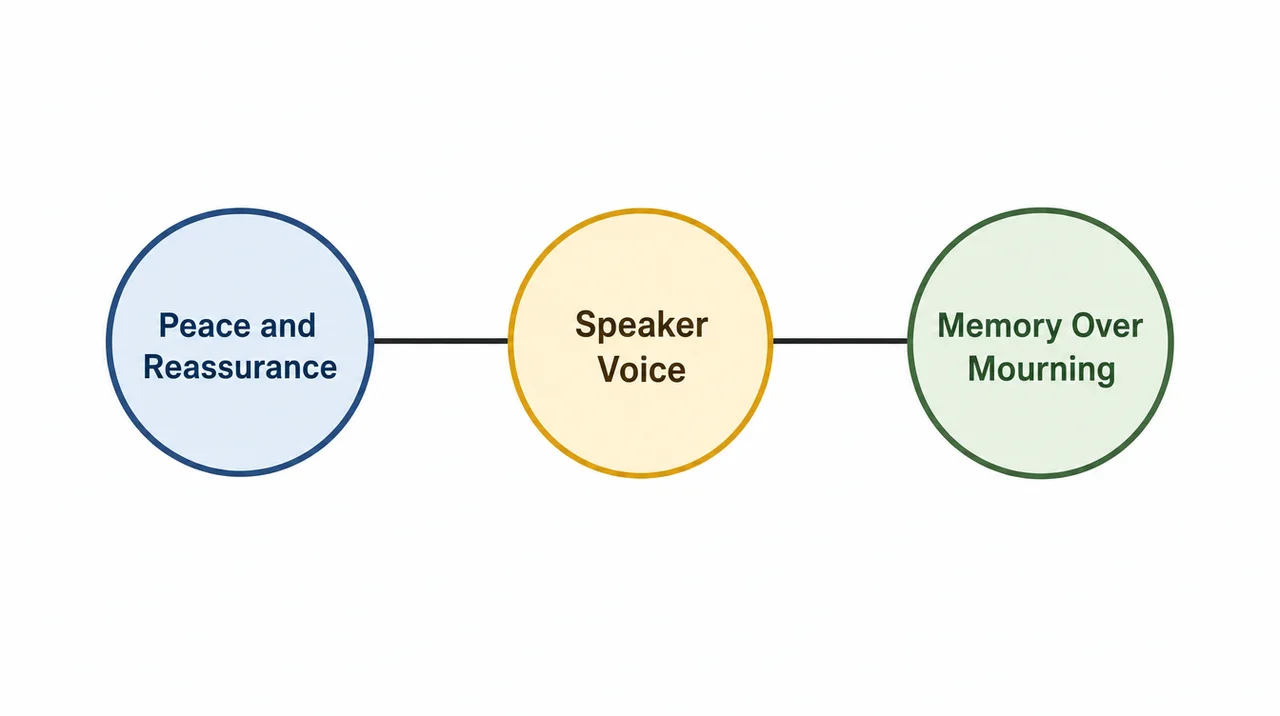
Most versions of the Don’t Cry for Me poem carry the same core message: I am at peace, and I want you to be okay. At least one Poem Hunter version turns the line around and tells mourners who stayed away not to cry now, so read the whole text before you choose it.
Peace and Reassurance
The speaker tells you something specific: the pain is gone, the struggle is over, and they are okay. That’s the part grieving people most need to hear, and the poem says it plainly without dressing it up.
Heaven versions frame it as arriving somewhere safe, whole, and welcomed. Presence versions frame it differently: the person hasn’t left, they’re still close by, still with you. The wording differs, but the reassurance lands in the same place: don’t carry worry for me on top of your grief.
Memory Over Mourning
The title repeats like an instruction, but the poem gives a reason each time: the speaker is safe and wants you to be happy. What it asks for is a slow shift: from missing them to remembering them, from grief that hurts to grief that softens.
It nudges you toward smiling when something reminds you of them, holding the good memories close, carrying them with you rather than just feeling the absence.
That movement, from grief that hurts to grief you can live with, is where most versions of this poem point.
Why Does the Poem Comfort People in Grief?
Mostly because of the first-person voice. Hearing “I” from the person who died can feel like a last message, even though everyone in the room knows it isn’t.
The line reads like an order, but in context it works as reassurance. The legacy and candle versions also ask to be remembered, which leaves room for tears alongside the comfort.
It doesn’t work the same for everyone. A heaven-focused version can be a real comfort if you believe in heaven. If you don’t, the candle or “still by your side” versions may sit better. And soon after a death, some people find any poem too much. That’s normal. You don’t have to use one.
How to Use the Don’t Cry for Me Poem at a Funeral or in a Card
Like any funeral poem, it works best when you start with where the words will end up. Reading aloud, printing in a programme and writing in a card are three different situations.
- Time it out loud first: Longer versions can run past your plan, and grief makes readers rush.
- Choose the steadiest voice: That isn’t always the closest relative. Someone very close may not get through it, and that’s okay.
- Pause between stanzas: It gives the reader and the room a chance to breathe.
- Credit it correctly: Print the author’s name under the title. If your version has no confirmed author, write “Author unknown” rather than guessing a name.
- Ask before you print: A funeral programme or a memorial page is a copy of the poem, so check permission with the author or the site that published it.
- For a card, keep it short: Two to four lines are usually enough. Adding a line of your own often makes it feel more personal than the whole poem would.
Closing thoughts
The Don’t Cry for me poem has so many versions, I think, because grieving people kept writing the one they needed and couldn’t find.
Keep that in mind if no copy fits your person quite right. Read the closest one, credit it honestly, and add a line only you could write.
A true name and one true line of your own often land harder than a flawless copy. Have a version you can’t place? Paste a line in the comments, and I’ll help you trace it.
If the words you remember are about being free rather than being in heaven, you may be thinking of a different farewell poem that opens with a similar line. Have a version you can’t place? Paste a line in the comments, and I’ll help you trace it.
Frequently Asked Questions
Is There a Poem That Says “Don’t Cry for Me When I Am Gone”?
I couldn’t trace a single poem with that exact title to a named author. The line turns up inside several poems instead. Jon M. Nelson’s “Don’t Cry For Me” closes by asking loved ones not to cry after he’s gone, and “A Silent Tear,” shared on the Sue Ryder bereavement forum, uses a close variant. Searching the full line in quotation marks is the fastest way to find yours.
Which Bible Verse Says “Don’t Cry for Me”?
Luke 23:28 is the closest. On the road to the crucifixion, Jesus tells the women weeping for him to weep for themselves and their children instead. Most translations say “weep not for me” or “do not weep for me,” while some modern ones, such as The Message and the Good News Translation, use “don’t cry for me.”
What Poem Is Often Read at Funerals?
Three common choices share the same speaking-from-beyond voice. “Do Not Stand at My Grave and Weep” is usually credited to Mary Elizabeth Frye. Christina Rossetti’s sonnet “Remember” was published in 1862 in Goblin Market and Other Poems. Henry Scott Holland’s “Death Is Nothing at All” comes from one of his sermons.
What’s the Saddest Poem Ever Written?
No poem holds that title, because what feels saddest depends on your own loss. Elegies such as Tennyson’s “In Memoriam A.H.H.,” written after the death of his friend Arthur Henry Hallam, are a common answer, but the honest answer is that it’s personal.