

I first came across Charles Bukowski on a quiet evening, flipping through a book of poetry quotes. One line stopped me:
“If it doesn’t come bursting out of you in spite of everything, don’t do it.”
It felt blunt, almost rude, but there was something honest about it too. It didn’t tell me how to become a writer. It told me when not to bother.
I wanted to know who wrote it, so I looked up Bukowski. That search led me to the full poem, and then to the other Bukowski poems I still reread today.
The more I read, the more I noticed the same thing: he said hard things plainly, and somehow that made them easier to trust.
Charles Bukowski wrote thousands of poems about ordinary life, loneliness, love, work, drinking, death, failure, and the struggle to keep going.
His poetry is known for its plain language, free verse, dark humour, and autobiographical feel. What I like most is how he takes an everyday moment and makes it feel personal.
Below are seven of the most notable Charles Bukowski poems, each with a short excerpt, its themes, and what it means. A poem rarely has one fixed meaning, so I’ll leave room for your own reading too.
Who Was Charles Bukowski?
Charles Bukowski was a German-American poet, novelist, and short-story writer tied closely to Los Angeles and its working-class life.
He was born in Germany in 1920 and brought to the United States at age two. He spent years in low-paying jobs, including more than a decade at the U.S. Postal Service.
His first book of poems, Flower, Fist, and Bestial Wail, came out in 1959. In 1969, publisher John Martin of Black Sparrow Press offered him $100 a month to quit the post office and write full time. Bukowski said yes. He died of leukaemia in 1994, but new books of his poems kept coming out for years.
His writing came straight from his own life: drinking, women, loneliness, hard jobs, money trouble, failure, ageing, and brief moments of pleasure. That is why his poems feel so personal. He turned ordinary days into poetry.
6 Bukowski Poems Worth Reading

These seven Charles Bukowski poems offer a useful starting point for understanding the different sides of his work, from vulnerability and loneliness to creativity, resilience, and social decline.
For each poem, you’ll find a short excerpt, its main themes, and a plain-English explanation of what Bukowski is exploring.
If you’re looking for a particular kind of Bukowski poem- something about writing, love, loneliness, hope, ambition, or the passage of time the themes beneath each title can also help you find the poem that best matches what you want to read.
1. Bluebird
“there’s a bluebird in my heart that
wants to get out
but I’m too tough for him,
I say, stay in there, I’m not going
to let anybody see
you…”
Themes: Vulnerability · Emotional restraint · Loneliness
Meaning:“Bluebird” is one of Bukowski’s most personal poems. The bluebird stands for a softer part of the speaker that he hides from other people.
He admits this side exists, but he has built a tough shell around it. He only lets the bird out at night, when everyone else is asleep.
He doesn’t pretend the tenderness is gone. He keeps it locked away, and that tension gives the poem its power.
I like this poem because it shows a quieter Bukowski. The last lines turn to the reader with a simple question, and that small move pulls you right into the poem.
Under the rough language and hard-man image, there is someone still capable of real tenderness.
2. The Laughing Heart
“your life is your life
don’t let it be clubbed into dank submission.
be on the watch.
there are ways out.
there is a light somewhere.
it may not be much light but
it beats the darkness.
be on the watch…”
Themes: Hope · Choice · Resilience
Meaning:“The Laughing Heart” is about taking charge of your life, even when things are hard. Bukowski urges the reader not to give in to darkness or disappointment.
The poem says there is still a chance for something better, but you have to notice it and act on it.
It never promises that life will get easy. What it offers is smaller and easier to believe: some control over where you go next.
He even admits the light he describes may not be much. It reads like advice from a friend, and it sits well beside other poems about self-worth people turn to in hard times.
What I like most is that the hope never feels polished. It sounds like it comes from someone who knows disappointment well and still believes life can change.
3. Roll the Dice
“If you’re going to try, go all the way.
otherwise, don’t even start.
if you’re going to try, go all the
way. this could mean losing girlfriends,
wives, relatives, jobs and
maybe your mind…”
Themes: Commitment · Risk · Persistence
Meaning:“Roll the Dice” treats creative work and ambition as things that demand everything you have.
Bukowski is honest about the cost. You might lose people, jobs, comfort, and even some of your peace of mind.
The poem speaks to anyone who has started a hard project or tried to build a life around creative work. Its message is simple: half an effort won’t get you there.
The risks are real, but so is the cost of never trying. Yet the ending turns almost joyful. It promises laughter at the end of the struggle and calls it the only fight worth having.
4. So You Want to Be a Writer?
“If it doesn’t come bursting out of you
in spite of everything,
don’t do it.
unless it comes unasked out of your
heart and your mind and your mouth
and your gut,
don’t do it…”
Themes: Writing · Honesty · Creativity
Meaning:“So You Want to Be a Writer?” questions the idea of writing just because you want to be called a writer.
Bukowski says real writing comes from an inner need. Wanting fame, status, or a literary image is the wrong reason to start.
The poem also pushes back against forced creativity. If writing has to be dragged out of you, Bukowski says it may be better to stop and wait.
Most of the poem repeats the same flat refusal, line after line. Because of that, the few lines of encouragement near the end hit much harder.
This is the poem that started it all for me, and it’s still my favourite. Its advice reaches beyond writing. It asks whether something really matters to you before you spend your life chasing it.
5. Alone with Everybody
“the flesh covers the bone
and they put a mind
in there and
sometimes a soul,
and the women break
vases against the walls
and the men drink too much
and nobody finds the
One
but keep
Looking
crawling in and out of beds…”
Themes: Loneliness · Human connection · Isolation
Meaning:“Alone with Everybody” looks at what it means to be surrounded by people and still feel completely alone. The poem moves through relationships, physical desire, and conflict.
Then it ends with a list of places that keep filling up, from junkyards to hospitals to graveyards. Under all of it runs a steady sense of separation.
For Bukowski, loneliness doesn’t only happen when you’re by yourself.
You can have relationships, conversations, and closeness and still feel cut off. The title says it best: being “with everybody” doesn’t mean you belong.
6. Dinosauria, We
“Born like this
Into this
As the chalk faces smile
As Mrs. Death laughs
As the elevators break
As political landscapes dissolve
As the supermarket bag boy holds a college degree
As the oily fish spit out their oily prey
As the sun is masked
We are
Born like this…”
Themes: Civilization · Social decline · Fear
Meaning:“Dinosauria, We” moves past personal struggles to look at society itself.
It pictures a civilisation heading toward ruin while people carry on as if nothing is wrong.
The dinosaur image suggests a species stuck in its own habits and unable to stop its decline. War, greed, violence, and social decay all feed the poem’s dark mood.
The poem also asks a hard question: what happens when people see the problems clearly and still refuse to change?
It closes on a strange quiet after the destruction, with the sun still hidden and waiting for what comes next. That ending leaves a thin thread of hope inside one of his bleakest poems.
What Makes Bukowski’s Poetry Different From Other Poets?
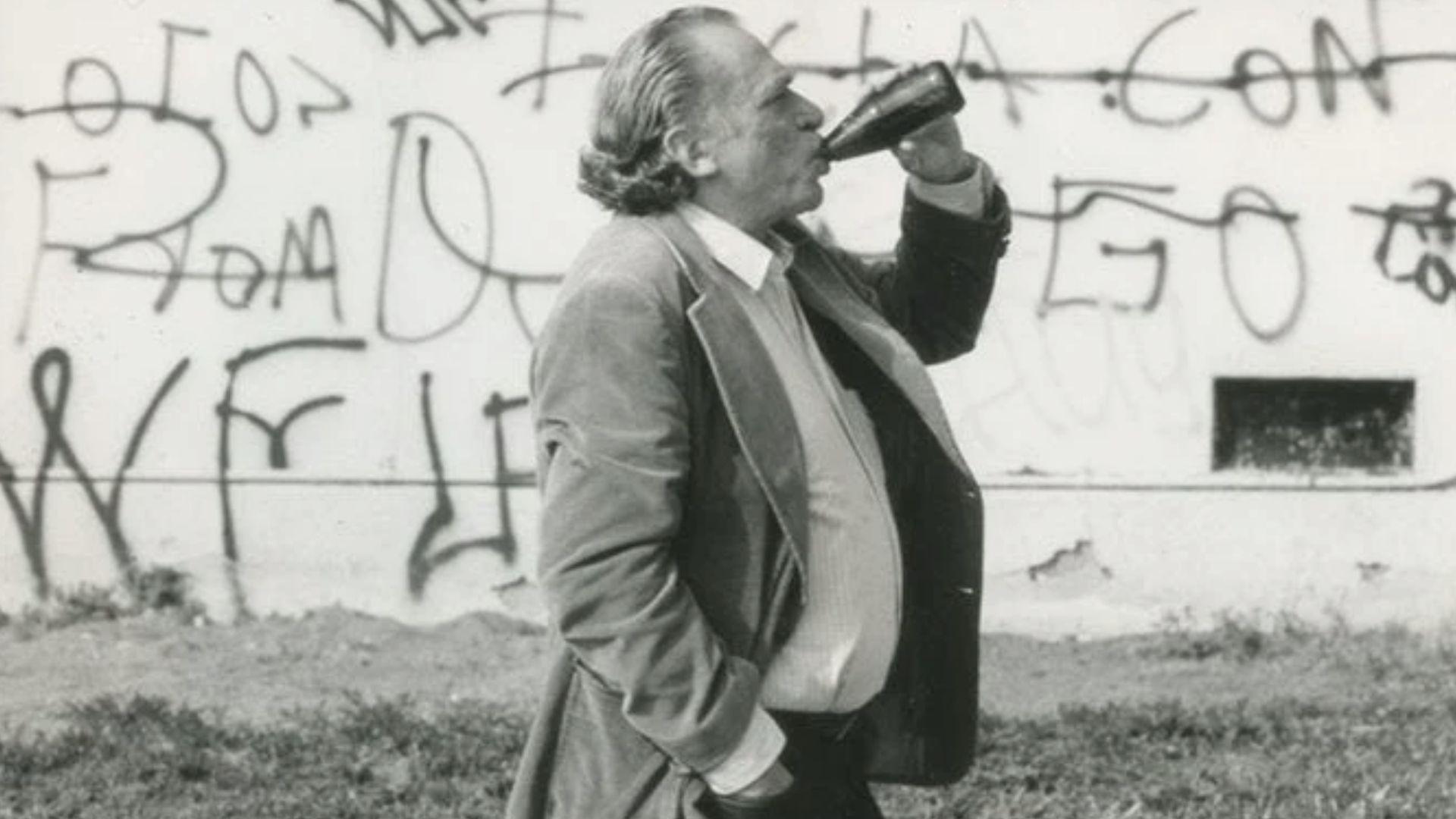
Bukowski’s poetry is plain-spoken free verse about ordinary, often rough, lives. He wrote in short, narrow lines and used everyday speech instead of rhyme or formal rhythm.
Almost everything came from his own life: jobs, bars, racetracks, women, and loneliness. You don’t need a literature degree to follow it.
Under the tough talk there is real softness. The critic Adam Kirsch, reviewing a late collection in The New Yorker, described the poems as “aggressively vulgar and clandestinely sensitive,” as quoted by the Poetry Foundation. If you want to read him by theme, here is where to look:
- Loneliness: “Alone with Everybody” and “Bluebird” are the best Bukowski poems about loneliness on this list.
- Writing: “So You Want to Be a Writer?” and “Roll the Dice” treat writing as something you can’t fake.
- Life and hope: “The Laughing Heart” is his most direct piece of encouragement.
- Time and endings: “The Days Run Away Like Wild Horses Over the Hills” looks at personal loss, while “Dinosauria, We” looks at the end of a whole society.
Where to Start If You’ve Never Read Bukowski
Start with The Pleasures of the Damned (2007), a selection of poems from 1951 to 1993 edited by John Martin, his longtime publisher.
It covers his whole career in one book. Of all the Bukowski poetry books, it’s the one I’d hand a new reader.
If you’d rather start small, read “Bluebird” and “The Laughing Heart” first. Both are short poems you can finish in two minutes.
After that, try The Last Night of the Earth Poems (1992), the last poetry book published in his lifetime.
One fair warning: much of his work deals with heavy drinking, sex, and violence in blunt language.
Frequently Asked Questions
What is Charles Bukowski’s Most Famous Poem?
There’s no official ranking, but “Bluebird” is probably the most widely shared Bukowski poem, with “The Laughing Heart” close behind. “Dinosauria, We” reached a wider audience after its opening words became the title of the 2003 documentary Bukowski: Born into This.
Where Can I Read Bukowski Poems for Free?
The Poetry Foundation website hosts a selection of his poems alongside a short biography. Many public libraries also lend his collections, including ebook editions through library apps. Be careful with quote sites and social media, where his lines are often changed or invented. If a line matters to you, check it against a printed book.
Did Bukowski Write Poems About Love?
Yes, though rarely the romantic kind. His 1977 collection Love Is a Dog from Hell is full of poems about relationships, jealousy, and breakups, told with his usual bluntness. Some of his later poems sound much gentler.
Why Bukowski Poems Still Matter to Me
I came to Bukowski through one blunt line about writing, and I stayed for everything else. His best poems sit next to you and tell the truth about bad jobs, lonely nights, and the stubborn urge to keep going. That’s why these Bukowski poems still matter to me.
Pick one poem from this list, read it slowly, then read it again out loud. Your favourite may not be mine, and that’s fine. If you enjoy poets who write with the same honesty from a very different angle, Adrienne Rich’s poems make a good next stop.