


Some poems you read once and move on. Others stay surfacing during a hard conversation, a quiet morning, a moment you can’t quite name.
Adrienne Rich’s poems are that second kind, and they tend to get more useful the older you get.
She began with formal, controlled verse, prize-winning at twenty-one. Then life pressed into the work. Marriage, motherhood, sexuality, political fury.
The poems stopped being polished and started being honest. That shift is what makes her worth reading now, not just studying.
By the end of this, you’ll know which poems matter most, what they’re doing beneath the surface, and exactly where to start based on how you read. Some of what she wrote will land differently than you expect.
Who Was Adrienne Rich?
Adrienne Rich (1929–2012) was an American poet whose work moved from formal verse to politically urgent, free-form poetry across six decades.
She began her career winning the Yale Younger Poets prize at 21. Her early work was polished, controlled, and widely praised.
But life changed her writing. Marriage, motherhood, and her sexuality all pulled her toward harder truths. She stopped writing to impress and started writing to say something real.
That shift is why her work still holds. You go looking for one poem and end up reading everything she ever wrote.
The Best Adrienne Rich Poems to Read
This list spans Rich’s career from the earliest published work in the 1950s through the later political poetry. Each poem was chosen because it appears consistently on critical lists, represents a distinct phase of the writing, and gives first-time readers a real entry point.
The list moves roughly in order. From the tighter, formal early work toward the more open, politically charged poems Rich became known for. That arc matters. You’ll see the voice change as you move through it.
“Aunt Jennifer’s Tigers” (1929)

Aunt Jennifer embroiders tigers on a panel while her hands tremble under the weight of her uncle’s wedding ring. The tigers are free. She is not. That contrast is the entire poem.
The tigers aren’t decoration. They’re everything Aunt Jennifer can’t be in her own life. Rich makes constraint visible through needlework. It’s a formally tight poem, which makes the feeling underneath it hit harder.
“Living in Sin” (1955)
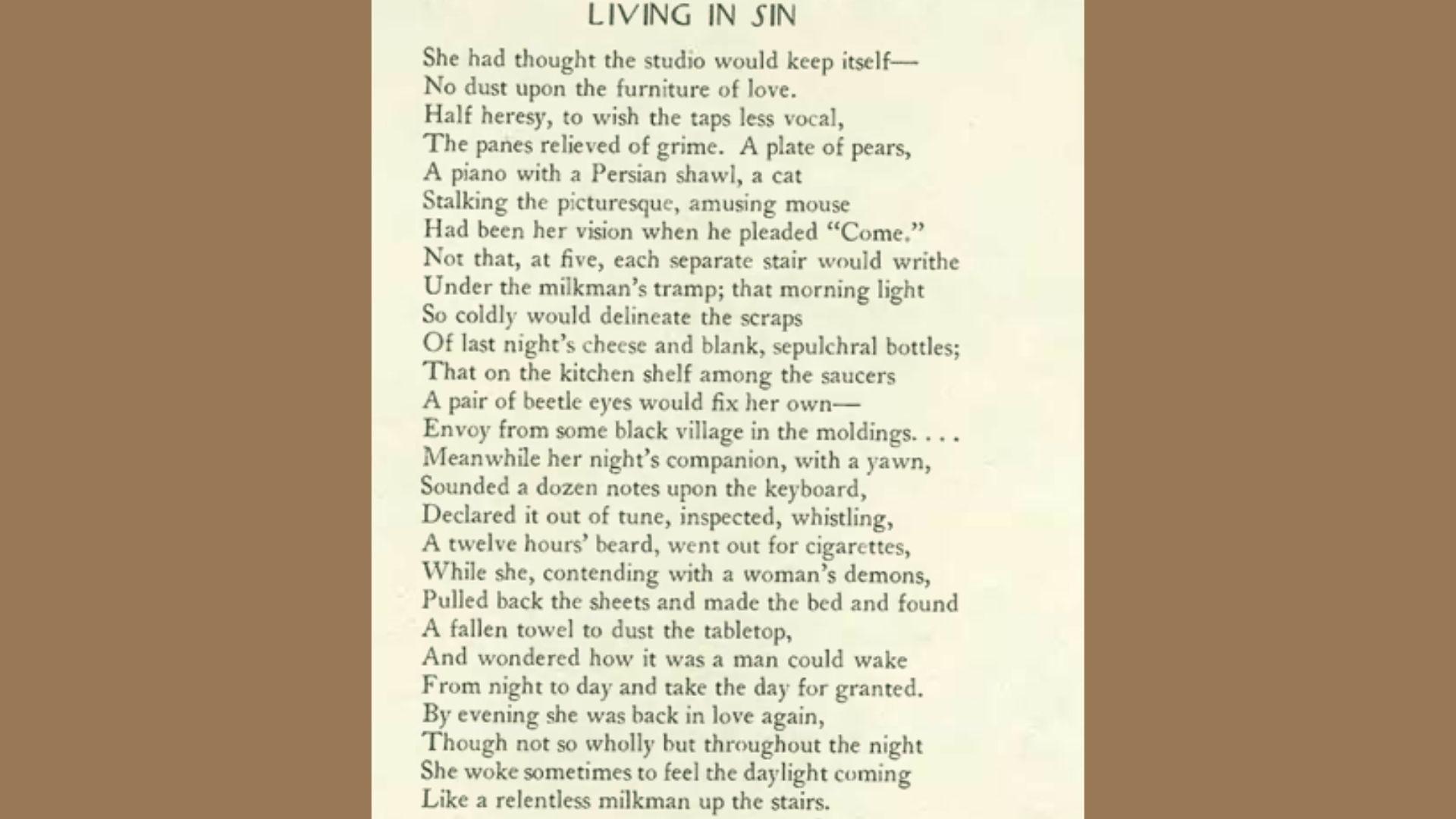
A woman moves in with a lover expecting romance. What she gets is a beetle on the stove, dust on the piano, and the milkman at dawn. The mundane details aren’t background noise. They are the point.
Rich is precise about how disillusionment works. It doesn’t arrive dramatically. It arrives as a milkman. The poem earns its quiet devastation by refusing to dress up what is, in reality, ordinary disappointment.
“A Valediction Forbidding Mourning” (1970)

Two people share a space but can no longer reach each other. That disconnection is what the poem is about. Most lists include it. Very few explain what Rich is actually doing.
John Donne wrote a poem with the same title in the 1600s, built around unity and shared movement.
Rich takes that title and writes directly against it. The act isn’t just literary. It’s a reclamation, a rewriting from inside.
“Diving into the Wreck” (1972)
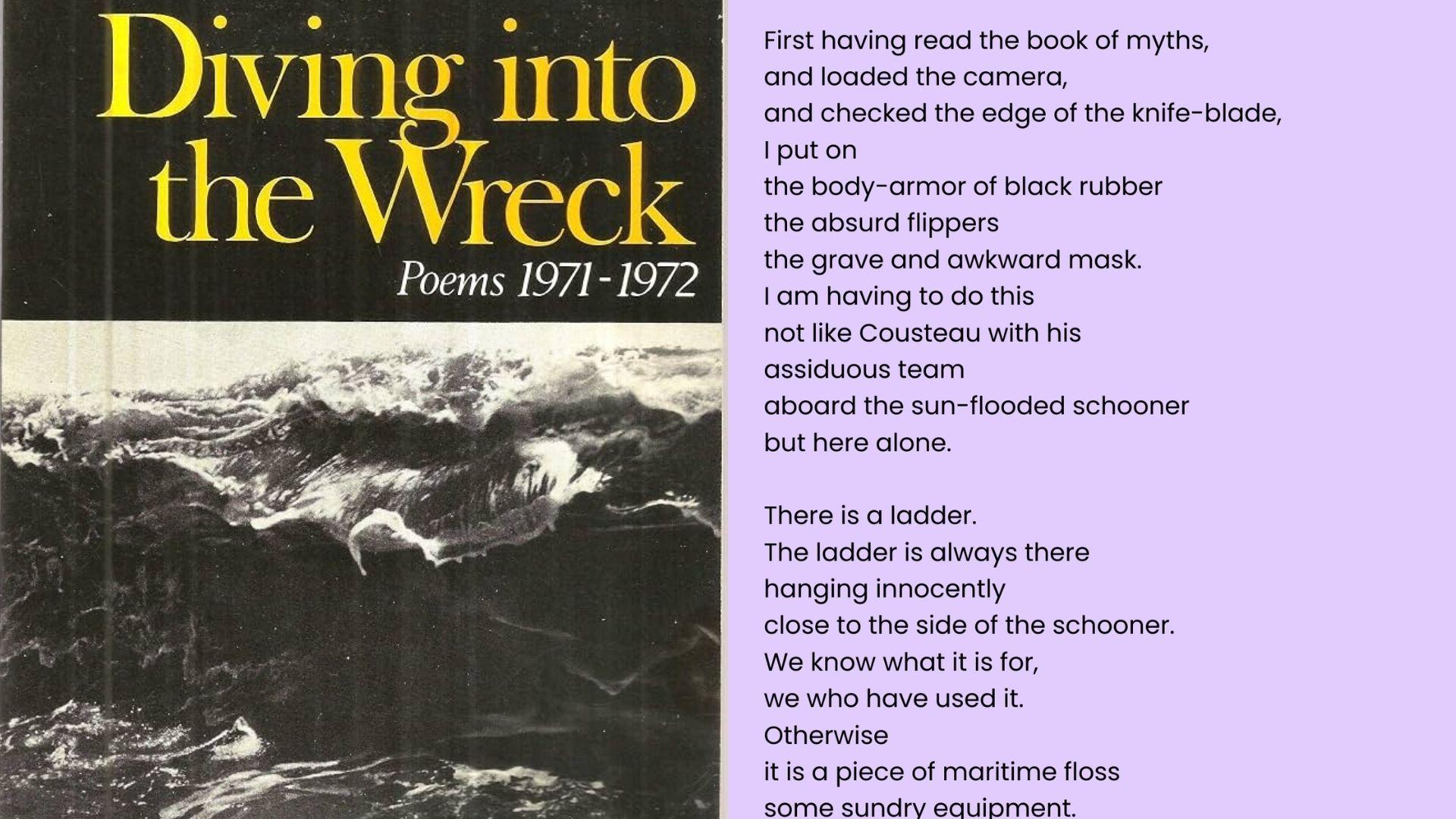
A speaker descends alone into the ocean carrying a book of myths, a camera, a knife. They’re not looking for treasure. They’re looking for what was damaged and what survived. That’s the whole poem.
The wreck is a metaphor, not an allegory. Rich doesn’t fix its meaning. It works as a feminist text and as a document of personal crisis at the same time. The ambiguity is the strength.
“Power” (1974)
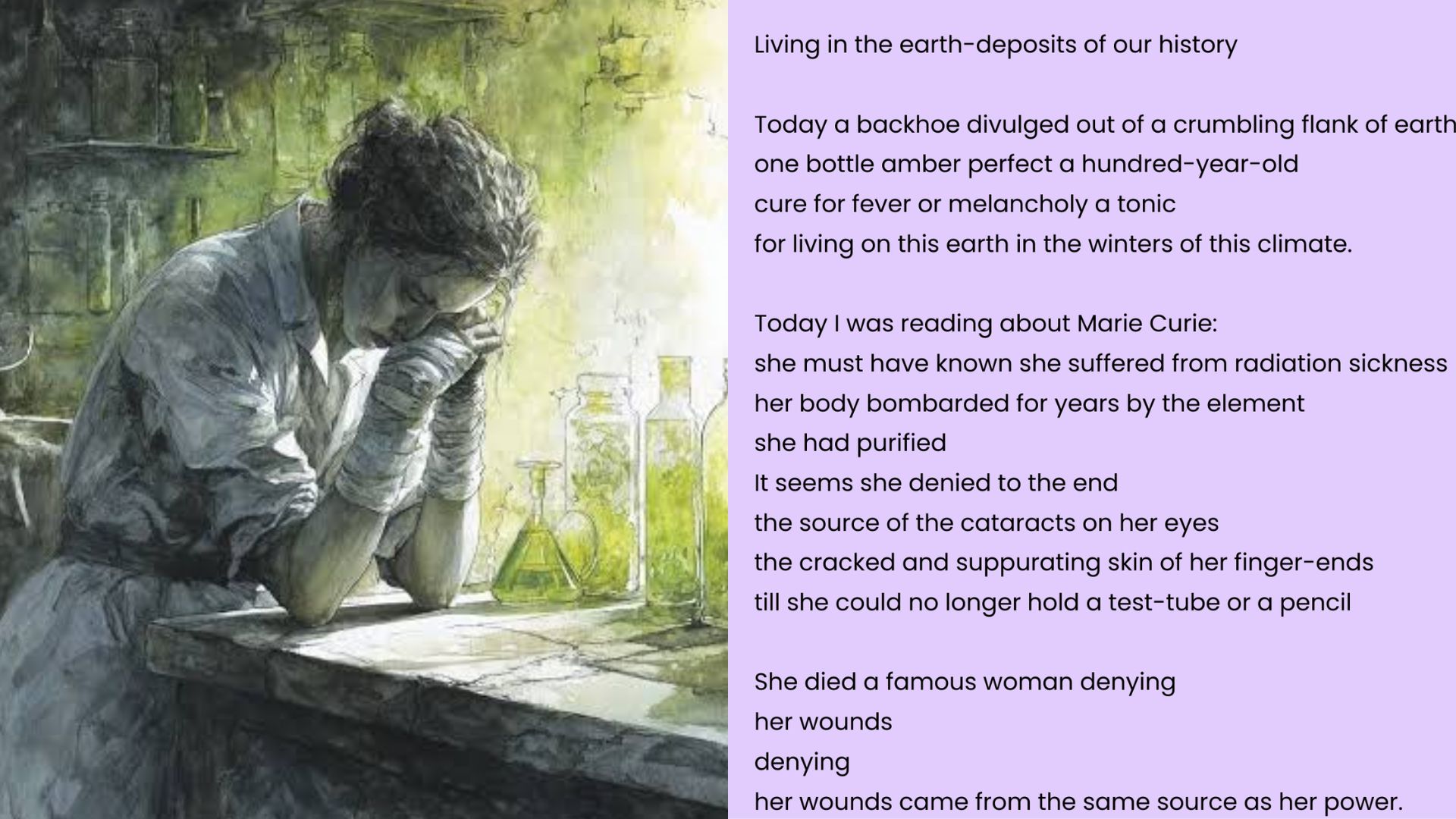
Marie Curie’s work with radioactivity gave her extraordinary power. It also gave her the radiation exposure that destroyed her health and killed her. Rich holds that fact steady without softening it.
The poem isn’t mourning Curie. It’s asking what women have historically had to pay for access to knowledge and recognition. The cost wasn’t a side effect. In Rich’s reading, it was built into the terms from the start.
“Twenty-One Love Poems” (1976)
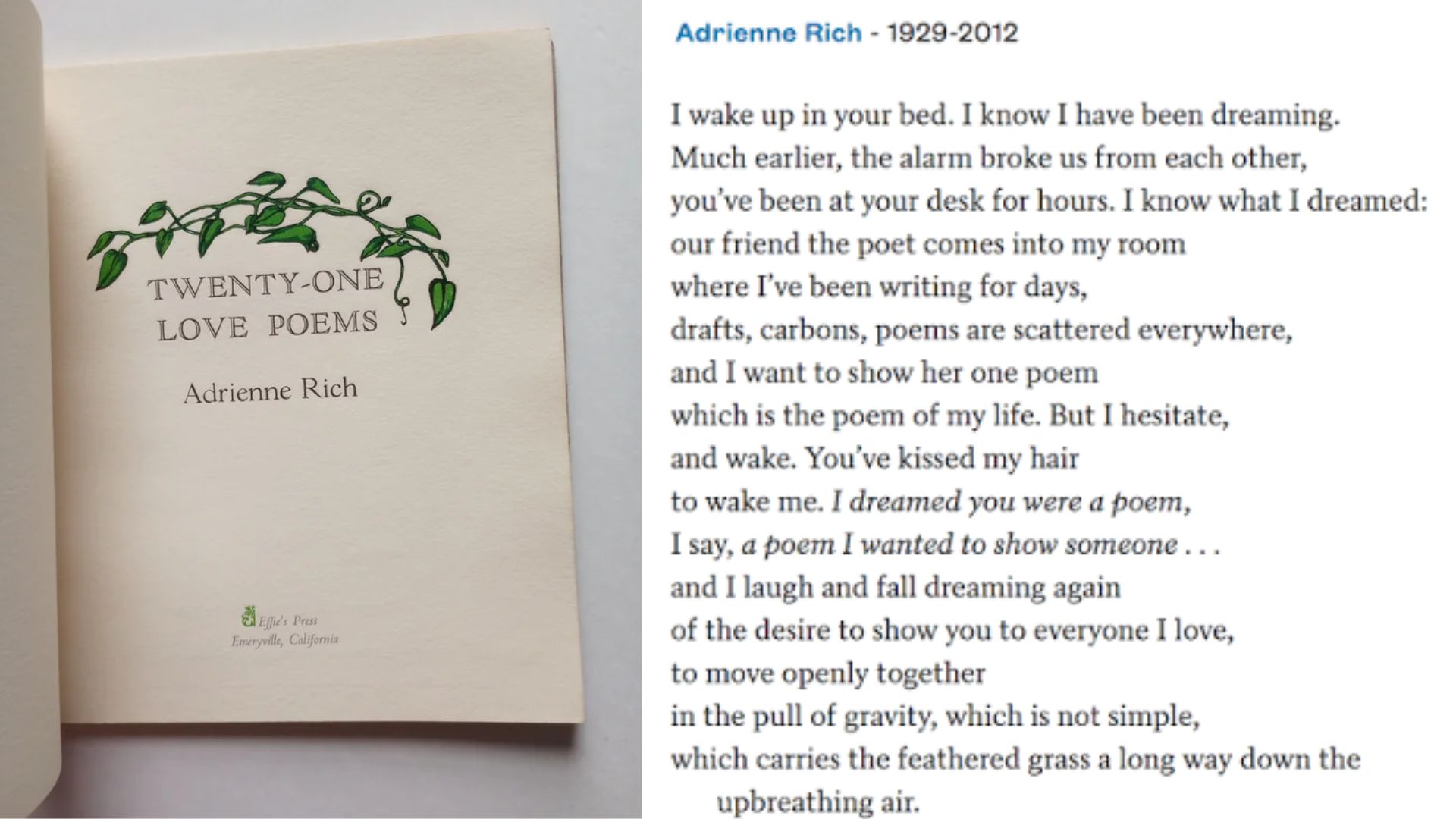
Rich published a lesbian love sequence in 1976 without apology, hidden pronouns, or coded language. Two women, a relationship, a city. That was radical for its time.
Read it as one sequence, not individual poems. A standalone poem captures a moment. A sequence captures a relationship: its buildup, friction, private language, and loss.
The numbered poems show intimacy accumulating over time. That’s something a single poem can’t do.
“What Kind of Times Are These” (1991)
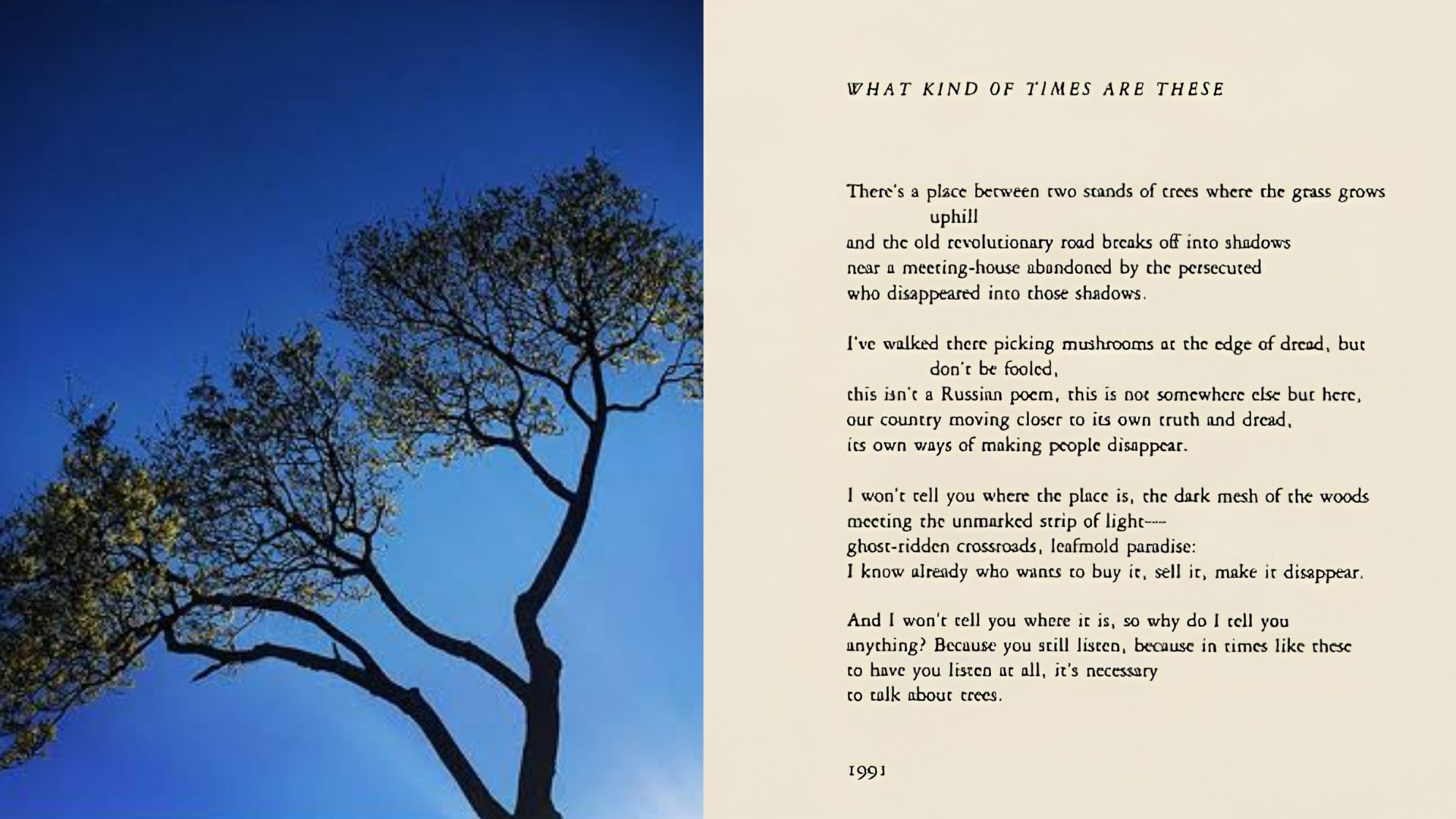
Rich describes a specific place: trees, a road, a field. Then refuses to name it. When the speaker is asked directly where this place is, the answer is a refusal. That refusal repeats throughout the poem.
The silence is the argument. Rich is saying some things can’t be named safely. The poem performs the conditions it describes. Political pressure becomes visible not through what is said, but through what the poem won’t say.
“Snapshots of a Daughter-in-Law” (1963)
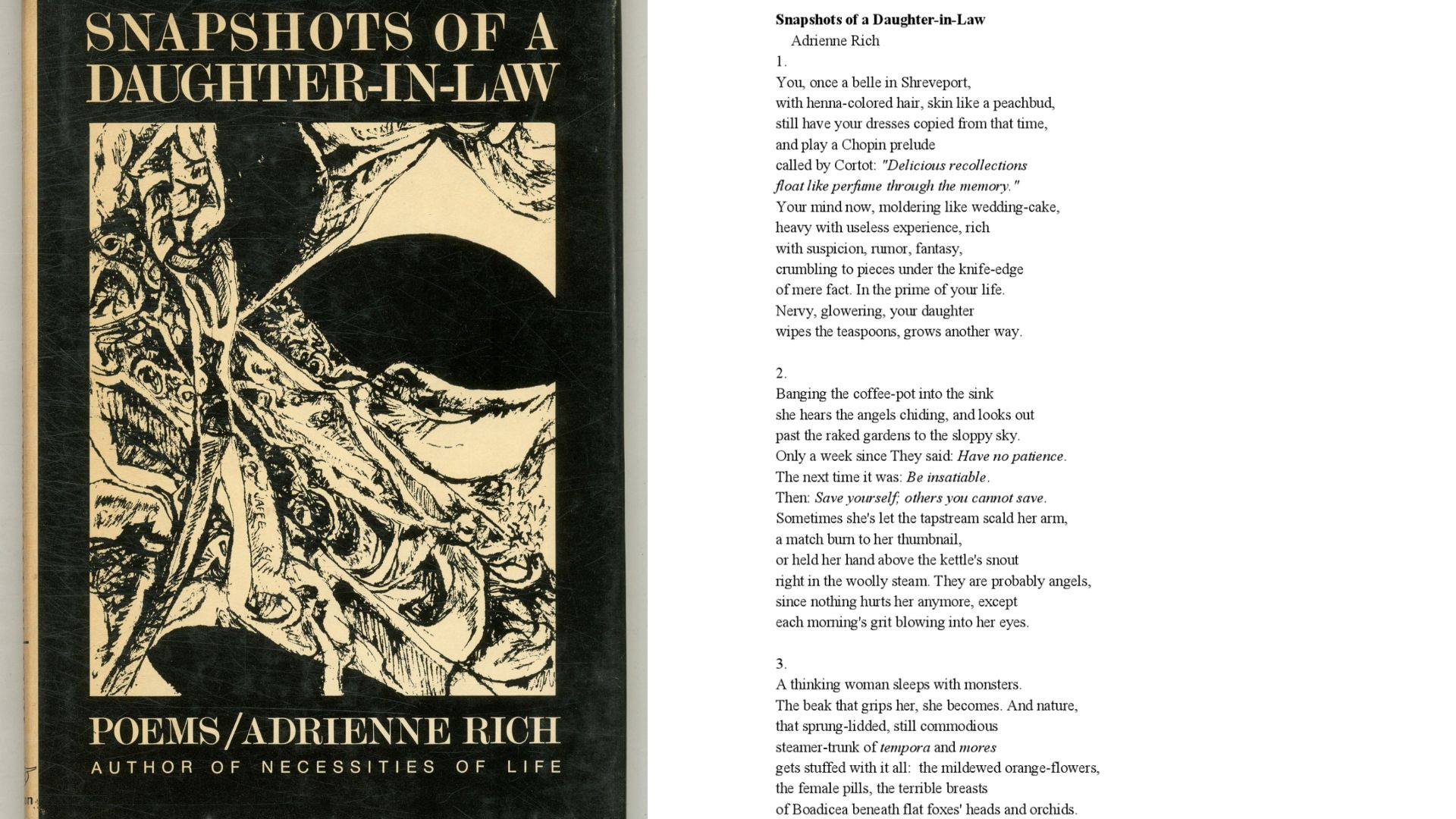
This poem is about a woman’s life assembled from roles: daughter-in-law, wife, cultural object. It’s fragmented and collage-like, and that’s deliberate. A fractured form fits a fractured experience.
Rich’s early work was formally disciplined. This poem breaks that open. It’s the transitional moment where the writing stops working within rules and starts working against them. Read “Aunt Jennifer’s Tigers” and then this. You’ll see the turn happening in real time.
What Themes Run Through Adrienne Rich’s Poetry?
Rich’s themes don’t sit in separate boxes. They compound across poems and collections. A reader who follows her work chronologically will watch them intensify, overlap, and push against each other.
Here’s what actually runs through the work:
- Feminism lives in the details, not the declarations. Rich doesn’t write about women’s oppression in the abstract. She embeds it in domestic objects, bodily experience, and the texture of everyday life. The wedding ring in “Aunt Jennifer’s Tigers.” The milkman in “Living in Sin.” The oppression is structural, and she makes you feel the structure.
- The personal and the political are the same thing. Early poems are formally controlled, the feeling held tight inside the form. Later poems let political urgency rupture the structure itself. The form isn’t decorative. It tracks where Rich is in her thinking.
- Language is never neutral. Rich wrote and spoke extensively about the power of naming. That concern runs through the poems too. What gets named, what gets withheld, what a word can or can’t hold. “What Kind of Times Are These” is built entirely on that question.
These three threads don’t rotate. They compound. By the later work, you can’t separate one from the others.
Where to Start If You’re New to Adrienne Rich’s Poetry
Not every reader should start with “Diving into the Wreck.” Rich’s entry points are genuinely different depending on what kind of reader you are.
- If you want emotion and intimacy first, start with “Living in Sin” and move into “Twenty-One Love Poems.” Both are immediate. Neither asks you to bring much context.
- If you want political clarity, go to “Diving into the Wreck” and “What Kind of Times Are These.” These are the poems where the stakes are most visible on the surface.
- If you want to understand how she writes, start with “Aunt Jennifer’s Tigers.” It shows Rich at her most formally controlled. Then read “A Valediction Forbidding Mourning” and watch that control start to crack.
Any of these works as a starting point. The only wrong move is picking one poem, finding it doesn’t land, and stopping there. Try a different entry point first.
Wrapping up
Adrienne Rich’s poems have a way of finding you at the right moment. You read one line and suddenly you’re thinking about something you buried months ago. That’s not an accident. That’s a writer who knew exactly what she was doing.
You’ve seen the full range here: the controlled early work, the personal turning points, the politically direct later poems. You know which ones matter and why. You know where to start based on the kind of reader you are.
Now the only move left is to actually read one. Pick any poem from this list. Read it slowly. Sit with it. Then come back and tell me in the comments which one stayed with you longest. I’d genuinely like to know.
Frequently Asked Questions
Is Adrienne Rich LGBTQ?
Yes, Adrienne Rich was an out lesbian and a celebrated icon in the LGBTQ+ and feminist literary communities.
Which poetry collection is considered Adrienne Rich’s best?
Adrienne Rich’s collection Diving into the Wreck: Poems 1971–1972 is widely considered her best and most influential work.
What is the poem “Power” by Adrienne Rich about?
It’s a meditation on Marie Curie that explores the dangerous relationship between physical suffering and access to power for women