

Some poems earn their place in a syllabus. This one earns a place in your head. The landscape poem about the fall of Icarus is twenty-one lines long.
Williams gives you a farmer, a spring morning, and Icarus drowning in the last two words. No drama. No mourning. Just the world moving on
This piece walks you through the full poem text, what it actually means, the myth behind it, and why Williams made Icarus almost invisible. Everything you need to understand it clearly, in one place.
The Full Text of “Landscape with the Fall of Icarus”
What follows is the complete text of the poem as William Carlos Williams published it in 1962.
According to Brueghel
when Icarus fell
it was spring
a farmer was ploughing
his field
the whole pageantry
of the year was
awake tingling
near
the edge of the sea
concerned
with itself
sweating in the sun
that melted
the wings’ wax
unsignificantly
off the coast
there was
a splash quite unnoticed
this was
Icarus drowning
What Type of Poem Is “Landscape with the Fall of Icarus”?
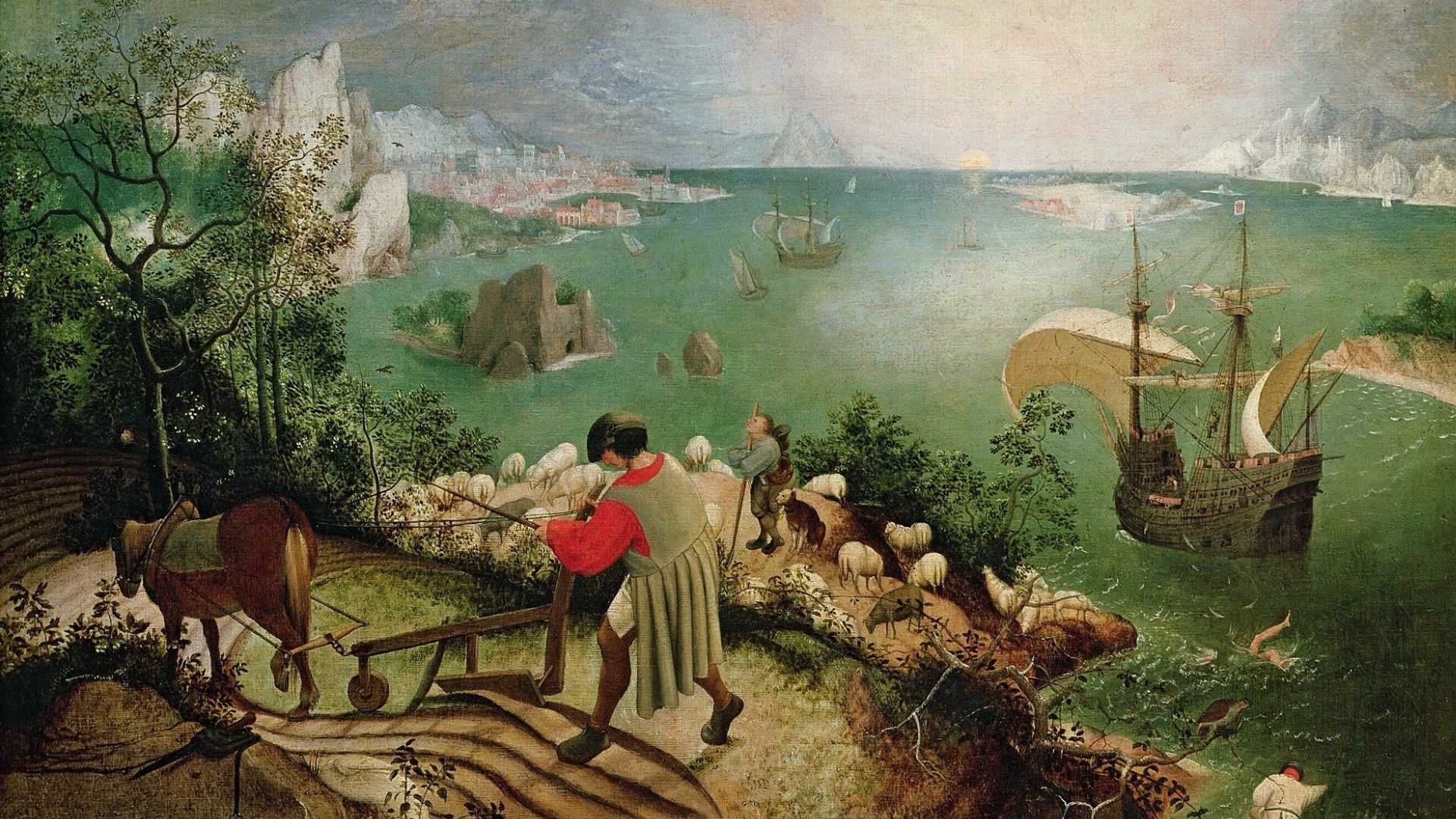
It’s an ekphrastic poem written directly in response to Pieter Bruegel the Elder’s 16th-century painting of the same name. Williams didn’t retell the myth. He wrote what the painting was quietly arguing.
The structure backs that up. Three-line stanzas, no rhyme, no punctuation, plain language. If you’re writing a poetry analysis essay, those choices are your starting point.
The poem is part of Williams’s final book, Pictures from Bruegel, where every poem responds to a different Bruegel canvas.
This was never a mythology lesson; it’s a study of what the painting says about how life keeps moving while tragedy goes unnoticed.
Key Symbols in the Poem
Williams doesn’t spell anything out. He shows you objects and lets them carry the meaning. These three do most of the heavy lifting.
1. The Farmer
The farmer is the clearest symbol in the poem, and also the most human one. He’s not ignoring Icarus out of cruelty. He just has work to do.
He represents every person who keeps moving while something terrible happens nearby, not because they don’t care, but because life demands it. The field won’t plough itself.
2. Spring
Spring should feel hopeful. That’s the whole point of spring, new life, warmth, things beginning again. Williams sets Icarus’s death inside that energy deliberately.
The world is “awake tingling” while someone drowns in it. That contrast between beauty and death sharing the same morning is what makes the season feel so quietly devastating here.
3. The Splash
This is the moment the myth collapses into reality. A fall that should echo through history lands as a single small sound. “A splash quite unnoticed” that’s it. That’s all Icarus gets.
Williams could have written it dramatically. He didn’t. The smallness of the word is the whole argument. Tragedy doesn’t always announce itself. Sometimes it just disappears into the water.
The Myth Behind the Poem: What Icarus Actually Did
Icarus was the son of Daedalus. To escape from Crete, Daedalus built wings from feathers and wax for both of them.
He warned Icarus not to fly too high, or the sun would melt the wax. Icarus ignored it, flew too close to the sun, and fell into the sea.
It’s a dramatic story. But Williams barely touches it. In the poem, you get a farmer, some spring sunshine, and then a small splash.
The name “Icarus” only shows up in the very last line. Williams doesn’t retell the myth he shows you what the world was doing while it happened.
What the Poem Is Actually About (It’s Not Icarus)
Most people come in expecting a poem about Icarus falling. That’s not what this is. Icarus appears once.
In the very last line. He gets less space than the farmer, the sun, or the open water.
Williams spends the whole poem on ordinary life in full motion. The farmer plows. The sun shines. The season is alive. Icarus? He drowns quietly, off to the side, with almost no description at all.
The word “unsignificantly” is the key. Williams wrote it that way on purpose. It’s flat. It’s awkward. It shrugs. Because that’s what the world did.
That’s the real subject of the poem. Life is warm and full and absorbing, and that’s precisely why no one looks up. It’s not cruel. It’s just what being alive feels like from the inside.
Why Does the Poem Still Matter?
This poem matters because it tells a truth most people recognise but rarely say out loud: when something bad happens to someone else, life just keeps going.
Not because people are cruel. Because life is busy, warm, and absorbing, exactly like that spring morning Williams describes.
Williams wrote it flat on purpose. No dramatic language. No mourning. Because if he had made it beautiful and emotional, he would have given Icarus the attention the world actually denied him. The plain writing is the point.
That’s why reading it feels different from hearing what it’s about. The shrug has to be felt, not explained.
Final Takeaway
The Landscape With The Fall of Icarus Poem is not really about Icarus. It’s about the farmer. The spring morning.
The world that kept moving. Williams made that choice deliberately, and it’s what makes this poem stick with you long after you’ve read it.
I think that’s what great poetry does. It shows you something true about life without spelling it out.
If this breakdown helped you understand the poem better, share it with someone studying it too. And if you want to go deeper, read the poem one more time. It hits differently the second time around
Frequently Asked Questions
What is the meaning behind the painting “Landscape with the Fall of Icarus”?
The meaning behind Pieter Bruegel the Elder’s painting Landscape with the Fall of Icarus is that human suffering and grand tragedies go largely unnoticed by the rest of the world, which continues with the ordinary rhythms of daily life
What is the most famous Icarus painting?
The most famous Icarus painting is “Landscape with the Fall of Icarus”, widely attributed to Pieter Bruegel the Elder (c. 1555), which depicts the mythological figure’s fatal plunge into the sea as a nearly invisible detail in an otherwise ordinary pastoral scene.
What does Icarus falling symbolise?
The fall of Icarus primarily symbolizes hubris (excessive pride), overambition, and the dangerous consequences of ignoring wise boundaries and limits.