

Every Christmas Eve, the same poem gets read in millions of homes across the world. Folks know the opening line by heart. Far fewer know the full story behind it.
“Twas the Night Before Christmas” has been shaping how the world pictures Christmas since 1823. It gave us Santa’s sleigh, his reindeer, and the image of him coming down the chimney. All of it started here.
The detailed text is below, along with everything worth knowing about where it came from.
The Full Text of “Twas the Night Before Christmas”
This is the complete, original text of “A Visit from St. Nicholas,” exactly as it appeared in print in 1823.
‘Twas the night before Christmas, when all through the house
Not a creature was stirring, not even a mouse;
The stockings were hung by the chimney with care,
In hopes that St. Nicholas soon would be there;
The children were nestled all snug in their beds,
While visions of sugar-plums danced in their heads;
And mamma in her ‘kerchief, and I in my cap,
Had just settled our brains for a long winter’s nap,
When out on the lawn there arose such a clatter,
I sprang from the bed to see what was the matter.
Away to the window I flew like a flash,
Tore open the shutters and threw up the sash.
The moon on the breast of the new-fallen snow
Gave the lustre of mid-day to objects below,
When, what to my wondering eyes should appear,
But a miniature sleigh, and eight tiny reindeer,
With a little old driver, so lively and quick,
I knew in a moment it must be St. Nick.
More rapid than eagles his coursers they came,
And he whistled, and shouted, and called them by name;
“Now, Dasher! now, Dancer! now, Prancer and Vixen!
On, Comet! on, Cupid! on, Donder and Blitzen!
To the top of the porch! to the top of the wall!
Now dash away! dash away! dash away all!”
As dry leaves that before the wild hurricane fly,
When they meet with an obstacle, mount to the sky,
So up to the house-top the coursers they flew,
With the sleigh full of toys, and St. Nicholas too.
And then, in a twinkling, I heard on the roof
The prancing and pawing of each little hoof.
As I drew in my hand, and was turning around,
Down the chimney St. Nicholas came with a bound.
He was dressed all in fur, from his head to his foot,
And his clothes were all tarnished with ashes and soot;
A bundle of toys he had flung on his back,
And he looked like a peddler just opening his pack.
His eyes – how they twinkled! his dimples how merry!
His cheeks were like roses, his nose like a cherry!
His droll little mouth was drawn up like a bow,
And the beard of his chin was as white as the snow;
The stump of a pipe he held tight in his teeth,
And the smoke it encircled his head like a wreath;
He had a broad face and a little round belly,
That shook, when he laughed, like a bowlful of jelly.
He was chubby and plump, a right jolly old elf,
And I laughed when I saw him, in spite of myself;
A wink of his eye and a twist of his head,
Soon gave me to know I had nothing to dread;
He spoke not a word, but went straight to his work,
And filled all the stockings; then turned with a jerk,
And laying his finger aside of his nose,
And giving a nod, up the chimney he rose;
He sprang to his sleigh, to his team gave a whistle,
And away they all flew like the down of a thistle.
But I heard him exclaim, ere he drove out of sight,
“Happy Christmas to all, and to all a good-night.”
You’ll notice some reindeer names are spelt differently in other versions. That’s covered further down.
Who Wrote Twas the Night Before Christmas?
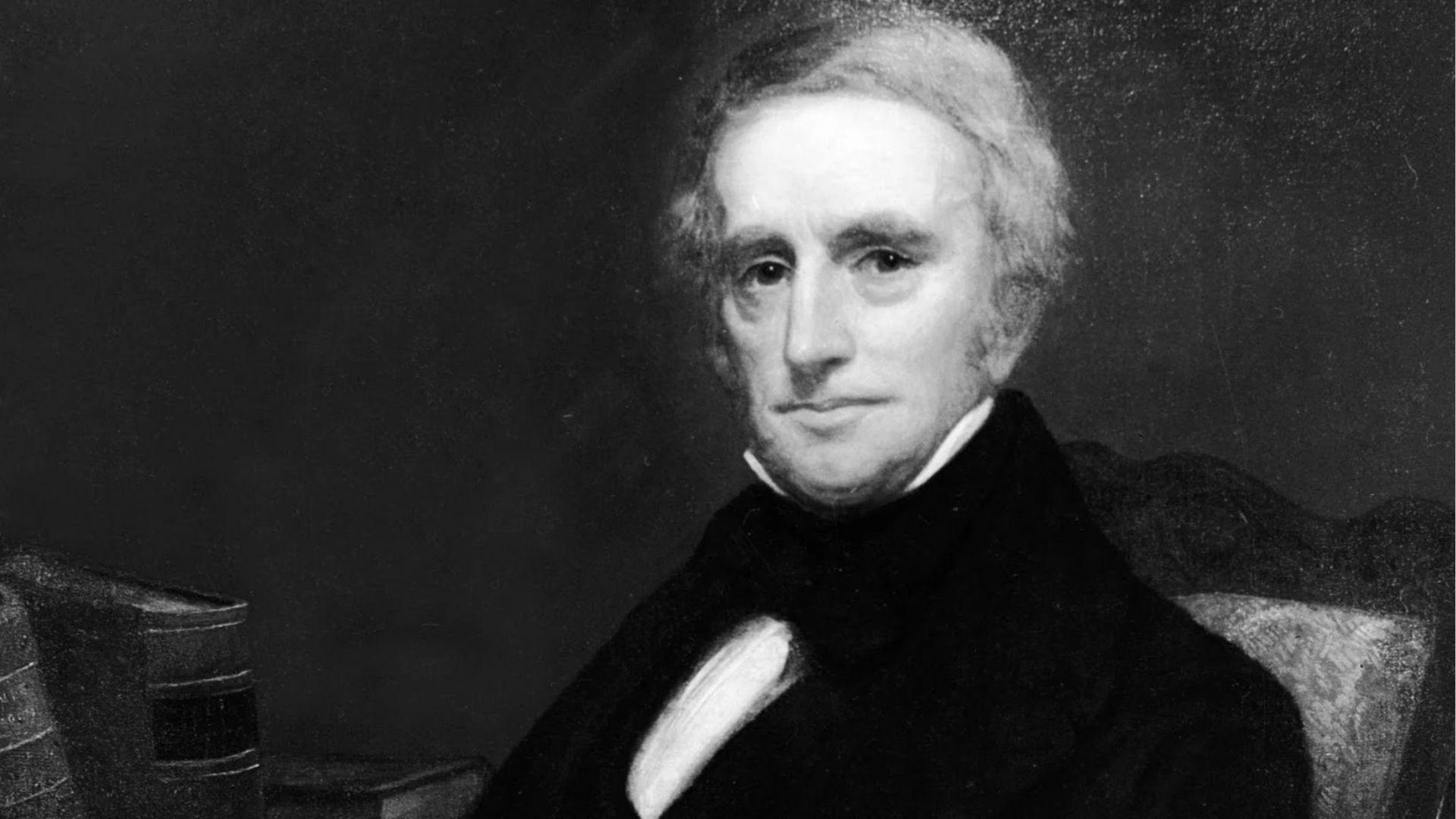
The poem was first published on December 23, 1823, in the Troy Sentinel newspaper in New York, and is traditionally credited to Clement Clarke Moore.
The story of its origin:
But here’s the thing. Moore didn’t claim authorship until 1844, more than two decades after the poem first appeared in print. That gap is exactly what keeps the question open.
The other name that comes up is Henry Livingston Jr., a New York poet and Moore’s contemporary. His descendants and some literary scholars argue the poem sounds far more like Livingston’s work than Moore’s.
The meter, the playful tone, the word choices, none of it sits comfortably alongside anything else Moore ever wrote. Livingston’s case comes down to two things: his other poems show stylistic patterns that closely match this one, and his family had been saying he wrote it for generations, long before it ever became a public debate.
Moore’s supporters point to his own written claim and the fact that he included the poem in an 1844 collection of his work.
But neither side has ever produced a manuscript in the author’s hand, and no record from the time of publication names either man as the writer.
The honest answer is that nobody really knows who wrote it. Moore gets the credit in most textbooks, but the question has never truly been settled.
Which Christmas Traditions Did This Poem Actually Create?
Several things you assume are ancient Christmas traditions were actually invented in this poem. Before 1823, none of them existed in any fixed form; the broader tradition of winter seasonal poetry had circulated for centuries, but nothing had yet fixed a single image of Christmas night in popular imagination.
Santa Claus as a concept predates the poem, loosely drawn from the Dutch Sinterklaas. But he had no consistent appearance, no sleigh, no reindeer, and no established way of entering a home. This poem created all of that in one sitting.
The physical description came first. A round belly, fur-trimmed clothes, rosy cheeks, a pipe, a sack of toys on his back. Every image of Santa you have seen traces back to these specific lines. No earlier source assembled them this way.
The reindeer came with it. Dasher, Dancer, Prancer, Vixen, Comet, Cupid, Donner, and Blitzen were not pulled from folklore. They were coined here, in this poem, in 1823. No prior Christmas tradition included flying reindeer by name or at all.
The chimney entry was also new. St. Nicholas in earlier European tradition came through doors and windows. The poem fixed the chimney as the point of entry, and it has stayed there ever since.
What made these details stick was repetition. The poem was reprinted across American newspapers through the 1820s and 1840s, reaching readers in towns that had no shared Christmas tradition to speak of.
By the time illustrated editions arrived in the second half of the century, the images were already familiar. The illustrations didn’t create the picture of Santa. They confirmed the one the poem had already planted.
By 1900, what started as a single anonymous poem had quietly become the foundation most of the Western world’s Christmas imagery was built on.
Why Do Different Versions Spell the Reindeer Names Differently?
The spelling differences you see across versions are not errors. They reflect editorial changes made by different publishers over nearly 200 years.
The 1823 Troy Sentinel printing used “Dunder and Blixem.” Those are Dutch words meaning thunder and lightning. Subsequent printings changed them to “Donder and Blitzen,” then later to “Donner and Blitzen.”
Each change came from a different editor or publisher making their own call. None of them was revisions by the original author.
The same pattern applies to punctuation, capitalisation, and a handful of other small word choices scattered through the poem. Different printing houses made different decisions, and those decisions compounded over time.
There is no single official version to point to. The poem passed into the public domain long before any authority could fix a standard text. Every publisher since has worked from whatever earlier printing they had access to.
This is why the version you grew up with may read slightly differently from the one someone else knows. Neither is wrong. They are just different stops along the same 200-year publishing history.
How People Read, Share, and Gift This Poem Today
The poem is public domain short, rhythmic, and built on simple elements of poetry that make it easy to read aloud with kids. That means you can print it, perform it, record it, or share it however you like. No licence needed. No restrictions.
For families who want a physical copy, illustrated editions are the most popular route. They vary quite a bit in tone. Some stick close to the traditional imagery the poem describes. Others take a more modern or playful approach. Neither is better. It depends on the age of the child and what feels right for your family.
Read-aloud recordings are another option that has grown steadily. Santa-voice performances in particular have become a tradition for a lot of families, either found online or done at home by a willing parent.
The poem is short enough to read in under five minutes. That’s part of why it works so well as a Christmas Eve ritual.
Final Verdict
“Twas the Night Before Christmas” is one of those rare things that shaped a culture without anyone planning for it to. A poem written for a few children in 1822 quietly became the blueprint for how the Western world pictures Christmas night.
You now have the full text, the real history, and the answers to the questions folks never think to ask. That is more than most people who recite it every year ever bother to find out.
Read it again this Christmas Eve. You will hear it differently now.
Frequently Asked Questions
Is there a controversy over who wrote “Twas the Night Before Christmas”?
Yes. Moore is the traditional credit, but Henry Livingston Jr. is a genuine competing claim. Moore didn’t claim authorship until 1844, and no handwritten manuscript exists for either side.
Are there different versions of “Twas the Night Before Christmas”?
Yes. The clearest difference is the reindeer names. The 1823 original used “Dunder and Blixem.” Later publishers changed these to “Donder and Blitzen” and then “Donner and Blitzen.”
What are the names of the eight reindeer in the poem?
Dasher, Dancer, Prancer, Vixen, Comet, Cupid, Donner, and Blitzen. These names were original to the 1823 poem. Rudolph was created separately in 1939 and does not appear in the original text.
Was Clement Clarke Moore really the author?
He has the traditional credit, but it remains disputed. Some scholars argue the poem matches Henry Livingston Jr.’s known work more closely than Moore’s. Moore claimed authorship in 1844, more than two decades after publication. No definitive evidence settles it.