


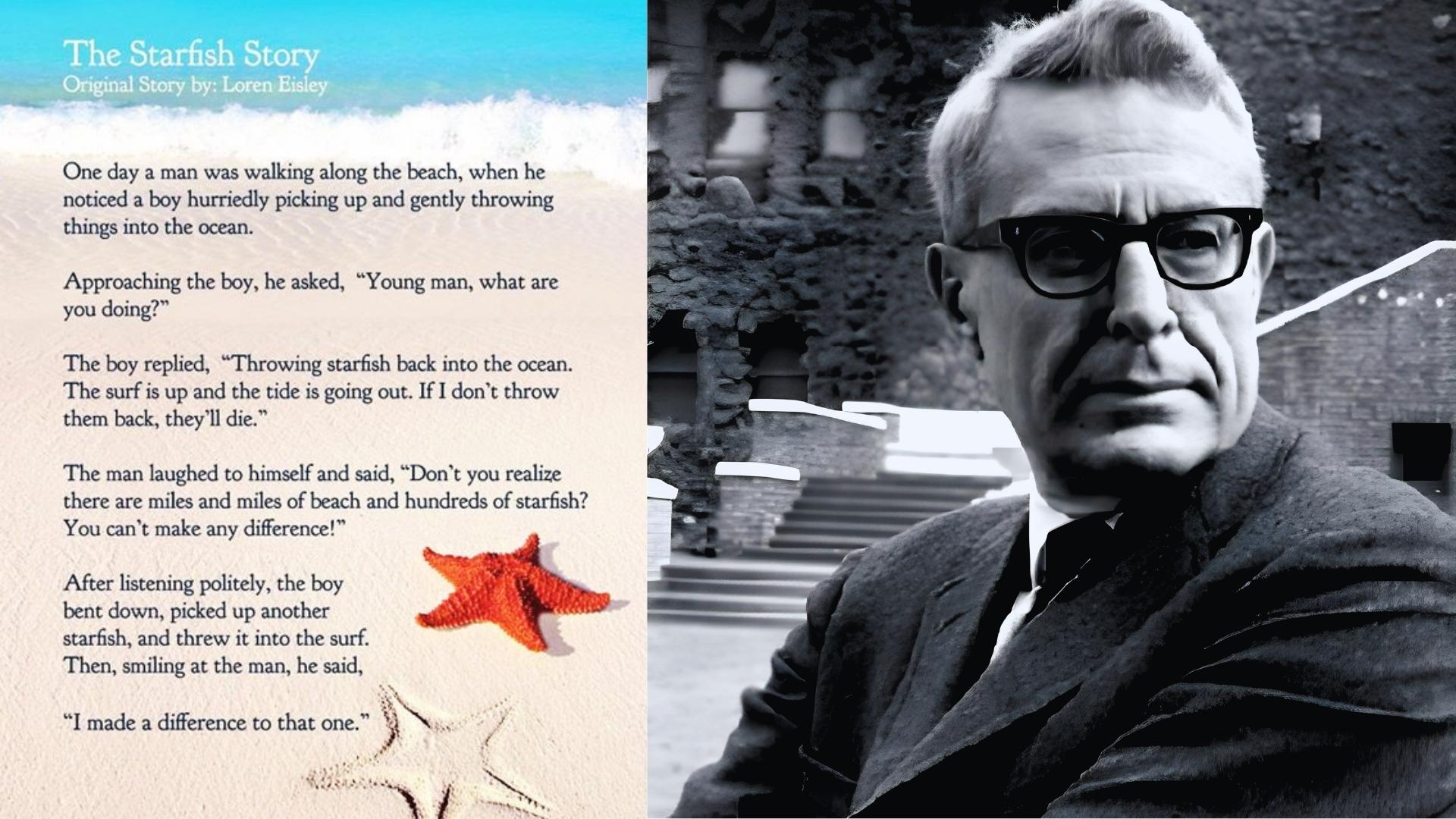
The starfish poem meaning is something many people search for when they first come across this short but powerful story.
Maybe you read it on a classroom wall, heard it at a charity event, or saw it shared online by someone who clearly needed it that day.
Either way, it tends to stay with you. There is something about it that feels both simple and true at the same time.
This article covers the full story, its deeper meaning, the moral behind it, and where it originally came from. You will also learn why it still connects with so many people across so many different walks of life.
Understanding this story can quietly shift the way you think about small actions and the real impact they leave on others.
What Is the Starfish Poem?

The starfish poem is a short, powerful story about a person walking along a beach covered in starfish. They find someone throwing starfish back into the ocean one by one.
When asked why, since there are too many to save, the person picks up another starfish, throws it in, and says, "I made a difference for that one."
In some versions, that person is an old man and a young boy. In others, including the version used by The Starfish Foundation, it is a little girl throwing starfish while people watch with amusement.
The character changes. The lesson does not. People often call it a poem because of the way it reads short, emotional, and quotable.
Technically, it is a parable, but over time, actual poetic versions have appeared in rhyme and verse, and both forms are widely shared today.
The Full Starfish Poem (Story)
Here is the full starfish poem in both its complete and short forms, exactly as it has been told and retold for decades.
Complete Version
Here is the full story as it is most commonly told
One day, an old man was walking along the beach after a storm. Thousands of starfish had been washed up on the shore, left to dry in the sun.
He noticed a young boy walking ahead, picking up starfish one by one and throwing them back into the ocean.
The old man caught up and asked, "What are you doing? There are thousands of starfish on this beach. You can't possibly make a difference."
The boy picked up another starfish, threw it gently into the waves, and said, "I made a difference for that one."
That is the core of the story. Some versions, like the one used by The Starfish Foundation, feature a young girl instead.
In that version, the old man is so moved that he joins her and soon others join too, until all the starfish are saved.
That detail matters. It shows how one act of kindness, done in the open, pulls others in.
Short Version
The short version cuts it down to just the key moment
A boy was throwing starfish into the ocean. A man told him it was pointless there were too many. The boy threw another one in and said, "Made a difference for that one."
This shorter version is what most people remember and quote.
The Meaning of the Starfish Poem
At its surface, the story is about starfish and a beach. But the real meaning goes much deeper than that.
What the Starfish Symbolizes
The starfish represents any individual in need. It could be a student who needs one more patient teacher.
A sick person who needs one volunteer to show up. A child who needs one adult to believe in them.
The starfish is not a group. It is one. That is the point. The story is asking you to stop looking at the crowd and look at the individual right in front of you.
The Meaning Behind the Beach and Ocean
The beach full of starfish is the world's overwhelming need. Poverty, illness, loneliness, inequality the problems are too large for one person to fix entirely.
The ocean is safe. It is where things belong, where they can survive and thrive.
The story is honest. It does not pretend the beach will ever be completely empty. But it says that even one starfish returned to the ocean is worth doing.
Understanding "I Made a Difference for That One"
This line is the entire lesson. The boy does not argue with the old man's logic. He does not claim he can save them all. He simply does what he can, for the one he can reach.
It is a response to the feeling of helplessness. When the problem feels too big, focus becomes smaller not out of defeat, but out of wisdom.
The "one at a time" principle is at the heart of what this story teaches.
The Moral of the Starfish Poem
The moral is not complicated. But it is easy to forget in daily life.
Every Small Act Has Value
People often hold back from helping because they think their contribution is too small to matter. The story pushes back against that directly.
Small acts still count. Throwing back one starfish is better than throwing back none.
This applies everywhere. Donating a small amount. Spending ten minutes with someone lonely. Picking up one piece of litter. None of it fixes everything, but all of it fixes something.
One Person Can Make a Difference
The story centers on a single boy. Not a team. Not an organization. Just one person doing what they can.
That is deliberate. It is meant to speak to the individual reading the story. You. Not "someone else" or "the government" or "a charity."
The story places the action in your hands, at your level, starting right now.
The Ripple Effect of Kindness
Here is what the story does not show, but what happens in real life: the boy's action does not go unnoticed. The old man watches. Others might watch too. Some of them might start helping.
The Starfish Foundation's version makes this explicit. The old man joins the girl. Then others follow. Soon, all the starfish are saved. That is the ripple effect in action.
One act of kindness often triggers others. When people see someone helping without needing applause or reward, it changes something in the atmosphere.
Others feel permission or even motivation to do the same.
Starfish Poem vs. The Star Thrower
There is an important distinction that many readers miss. The popular starfish story is not the original piece of writing.
The Original Story by Loren Eiseley
The real origin is an essay called The Star Thrower, written by Loren Eiseley and published in 1969 in a collection called The Unexpected Universe.
The copyright is held by Houghton Mifflin Harcourt, and the essay has been formally acknowledged as the source behind all popular retellings.
Eiseley's original essay is much longer, more philosophical, and written in a literary style. It is not a simple parable.
It includes personal reflection, natural observation, and existential questions about life and death.
In the original, Eiseley himself sees a man throwing starfish into the sea. But instead of a simple lesson, it leads to a deeper meditation on human purpose and the nature of existence.
Why Multiple Versions Exist
Over the decades, the essay was simplified, retold, and reshaped by teachers, speakers, and motivational writers.
Each person passed on their own version. Names changed. Details shifted. The philosophical depth was stripped away to leave the core message.
This is how folk wisdom often travels. The important idea survives, even when the original form changes.
Which Version Is the Original?
Loren Eiseley's The Star Thrower is the original source. The simple boy-and-old-man parable that most people know today is a retelling of a greatly simplified version adapted for wider audiences.
Both versions carry the same core truth. But Eiseley's original is more complex and worth reading if you want the full depth of the idea.
Why the Starfish Poem Still Matters Today
Decades after it was first written, this story keeps showing up in schools, hospitals, nonprofits, and social media feeds. That staying power is not accidental.
Lessons for Everyday Life
The story does not require any special skills, money, or status. Its message works for a student, a retiree, a teacher, a parent, or anyone in between.
It teaches that purpose does not require scale. You do not have to change the world. You just have to show up for someone today.
That is a lesson that fits every single day.
How the Story Encourages Compassion
One of the quiet effects of this story is that it points your attention outward. It shifts the focus from "What can I do that matters?" to "Who needs something right now?"
That shift from self-focused doubt to other-focused action is what compassion looks like in practice. The story models it in less than 100 words.
Its Influence on Education and Charity
This story is widely used in schools to teach empathy and social responsibility. It appears in training materials for volunteers, healthcare workers, and social workers.
Many nonprofit organizations have used the starfish as a symbol.
The Starfish Foundation, a registered 501(c)(3) nonprofit, has built its entire mission around it using the phrase "one student, one star, one by one."
Some groups use "one starfish at a time" as part of their mission statements.
It works because it is concrete. It gives people a mental image they can hold onto when the work gets heavy.
About the Author and the Story's Origins

Loren Eiseley (1907-1977) was an American anthropologist, educator, and writer who taught at the University of Pennsylvania.
He was not a motivational speaker or self-help author, he was a scientist who wrote with unusual depth and feeling, exploring nature, evolution, time, and the human place in the universe.
His 1969 essay, The Star Thrower, published in the collection The Unexpected Universe and copyrighted by Houghton Mifflin Harcourt, planted a seed that others grew in different directions.
His original encounter with a man throwing starfish on a beach became one of the most retold parables of the 20th century.
The simplification happened naturally, as teachers and speakers pulled out the central image and passed it on.
The story survives because the feeling it addresses never goes away and its honesty makes it timeless.
Conclusion
The starfish poem meaning comes down to one clear idea: your effort counts, even when the problem feels bigger than one person can handle.
You do not have to solve everything to make a real difference. You just have to act where you can, for the person in front of you.
The next time you feel too small to matter, think of the boy or the girl on the beach. Then go throw your starfish.
If this story moved you, share it with someone who might need it today or drop a comment below about a time when a small act changed something for you.
Frequently Asked Questions
Who originally wrote the starfish story?
Loren Eiseley wrote the original version in 1969, titled The Star Thrower, published in his essay collection The Unexpected Universe. The copyright is held by Houghton Mifflin Harcourt.
Is there a specific author for the short parable version?
No confirmed author exists. The short parable version developed over time through retellings by teachers, speakers, and writers.
What age group is the starfish story best suited for?
The story works well for ages 8 and up. It is simple enough for children but meaningful enough for adults in any setting.
Has the starfish story been used in any famous speeches?
Yes, it has appeared in motivational speeches, graduation addresses, and nonprofit fundraising campaigns across many countries.
Are there books based on the starfish story?
Several children's books and motivational books reference or adapt the story, though none is the definitive version of Eiseley's original essay.