



An old man wants to leave his body and turn into a golden bird. That’s the odd ending of Sailing to Byzantium, and it’s why so many readers stop and reread it.
Why a scarecrow? Why a city that changed its name long ago? Yeats packs old age, faith, and art into just 32 lines, so feeling lost is normal.
If you’ve read another Yeats poem and found his imagery dense, the same instinct to slow down and look closely applies here.
Once you know what a few key images stand for, the poem opens up. Below, I explain those symbols, show why the trip is really a journey of the mind, and unpack what the speaker wants that a body can never give.
What Is “Sailing to Byzantium” About?
“Sailing to Byzantium” is about an old man who feels he no longer belongs in the world of the young, so he leaves it to find something that lasts.
Everything around him is about bodies:Love, birth, and the busy life of animals. He’s still full of feeling, but his body is wearing out, and that hurts.
So he makes a choice. He decides to sail to Byzantium, a city that stands for art, faith, and things made to last.
He hopes his soul can learn to sing there and be free of a failing body. By the end, he pictures himself as a golden bird, made by craftsmen, that never ages.
The poem doesn’t tell you whether this works. It’s more of a wish than a report. That’s part of why it stays with people. Most of us know what it feels like to be out of step and to want something that won’t fade.
Sailing to Byzantium by Yeats Full Text
Here’s the full text of the poem, split into its four stanzas so it’s easy to read alongside the analysis below.
I
That is no country for old men. The young
In one another’s arms, birds in the trees,
Those dying generations at their song,
The salmon-falls, the mackerel-crowded seas,
Fish, flesh, or fowl, commend all summer long
Whatever is begotten, born, and dies.
Caught in that sensual music all neglect
Monuments of unaging intellect.
II
An aged man is but a paltry thing,
A tattered coat upon a stick, unless
Soul clap its hands and sing, and louder sing
For every tatter in its mortal dress,
Nor is there singing school but studying
Monuments of its own magnificence;
And therefore I have sailed the seas and come
To the holy city of Byzantium.
III
O sages standing in God’s holy fire
As in the gold mosaic of a wall,
Come from the holy fire, perne in a gyre,
And be the singing-masters of my soul.
Consume my heart away; sick with desire
And fastened to a dying animal
It knows not what it is; and gather me
Into the artifice of eternity.
IV
Once out of nature I shall never take
My bodily form from any natural thing,
But such a form as Grecian goldsmiths make
Of hammered gold and gold enamelling
To keep a drowsy Emperor awake;
Or set upon a golden bough to sing
To lords and ladies of Byzantium
Of what is past, or passing, or to come.
Sailing to Byzantium Summary, Stanza by Stanza
The poem moves in four clear steps: A complaint, a decision, a prayer, and a dream. Here’s each one in plain words
Stanza One
The speaker looks at the country he’s leaving, and all he sees is youth. Couples hold each other, birds sing in the trees, and fish fill the rivers and the sea.
Every living thing is busy being born and busy dying. Nobody there stops to care about works of the mind that never grow old. This is his complaint. He feels shut out, and a little ignored.
Stanza Two
Now he looks at himself. An old man, he says, is a sorry sight, like a ragged coat hung on a stick. The only cure is for the soul to sing louder with every new tear in the coat.
But a soul can’t learn to sing on its own. It has to study great works made by human hands. That’s why he has crossed the sea to Byzantium. Here the complaint turns into a decision.
Stanza Three
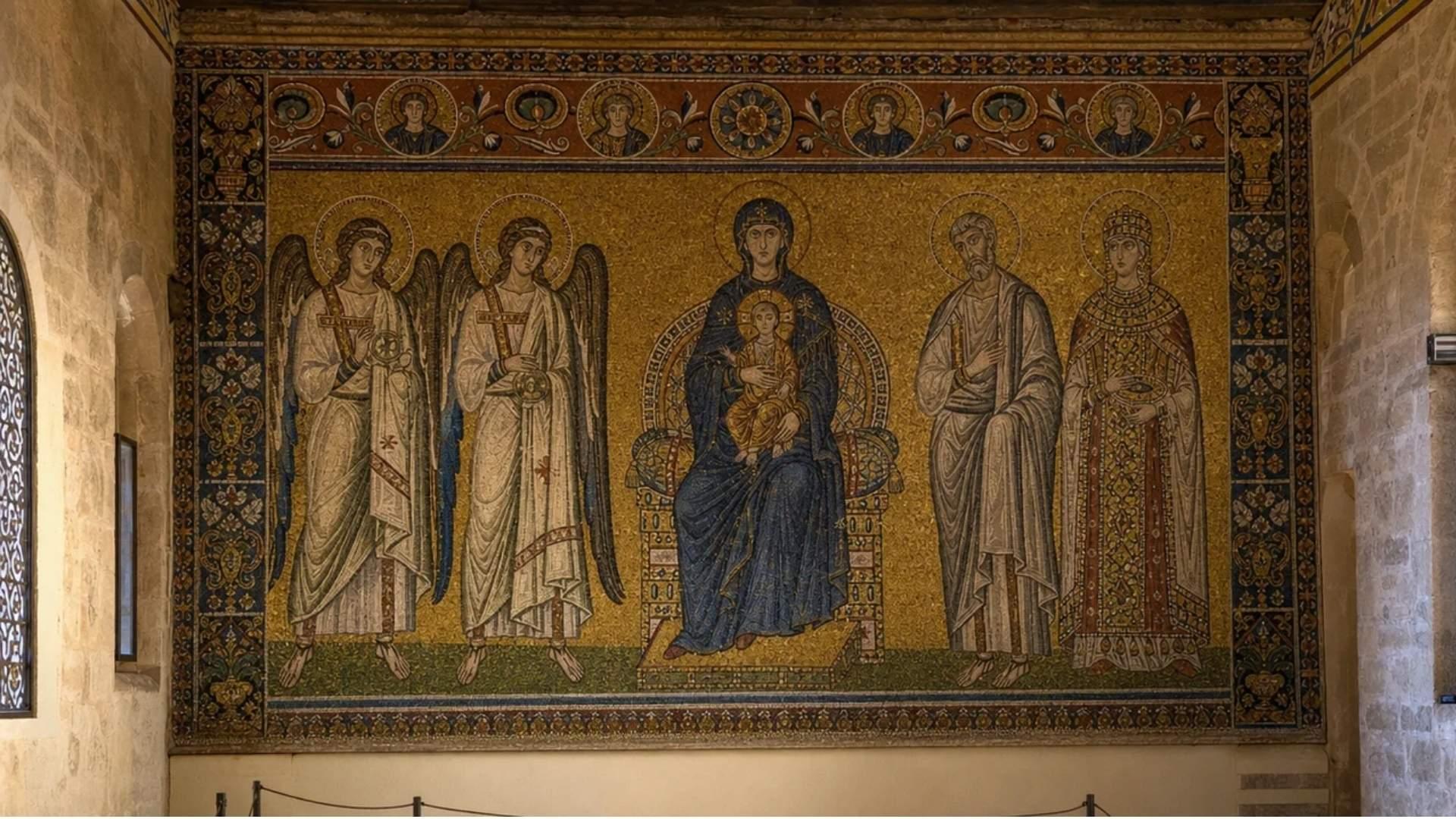
He’s arrived. He stands before saints and sages shown in gold mosaic on a wall, lit up as if they were standing in holy fire. He calls to them to step out of the flames, spin down in a spiral, and teach his soul to sing. Then he asks for something bigger.
He wants them to burn away his heart, because it’s tied to a dying body and doesn’t even understand itself.
And he wants to be gathered into a life that is made rather than born, one that lasts forever. Now the decision has become a prayer.
Stanza Four
If he’s freed from nature, he says, he’ll never take a natural shape again. He’ll be a bird of hammered gold, the kind Greek goldsmiths made to keep a sleepy emperor awake.
Or he’ll sit on a golden branch and sing to the lords and ladies of the court. His song will be about the past, the present, and what’s still to come. It’s a strange kind of heaven, and I’ll come back to why later.
What Does Byzantium Represent in the Poem?
Byzantium is the poem’s main symbol, so two questions help here:Why Yeats picked this city, and why the trip isn’t a real one.
Why Yeats Chose Byzantium
Byzantium is the old Greek name for Constantinople, the capital of the eastern Roman Empire. Today we call the city Istanbul.
Yeats had seen Byzantine mosaics on trips to Italy and Sicily, and they stuck with him. The figures are flat, gold, and glowing, and they look calm, as if they stand outside time.
In his book A Vision, he described the city around the sixth century as a place where religious life, art, and everyday work belonged together. Artists worked as part of a shared tradition instead of chasing personal fame.
I should be honest here. That’s Yeats’s picture, not a history lesson. The real city had plenty of politics and violence.
He wasn’t after accuracy. He wanted a symbol for a place where the spirit and the crafted object are one thing. I also think the old name helps. “Byzantium” sounds more distant and dreamlike than “Constantinople,” which suits a poem about leaving ordinary life behind.
A Journey of the Mind, Not a Real Trip
The “sailing” in the title is a metaphor. There’s no ship and no map. A few years later, in a radio talk, Yeats described the poem as being about the state of his soul, and the voyage as a way of picturing that.
This matters for how you read it. If you take the trip literally, the ending makes no sense, because nobody turns into a golden bird.
If you read it as a journey of the mind, the poem becomes about a shift in what he values. He moves from wanting the pleasures of the body to wanting what art and the spirit can hold.
If you enjoy the poem, it’s worth reading the follow-up Yeats wrote in 1930, called “Byzantium.” It pictures the city in a darker, more tangled way.
The Soul: Why It Has to Learn to Sing
The soul in this poem has to grow by learning, and it doesn’t just wait quietly for death. It sings, it studies, and it needs teachers.
I find that a fresh idea. Most of us picture the soul as something we already have, finished and fixed.
Yeats treats it more like a skill. For him, spiritual growth is work, and it takes practice. That’s why the sages in the gold wall matter so much.
They’re like music teachers for the soul, showing it how to find its voice before the body gives out.
Art: Why It Counts as a Way to Last
Art counts as a way to last because it makes things outlive their makers, though Shelley’s “Ozymandias” argues the opposite, that even the grandest human-made monuments eventually crumble
Made things don’t age the way bodies do, so becoming one feels like a way to escape. That’s why the speaker wants to be gathered into something crafted.
There’s a catch, though, and it works only up to a point. The golden bird still sings about the past, present, and future, so it’s still tied to time.
Some readers also hear a bit of irony in the ending, since a golden bird is a court decoration, not a free spirit. I don’t think the poem settles this. Yeats may not have fully settled it either.
Key Lines and Images Explained
Four images do most of the work in this poem. Once you see what each one stands for, the rest falls into place
The coat on a stick: It stands for the speaker’s old, worn-out body, seen from the outside like a scarecrow. A coat is only a coat until someone is inside it, and what fills it, he says, is the soul. The more the coat tears, the louder the soul has to sing, which flips the usual idea that age is only loss.
The dying animal: It stands for his body, and it isn’t meant as an insult. An animal is born to die, and his heart is stuck to one. The heart doesn’t understand what it’s fastened to, and that confusion is the pain of wanting what a tired body can’t do.
The sages in the fire: They stand for the teachers his soul needs. These are the holy figures in the gold mosaic wall, shown as if surrounded by flame. He asks them to step out and turn in a spiral, or gyre, an idea from Yeats’s book A Vision. You don’t need the whole system to follow the poem. Just picture teachers coming down to meet a student.
The golden bird: It stands for the lasting form he hopes to take, one that never ages. The bird is made of hammered gold, and its song means the soul’s voice lives on. But it’s also a made thing, built for an emperor’s court, and its job is to sing about time, the very thing the speaker wants to escape.
Form and Structure: Why the Poem Sounds So Formal
The poem sounds formal because its strict shape matches its theme: Order and things that last. A tight form is itself a made object, like the golden bird the speaker wants to become.
It has four stanzas of eight lines each, written in ottava rima, an Italian form with a set rhyme pattern.
The first six lines alternate their rhymes, and the last two rhyme together, like a lid clicking shut on each stanza.
Every line is iambic pentameter, five beats in a da-DUM, da-DUM rhythm that’s close to natural speech.
You could say the poem is built like a mosaic, with small pieces fitted tightly together. Yeats doesn’t hit the meter perfectly, though. A few lines bend and stretch, which keeps it from sounding like a machine.
Final Takeaway
Sailing to Byzantium says one simple thing:Getting old is hard, but it doesn’t have to silence your voice.
Yeats felt stuck in a body that was slowing down. So he looked for something bigger, like a soul that keeps learning and art that lasts.
I love that he doesn’t pretend it’s easy. He just points to a way forward. It’s a short poem with a big idea. That’s why it still feels real today.
We all feel out of place sometimes. Go back and read it once more, slowly. The scarecrow coat and the golden bird will make more sense now. Then drop a comment and tell me which image stayed with you.
Frequently Asked Questions
Which country is referred to in “Sailing to Byzantium”?
Most readers take it as Ireland, representing any world ruled by youth, sensual pleasure, and the cycle of birth and death that excludes the old.
What are some of the most famous lines from W. B. Yeats’ poem “Sailing to Byzantium”?
Some of the most famous lines from W. B. Yeats’s Sailing to Byzantium ” find aging, mortality, art, and the desire for lasting permanence beyond physical life.
What was W. B. Yeats’ most famous line?
Many people point to “Things fall apart, the centre cannot hold” from “The Second Coming,” though no single line is officially his most famous.
What is the rhyme scheme of “Sailing to Byzantium”?
The poem follows ottava rima with an ABABABCC pattern, with six alternating rhymes closed by a rhyming couplet in each stanza.
Is Byzantium and Sailing to Byzantium the same?
No, Byzantium and the Sailing to Byzantium poem are not the same thing, though they are closely connected


