



Most people know the man in the glass poem but cannot fully explain what it is actually saying. They feel it. They share it. But the meaning stays just out of reach.
Peter Dale Wimbrow Sr. wrote it in 1934. It is a short, direct piece about self-honesty and the gap between your public face and your private truth.
Here you will find what the poem means at its core, why the mirror is more than a symbol, what has kept it alive for over 90 years, and why recovery communities keep returning to it.
If you have read it and felt something without quite knowing why, this will help you put words to that feeling.
What Is "The Man in the Glass" Poem?
The man in the glass poem was written by Peter Dale Wimbrow Sr. in 1934 and first published in the American Magazine.
You might have seen it credited to "Dale Wimbrow", that is just the name he went by professionally. Same person, same poem.
One other thing worth clearing up:The original title was "The Guy in the Glass." Over the decades, as the poem passed from hand to hand through pamphlets, recovery groups, and locker room walls, the title shifted. "The Man in the Glass" is the version that stuck, and it is the one most people know today.
It is a short poem. Eight stanzas, plain language, no complicated imagery. What made it travel so far is not its style. It is its argument. And that is worth understanding properly.
What Does "The Man in the Glass" Poem Mean?
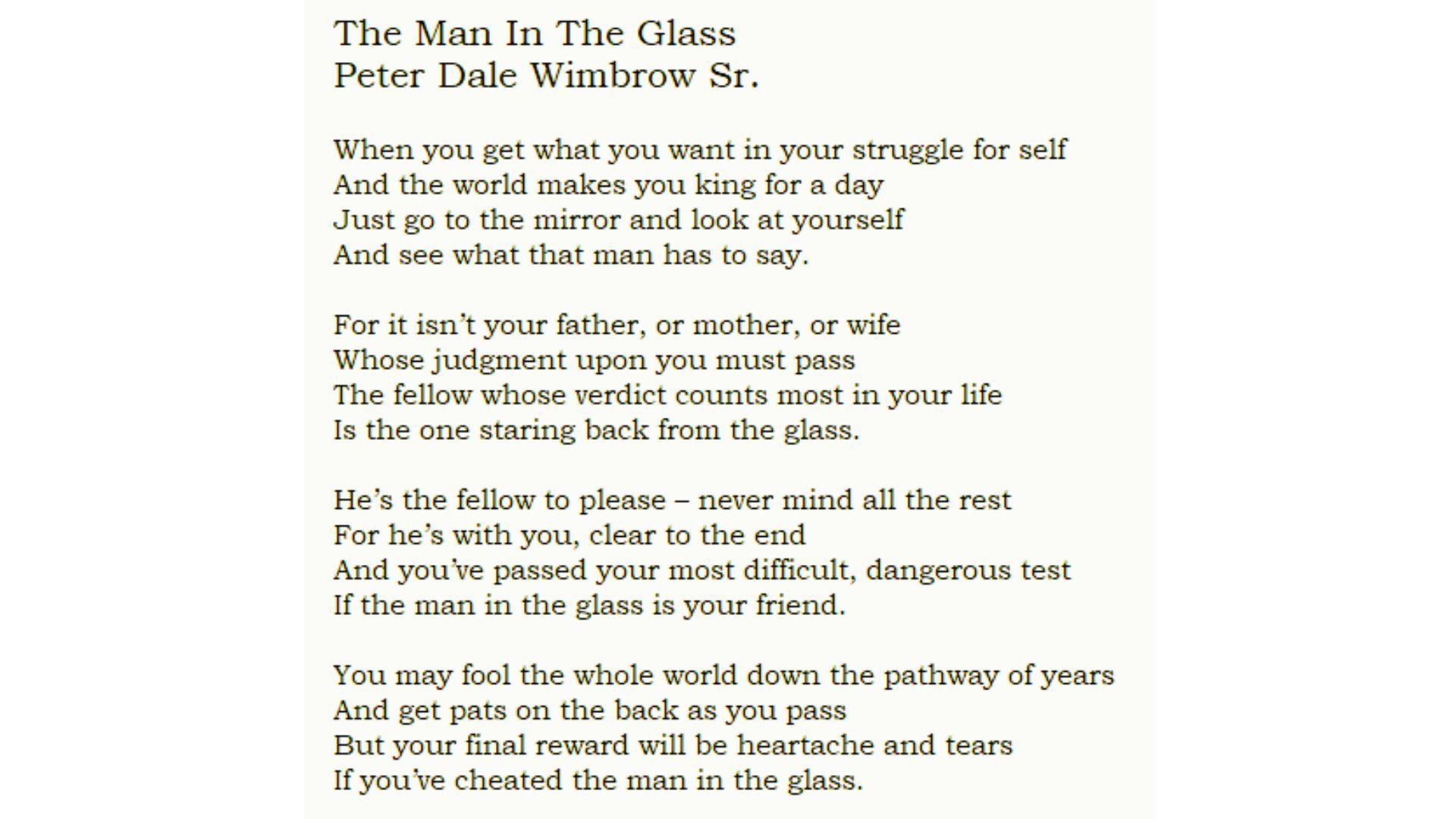
The man in the glass poem makes one argument: The only approval that actually counts is your own honest self-assessment, and you cannot fake that.
Most people come to this poem thinking it is about success. It is not. It is about the gap between how you look to others and what you know about yourself. That gap is where the whole poem lives.
The Mirror as the Final Judge
Think about every other judge in your life. Your boss, your friends, the crowd at whatever table you are trying to sit at. They only see what you show them. You can manage that. You can frame things, leave things out, say the right things at the right time.
The man in the glass cannot be managed.
He was there for all of it. Every shortcut you took. Every time you said one thing and did another. Every moment where you chose what looked good over what was right. You cannot edit what he saw.
That is why Wimbrow uses the mirror the way he does. It is not a symbol for vanity or self-obsession. It is the one witness in your life who holds complete information and has no reason to let you off the hook.
The poem's final question, whether the man in the glass will look back at you with respect, lands differently once you understand that. It is not asking if you feel proud. It is asking if you have actually earned it.
Why Public Approval Is Not the Point
Here is where most readings of the man in the glass poem go sideways.
Wimbrow opens with the world making you "king for a day." People read that as a starting point. Get the success first, then check in with the mirror. But that is backwards.
The poem is not saying success is bad. It is saying success is irrelevant to the verdict. You can fool every person in the room. You can win every award, collect every pat on the back, build the career that looks exactly right from the outside.
None of that changes what the man in the glass knows.
The two verdicts, public praise and private integrity, run on completely separate tracks in this poem. What the world thinks of you has no bearing on what your reflection thinks of you.
Wimbrow keeps them deliberately apart because mixing them is exactly the mistake the poem is warning against.
Once you see that, the poem stops being motivational in the usual sense. It is more of a quiet pressure, a reminder that whatever you are performing for other people, the one audience you cannot perform for is waiting at home.
Why Has This Poem Lasted Since 1934?
The man in the glass poem has stayed in circulation for over 90 years because its argument does not depend on any era, religion, or cultural frame to hold up.
Most writing from 1934 needs context to land. This poem does not. You can hand it to someone with no knowledge of the Great Depression and it still works. That is rare.
The structure is a big part of why. One scene. One mirror. One standard. It does not ask you to follow a system or join anything. It asks one question and leaves you with it.
The 1934 context does explain the tone though. This was a time when the gap between public image and private reality was enormous. Wimbrow was not writing about abstract integrity. He was writing about something his readers were living.
That is why it does not feel preachy. It just points at the mirror and lets the question sit there.
Where it breaks down is when people treat it as a pump-up read before a big moment. The man in the glass poem is about accountability after the fact, not motivation before it. Used as a mirror, it works. Used as a trophy, it misses the point entirely.
Why Do Recovery Communities Still Use This Poem?
Recovery asks one thing above everything else. Be honest with yourself. Not just about what you did, but about who you were when you did it.
The man in the glass poem puts that ask in plain language without attaching it to any program, religion, or rulebook. It just holds up the mirror and asks whether the person looking back is someone you can respect.
That is why it travels so well inside recovery spaces. Someone on day one and someone ten years in can read the same lines and both feel the weight of it.
The poem also does not promise that honesty will be easy or that facing your reflection will feel good. It just says that it is the only verdict that counts. Recovery communities understand that framing because it matches what the process actually feels like.
It is not asking you to be better for anyone else. It is asking you to stop lying to yourself. In recovery, that is not a motivational idea. It is the whole work.
Conclusion
The man in the glass poem has one job. It asks you to be honest with yourself when no one else is watching.
You now know who wrote it, what it actually argues, why it has lasted this long, and why it means something particular inside recovery spaces.
If this poem has stayed with you, share it with someone who needs that kind of quiet reminder. And if you want to find more poems that carry real weight, check out our other poetry breakdowns on RememberedLore.
Frequently Asked Questions
Who is Peter Dale Wimbrow Sr.?
He was an American entertainer, songwriter, and writer who contributed to radio and print media in the early twentieth century. The poem remains his most recognised work.
Is "The Man in the Glass" poem in the public domain?
Yes. The poem was published in 1934, making it old enough to have entered the public domain in most countries, including the United States.
How long is "The Man in the Glass" poem?
The poem contains eight stanzas with four lines each, making it thirty-two lines total. It is a short read, typically under two minutes.
Has "The Man in the Glass" poem appeared in any books or films?
The poem has been referenced in various self-help books, motivational literature, and sports coaching contexts, though it has not been adapted into a major film.
Is there a specific audience "The Man in the Glass" poem was written for?
Wimbrow wrote it for a general magazine readership. It was not aimed at any specific group, which is partly why it has resonated so broadly across different communities.