


Somewhere in a drawer there is probably a poem shaped like an apple, written in pencil on lined paper, with the words squeezed in wherever they fit.
That small classroom exercise is shape poetry, a form in which the words draw the thing they describe, and it is older and more flexible than the apple suggests.
The outline forces every word to earn its place, which is why the form still works for writers of any age, from second graders to adults in a community workshop.
Below, you’ll find the form’s history, a five-step writing method, three ways to fit text into an outline, shape poem ideas by grade level, and a 45-minute lesson plan.
What Is Shape Poetry?
Shape poetry, also known as pattern poetry or shaped verse, is poetry whose visual arrangement mirrors its subject.
The poet sizes and breaks lines so the text forms a recognizable outline, such as a tree, a heart, or a raindrop.
Readers take in the shape and the words together, and each should strengthen the other.
The outline works as a visual metaphor. A poem about a snail that coils into a spiral signals slowness before the reader reaches the first word, and a poem about freedom locked inside a rigid square makes its point through contrast.
Either choice works as long as it is deliberate, and the test for any shape poem is whether the outline adds something the words alone would not.
Shape poetry is often used interchangeably with concrete poetry, but the terms are not identical.
Concrete poetry is the wider category, covering any poem where typography and layout carry meaning, such as spacing, repeated letters, and fonts.
In contrast, a shape poem specifically forms the outline of its subject. Once drawing with words feels steady, these concrete poem examples show where poets take the idea next.
Famous Examples Through History
Shape poetry has a long record, and four stops show how the form has changed.
Ancient Greece
The oldest surviving shape poetry examples come from Hellenistic Greece, where six pattern poems took the forms of two altars, an egg, a syrinx, an ax, and a pair of wings, according to Edward Hirsch on pattern poems at the Poetry Foundation.
Simmias of Rhodes wrote the egg, the wings, and the ax.
George Herbert’s “Easter Wings”
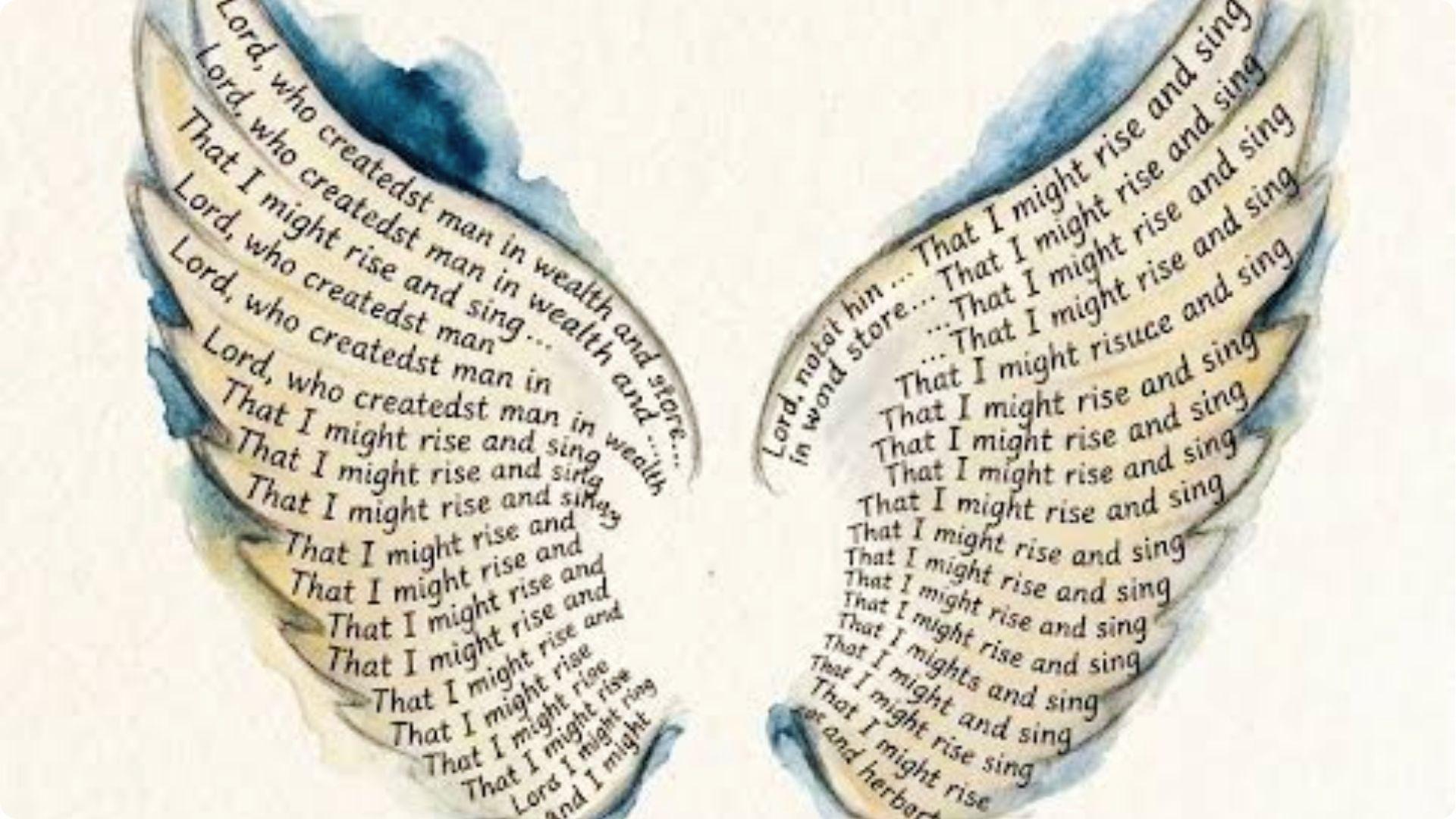
The best-known English examples are Herbert’s “The Altar” and “Easter Wings,” published after he died in The Temple (1633).
In “Easter Wings,” the lines narrow until the speaker reaches “Most poor” (a brief excerpt from a public domain poem) and then widen as he asks to rise.
Lewis Carroll and Guillaume Apollinaire
Carroll printed “The Mouse’s Tale” in a curling tail in Alice’s Adventures in Wonderland (1865), a visual pun on “tale” and “tail.”
Apollinaire, who coined the term Calligrammes for his 1918 collection, set the lines of “Il pleut” slanting down the page like rain on a windowpane.
The Noigandres Group in Brazil
In 1950s Brazil, the Noigandres group, formed in 1952 in São Paulo by Haroldo de Campos, Augusto de Campos, and Décio Pignatari, pushed the idea toward concrete poetry and published its Pilot Plan for Concrete Poetry in 1958.
How to Write a Shape Poem
To write a shape poem, choose a simple subject, brainstorm words and images for it, draft the poem as ordinary lines, sketch the outline, and fit the words into it, revising as you go.
Write the poem first and the shape second, because forcing weak words into a shape rarely produces a poem worth reading.
- Choose a subject with a clear silhouette: Pick something a reader would recognize from its outline alone, such as a tree, a moon, a house, or a wave, and avoid subjects with thin or crowded details. If nothing comes to mind, the shape poem ideas further down this page cover every grade level.
- Brainstorm words and images: List what the subject looks like, sounds like, and feels like, then add one comparison that goes beyond appearance, the kind of image covered in our guide to figurative language in poetry. Five to ten strong words usually give you enough material to start.
- Draft the poem as ordinary lines: Write it plainly, without thinking about the outline, and keep it short because a shape can only hold so many words. Reading the draft aloud now will show you which lines carry the poem.
- Sketch the outline: Draw the shape lightly in pencil, large enough to hold your words and simple enough to draw in a few strokes. On a computer, the basic shape tools in a word processor do the same job.
- Fit the words and revise: Break lines where the outline pushes them, swap or cut any word that will not fit, and keep the best images even if the shape has to bend. Read the finished poem aloud once more, and move any line break that makes you stumble.
Three Ways to Fit Text
Step five hides a choice, because words can meet an outline in three ways.
- Writing inside the outline suits beginners and short poems, since each line fills the width of the shape at that height.
- Tracing the outline runs one curling line of text along the edge, which works for thin or detailed subjects such as a spiral or a snake and leaves the center open for a title.
- Building the shape on screen skips the pencil guide and uses line breaks, centering, and spacing until the lines form a diamond or an hourglass, and a monospaced font such as Courier keeps the edges straight.
Whichever method you choose, keep the poem to six to twelve lines, since too many lines turn an outline into a block of text, and simplify the shape before shrinking the type if the curves get too tight to read.
Shape Poem Ideas by Grade Level
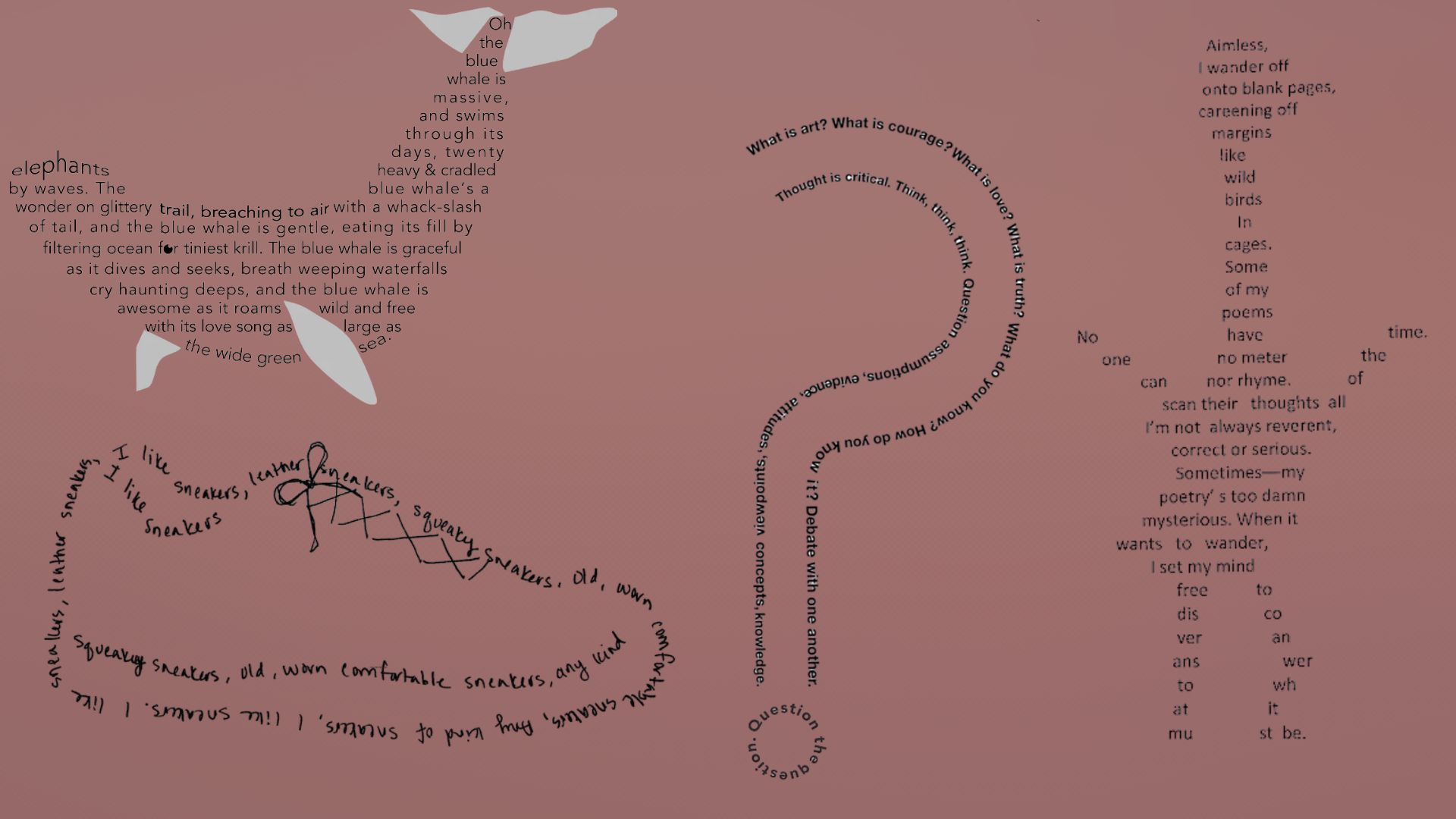
Common choices such as an apple or a star work for a first draft but give older writers little to push against. These ideas move from concrete objects toward subjects where the outline carries an argument.
Shape Poetry for Kids
Choose subjects a child can describe with all five senses, such as a snail spiral, a kite diamond, a snowman built from three circles, a leaf in fall, or a rain cloud.
Ask for one line about how the subject looks, one about how it feels or sounds, and one about what it does.
Middle School Ideas
Students can start choosing a shape for what it suggests as well as what it looks like.
An hourglass suits a poem about waiting, a staircase suits learning something hard, with each line a little longer than the last, and a bridge suits a friendship that survived an argument.
Ask what the outline says that the words do not.
Teen and Adult Shape Poem Ideas
Use shape to hold abstract or emotional subjects, such as a bare tree for a loss, a closed fist for restraint, or a house that narrows toward its door for a childhood home.
A shape that contradicts the words, like calm broken into jagged, uneven lines, adds irony.
In community writing groups, a shape poem also makes a good ten-minute warm-up, since the outline sets a limit and removes the pressure of a blank page.
A 45-Minute Lesson Plan
A shape poem lesson fits into 45 minutes with a model, draft, shape, and share sequence.
Writers study one model poem, draft plain lines, fit them into an outline, and then share and review.
This order keeps the focus on the poem before the shape, so the outline supports the writing instead of replacing it.
- Model (5 minutes): Show “Easter Wings,” which is in the public domain, on a screen or handout and read it aloud. Ask where the lines narrow and what the speaker is describing at that moment.
- Draft (15 minutes): Writers pick a subject, brainstorm for two minutes, and write plain lines with no outline in sight. Pairs swap drafts and check whether a reader can see, hear, and feel the subject.
- Shape (15 minutes): Each writer chooses one of the three methods above and fits the draft into an outline, cutting words as needed.
- Share and review (10 minutes): Reviewers ask whether the outline matches the subject, whether the shape adds meaning the words alone would not, and whether every word earns its space. Each reviewer names one line where shape and meaning agree and one place where the outline forced a weak word.
For adults in a workshop, give the drafting block more time or assign the draft beforehand.
Teachers of younger students can borrow from the ReadWriteThink shape poem lesson for grades 1 to 3, which opens with a read-aloud and a class-written sample poem.
Its online tool places words inside a shape without always forming the shape itself, so treat that tool as a related form.
Words First, Outline Second
Shape poetry works when the outline and the words say the same thing, and the strongest results come from choosing a simple subject, drafting plain lines first, and fitting them into a shape afterward.
Herbert’s wings, Carroll’s tail, and Apollinaire’s rain all follow that rule, and so does a short snail poem written in a classroom.
Pick one subject from the ideas above, give yourself fifteen minutes, and write the plain draft today. The shape can wait until that draft is ready.
Frequently Asked Questions
Do Shape Poems Have to Rhyme?
No. Shape poems have no required rhyme scheme or meter, so rhyme is a choice rather than a rule. Short rhymed lines can suit young writers, but imagery and the fit between shape and meaning matter more than sound.
How Is a Shape Poem Different From an Acrostic Poem?
An acrostic spells a word down the page with the first letter of each line, so its pattern hides in the letters. A shape poem shows its pattern through the outline of the whole text. Writers can combine the two by tapering an acrostic’s lines into a rough shape.
Can Shape Poems Work in Science or Math Lessons?
Yes, when the topic has a clear visual form. Students can summarize the water cycle inside a raindrop or the layers of Earth in a circle. Choosing which terms fit the shape pushes writers to prioritize the key vocabulary.