

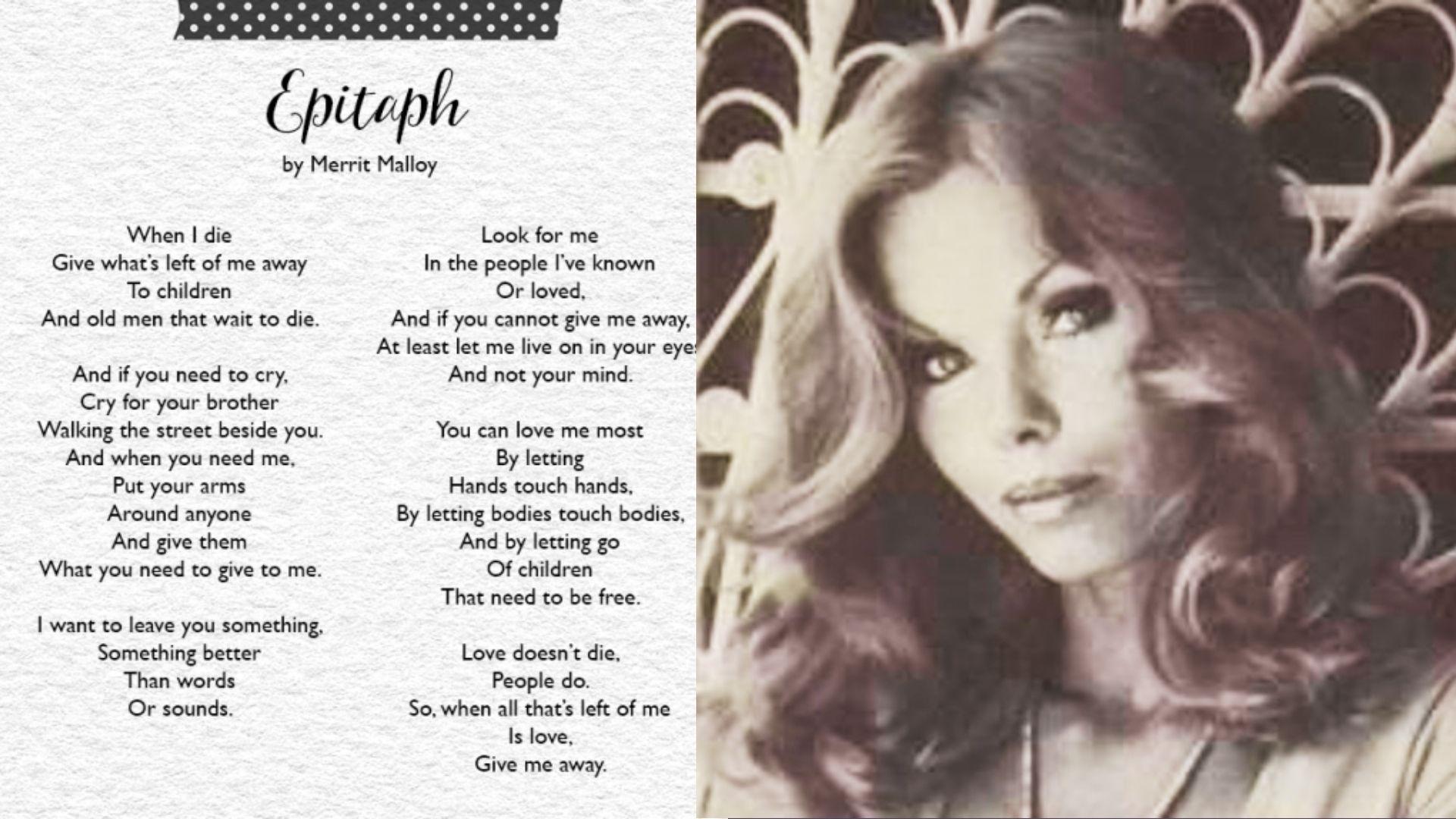
I first read this poem at a funeral. It stopped me cold.
Merrit Malloy’s “Epitaph” is one of those poems that people read when words feel impossible. It shows up at memorials, in grief cards, and on social media after a loss. And there’s a reason for that.
In this blog, I’m going to break it down for you completely. You’ll get the full text, a clear summary, the deeper meaning, themes, literary devices, and a look at the author herself.
I’ve studied this poem closely so you don’t have to dig around on your own.
By the end, you’ll understand exactly what Malloy was saying and why it still hits so hard.
Full Text of the Epitaph Poem
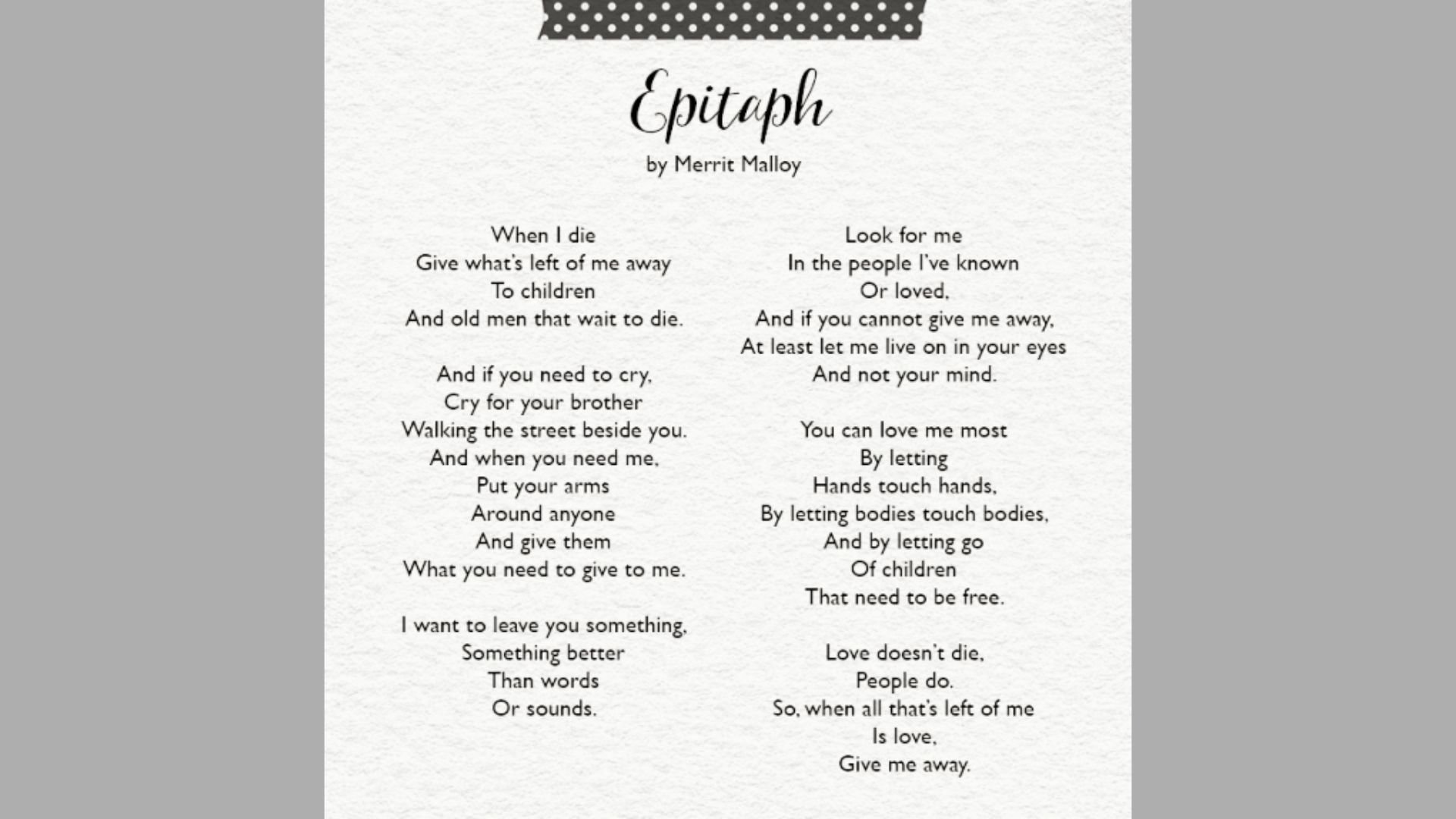
The poem begins with a simple request. The speaker asks to be “given away” after death. Not buried and mourned, but shared.
Given to strangers, to friends, to anyone who needs something the speaker once had.
She asks that her eyes, her hands, her laughter, and her love all go somewhere useful. She wants to live inside others rather than in a grave.
The last lines are the ones people remember most. She says that if you want to find her, look for her in the people she loves. That’s where she’ll be.
The full poem is widely available online and often printed in memorial programs.
Summary of the Epitaph Poem
At its core, this poem is about giving yourself away completely.
The speaker knows she will die. Instead of asking for grief, she asks the people left behind to pass her along.
Her love goes to someone who needs love. Her joy goes to someone who has lost theirs.
She sees death not as an ending but as a kind of redistribution. Everything she was gets passed on.
It’s a generous idea. And a comforting one.
Meaning of Epitaph by Merrit Malloy
“Give Me Away”
This phrase is the backbone of the poem. The speaker is not asking to be remembered in the usual way. She’s asking to be used. Passed on. Kept alive through action rather than memory alone.
It’s a radical kind of love. Most of us want to be remembered. She wants to be given forward.
Love as a Living Legacy
Malloy believes love doesn’t belong to one person. It passes between people. It moves.
When someone dies, the love they gave doesn’t disappear. It lives in the people who received it. And those people can pass it on again.
That’s the idea at the center of this poem. Love keeps moving even when the person who started it is gone.
The Poem’s View of Grief, Memory, and Human Connection
Malloy doesn’t ask you not to grieve. She just asks you to do something with the grief.
Instead of holding onto loss, she wants you to let her move through you and into someone else. Grief becomes action. Memory becomes generosity.
She also says something important about connection. We don’t exist alone. We exist in each other. When she says to find her in the people she loved, she’s saying that identity doesn’t end at death. It spreads.
Themes in the Epitaph Poem
The poem is short, but it covers a lot of ground.
Love Does Not Die
This is the biggest theme. Love outlasts the body. It lives in the people who carry it forward.
Malloy frames death as something love can survive. That’s a hopeful idea, and it’s why this poem gets read at so many funerals.
Generosity and Giving to Others
The speaker doesn’t hold on to anything. She gives her eyes, her hands, her laughter. There’s no clinging here.
That kind of open-handed generosity is rare. The poem holds it up as something worth aiming for.
Letting Go and Accepting Loss
The poem accepts death without fighting it. There’s peace in the speaker’s voice. She’s not afraid. She’s ready to be passed on.
That acceptance makes the poem feel calm instead of sad.
Human Relationships as a Lasting Legacy
We often think of legacy as something built. A career. A building. A name on something.
Malloy says no. The real legacy is the people you loved and who loved you back. That’s what lasts.
Literary Devices Used in Epitaph
Good writing uses tools, and this poem uses them well.
1. Repetition and Its Emotional Impact
The phrase “give me away” repeats throughout the poem. Each time it lands a little harder.
Repetition in poetry builds feeling. By the time you reach the end, the phrase feels like a chant. Something close to prayer.
2. Symbolism of Giving and Touch
Eyes, hands, laughter. These are not random choices. They represent how we connect with each other physically and emotionally.
Giving away her eyes means giving her way of seeing the world. Giving away her hands means giving her ability to reach out and touch others. It’s symbolic but grounded in real, physical things.
3. Imagery and Simple Language
Malloy keeps the language plain. No complicated words. No long metaphors.
That simplicity is a choice. It makes the poem feel personal. Like she’s talking to you directly.
4. Free Verse Structure
The poem doesn’t follow a set rhyme scheme or meter. It moves the way conversation moves. Naturally.
That keeps it from feeling stiff or formal. It reads like something someone actually said, not something composed for effect.
Form, Structure, and Style of the Poem
The poem is short. The lines vary in length. Some are just a few words. Others stretch a little longer.
That variation creates rhythm without forcing it. The poem breathes.
There’s no single turning point or dramatic shift. The whole thing holds the same quiet, steady tone from start to finish. That consistency is part of what makes it feel trustworthy.
About the Author

Merrit Malloy was an American poet and author. She wrote across several decades and worked in both poetry and creative nonfiction.
She’s not a household name in academic poetry circles, but her work reached people in a real way.
“Epitaph” became widely shared, especially at memorials, because it said something true about loss that most people couldn’t find words for on their own.
There’s not a lot of widely available biographical detail about her, but the poem speaks for itself.
Conclusion
I came back to this poem many times while writing this.
It’s not a complicated poem. But it carries something heavy and kind at the same time.
Malloy figured out how to write about death without making it dark. She made it feel like an act of love instead.
The idea that we live on inside the people we touched, that’s not new. But the way she says it here is direct and honest in a way that cuts through.
If you’ve read this poem at a loss or are reading it now to understand it better, I hope this helped you see what she was really saying.
It’s simple. Give love away. Keep giving it. That’s how it stays alive.
What do you think? Does this poem change how you see grief?
Frequently Asked Questions
What is the main message of the Epitaph poem by Merrit Malloy?
The poem asks that love be passed on after death rather than held in grief. Malloy sees love as something that keeps moving through people long after someone is gone.
Why is the Epitaph poem so popular at funerals?
It gives mourners something to hold onto without making death feel final. It frames loss as something that can still carry meaning and be shared forward.
What does “give me away” mean in the poem?
It means the speaker wants her love, joy, and spirit distributed to others rather than buried with her. It’s about staying alive through the people you’ve loved.
What literary devices does Merrit Malloy use in Epitaph?
She uses repetition, simple imagery, symbolism, and free verse. These choices keep the poem grounded and emotionally direct without feeling overdone.
Who is Merrit Malloy?
She is an American poet whose work reached wide audiences, especially through this poem. Though not widely covered in academic settings, her writing connected with ordinary readers in a lasting way.