


The Train of Life Poem by James S. Tippett is one of those rare pieces that feels like it was written just for you.
I remember reading it for the first time and feeling a quiet ache.
It put into words something I had never been able to say. In this post, I cover the full meaning, key themes, and why this poem still matters today.
I have spent years reading and writing about poetry, so you can trust what you find here.
Let’s get into it.
Meaning of “The Train of Life” Poem
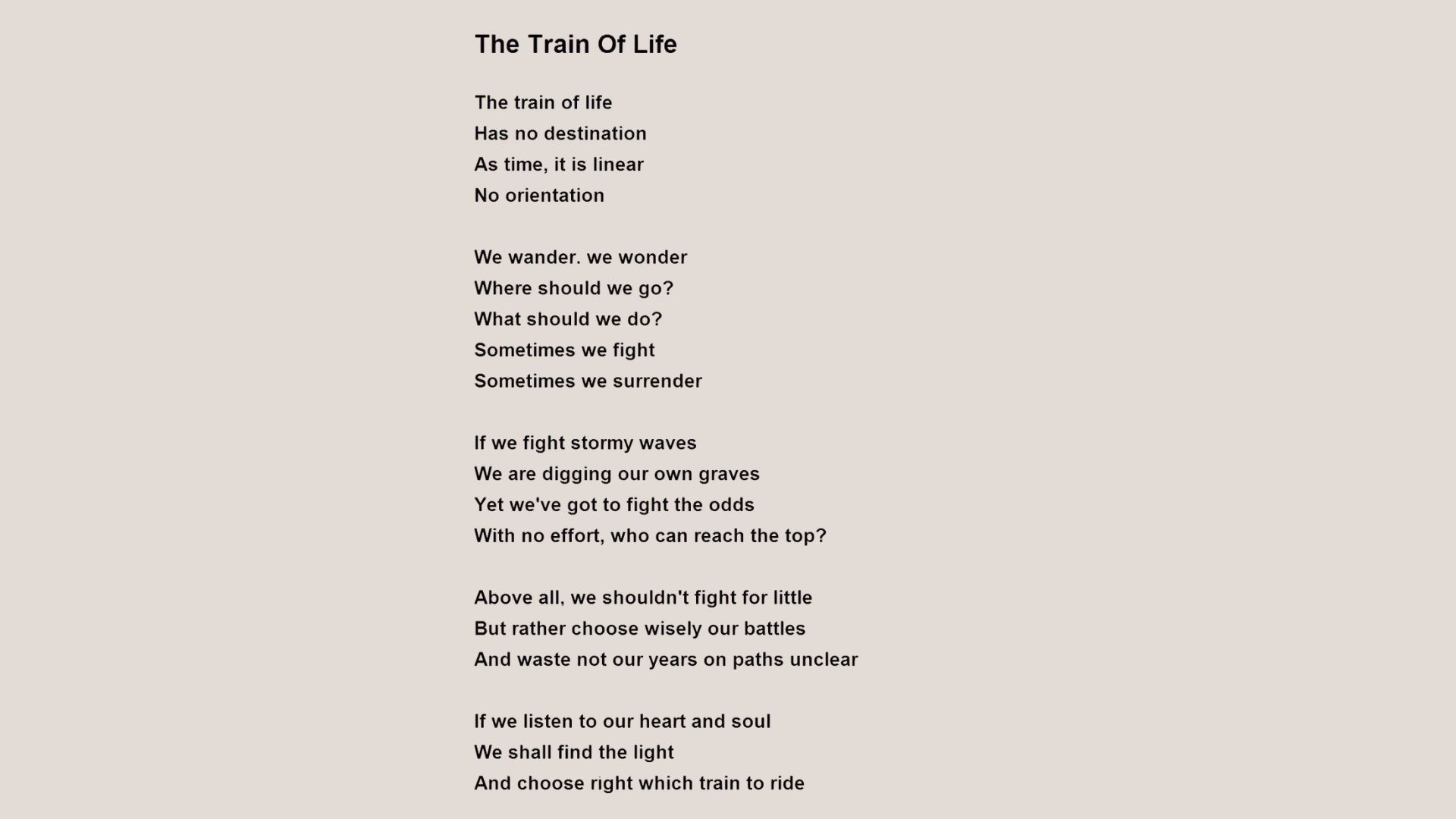
The train stands in for life from start to finish. Each person boards at birth and rides until the final stop.
Parents are already on when we arrive. Friends join at different stations and some leave sooner than we want.
No one gets a schedule. We do not know when the last stop comes, and the poem asks us to accept that rather than fight it.
What we can control is how we treat the people riding with us. That choice matters most.
Themes in The Train of Life Poem
Each theme in this poem speaks to something real that every person goes through.
Theme of Life as a Journey
Life as a train ride sits at the center of this poem. We all start from the same kind of place. We all end at the same kind of place.
What differs is what happens in between. The poem asks us to pay attention to the ride itself, not just where it ends.
This theme speaks to anyone who has ever stopped to ask what life is actually for.
Theme of Relationships and Connections
Every person we love is a fellow passenger. The poem puts this idea front and center. We share our ride with parents, siblings, friends, and partners.
Some travel with us for years. Others leave sooner than we want. But each one adds something real to the trip.
This theme invites readers to think about the people in their own lives and how much those people truly matter.
Theme of Loss and Separation
People we love get off the train. We cannot follow them. We cannot bring them back. This is a hard truth, and the poem does not sugarcoat it.
But it does not leave us stuck in grief either. It reminds us that separation is part of life.
Feeling the loss shows the connection was real. That matters, even when it is painful.
Theme of Love and Compassion
The poem gently pushes us to love the people near us. Be present. Be kind. Do not wait.
I feel this theme personally every time I read the poem. Life moves fast. We get busy. We forget to show care.
This poem is a soft reminder to slow down and notice the people sharing your ride. Small acts of love tend to leave the biggest marks.
Theme of Life’s Uncertainty
We do not know the schedule. We do not know the stops. The poem is clear-eyed about this. Life is not predictable.
People leave when we least expect it. Plans fall apart. The poem does not offer false comfort. It simply asks us to accept what we cannot control.
That kind of acceptance is not giving up. It is choosing to live fully with what you have right now.
Relevance of The Train of Life Poem Today
This poem has been shared across the internet for decades, and it keeps finding new readers for good reason.
Universal Message Across Generations
This poem works for a teenager who just lost a friend. It works for an adult who lost a parent. It works for anyone who has felt the weight of goodbye.
The message does not age. People from all walks of life connect with it because it speaks to something every human being goes through.
That kind of reach is rare. It is why the poem keeps getting passed along, year after year.
Emotional Comfort During Loss
When someone we love passes, we look for words. The Train of Life Poem by James S. Tippett gives us some of those words.
It does not erase the pain. But it puts grief into a frame that feels honest. The idea that everyone has a stop, and that stops are a natural part of life, helps people cope.
Many readers have said this poem helped them through some of their hardest moments. That is no small thing.
Life Reflection and Personal Growth
Reading this poem makes you stop and ask real questions. Who is on your train right now? Are you treating them well? These are not hard questions.
But they can shift the way you live. I come back to this poem when life feels too fast.
It grounds me. It reminds me of what actually matters. A poem that makes you want to be better at living is doing exactly what good writing should do.
About the Poet: James S. Tippett

James S. Tippett was an American poet born in 1885. He was known for writing in a way that felt grounded and personal.
His work often focused on everyday life and the feelings that come with it. Tippett had a real gift for taking big, heavy ideas and putting them into clear, simple language.
He passed away in 1958. During his lifetime, he wrote many pieces across different subjects.
But The Train of Life Poem is by far his most widely shared work. It continues to reach new readers each year, long after his passing.
His words have outlived him in the best way possible.
Conclusion
The first time I read The Train of Life Poem by James S. Tippett, I thought about everyone on my train.
The people I love. The ones who left too soon. It is a poem that stays with you.
If it moved you too, do not keep it to yourself. Share this post with someone who needs it today.
Drop a comment below and tell me who you thought of while reading. I would love to hear from you.
Frequently Asked Questions
Who wrote The Train of Life poem?
James S. Tippett wrote it, and it has been widely shared online and in print for many decades.
What is the main message of The Train of Life poem?
The poem reminds us to treat others with kindness because no one knows how long their ride will last.
Is The Train of Life poem suitable for funerals or memorial services?
Yes, many people read it at memorial services because it offers a gentle and honest way to think about loss.
What does the train symbolize in the poem?
The train stands for life itself, with each stop representing a different stage or moment we pass through.
Why do people still share The Train of Life poem today?
People share it because the message is simple, honest, and speaks to feelings that stay with us no matter how much time passes.