




It is almost midnight, your thumb is hovering over the send button, and the message on your screen still sounds like a greeting card.
The short poems that move her most do this by saying one thing completely and making the speaker smaller than the person addressed.
Yeats offers only his dreams, Dickinson offers proof, and Jonson turns down a god’s wine, which is why short poems to make her feel special work best when they confess something instead of complimenting.
After a week of carrying everyone else’s problems, she doesn’t want a polished sentence, only a sign someone noticed.
Seven poems follow in full, each with one detail worth noticing, plus a way to borrow a poet’s move for your own lines.
If the moment matters more than the mood, see our poems sorted by occasion guide.
Why Brevity Reaches Her Faster Than Length
A short poem reaches her faster because it leaves no room to hide.
In 4 to 16 lines, every word has to carry weight, the speaker usually talks straight to her, and the final line turns the poem toward a feeling she can keep. A long poem can wander, a short one lands.
Reading all seven together shows what that compression does. A compliment tells her she is wonderful, which she has heard before.
These poems show what the speaker would give up, admit, or refuse, and that is the difference between feeling flattered and feeling chosen.
The last line does much of the work: Jonson’s closes a whole image of a wreath in six words, and Yeats’s is the only command in his poem.
For more brief options to sit alongside these, see our short poem for someone special post.
Deep Short Poems for Her That Offer Everything You Have

The first three poems share a quiet admission: the speaker has less than the other person deserves and offers it anyway.
Reach for them when she needs to feel chosen on an ordinary Tuesday, not only on an anniversary.
“He Wishes for the Cloths of Heaven” by W. B. Yeats
Yeats published this in 1899 in The Wind Among the Reeds, spoken by Aedh, one of his lovelorn characters.
Notice the pivot at “But I, being poor,” where a grand wish becomes a small, true offer.
Had I the heavens’ embroidered cloths,
Enwrought with golden and silver light,
The blue and the dim and the dark cloths
Of night and light and the half-light,
I would spread the cloths under your feet:
But I, being poor, have only my dreams;
I have spread my dreams under your feet;
Tread softly because you tread on my dreams.
Credit: William Butler Yeats, “He Wishes for the Cloths of Heaven,” first published as “Aedh Wishes for the Cloths of Heaven” in The Wind Among the Reeds (1899). Public domain.
“I Would Live in Your Love” by Sara Teasdale
Teasdale’s four lines first appeared in Helen of Troy and Other Poems (1911) and were reprinted in Love Songs (1917), the text used here. Notice the paired verbs “borne up” and “drawn down,” which make the surrender sound calm instead of desperate.
I would live in your love as the sea-grasses live in the sea,
Borne up by each wave as it passes, drawn down by each wave that recedes;
I would empty my soul of the dreams that have gathered in me,
I would beat with your heart as it beats, I would follow your soul as it leads.
Credit: Sara Teasdale, “I Would Live in Your Love,” first published in Helen of Troy and Other Poems (1911); reprinted in Love Songs (1917). Public domain.
“That I Did Always Love” by Emily Dickinson
Dickinson wrote this around 1863, and it was first printed in 1896 under the title “Proof”; the text follows that 1896 printed version. Calvary, the hill of Christ’s crucifixion, makes the ending heavy, so send only the first four lines if that is too much.
That I did always love,
I bring thee proof:
That till I loved
I did not love enough.
That I shall love alway,
I offer thee
That love is life,
And life hath immortality.
This, dost thou doubt, sweet?
Then have I
Nothing to show
But Calvary.
Credit: Emily Dickinson, “That I Did Always Love” (also titled “Proof”), composed c. 1863; first published in Poems: Series One (1896). Public domain.
Romantic Poems to Make Her Cry Happy Tears

Tears over a poem are not always sad ones. The next two poems are about being answered, once with a rush of joy and once with a flirtatious turn, and both belong among the romantic short poems for her to make her cry the good way.
“A Birthday” by Christina Rossetti
Rossetti’s poem ran in Macmillan’s Magazine in April 1861, as the University of Toronto’s Representative Poetry Online entry records, and appeared in Goblin Market and Other Poems (1862). Notice that both stanzas end on “my love is come to me.”
My heart is like a singing bird
Whose nest is in a water’d shoot;
My heart is like an apple-tree
Whose boughs are bent with thickset fruit;
My heart is like a rainbow shell
That paddles in a halcyon sea;
My heart is gladder than all these
Because my love is come to me.
Raise me a dais of silk and down;
Hang it with vair and purple dyes;
Carve it in doves and pomegranates,
And peacocks with a hundred eyes;
Work it in gold and silver grapes,
In leaves and silver fleurs-de-lys;
Because the birthday of my life
Is come, my love is come to me.
Credit: Christina Rossetti, “A Birthday,” first published in Macmillan’s Magazine, April 1861; collected in Goblin Market and Other Poems (1862). Public domain.
“Song: To Celia” by Ben Jonson
Jonson first printed this in The Forest (1616), and it was later set to music as “Drink to Me Only with Thine Eyes.” Watch the final image: the wreath she returned now smells “Not of itself, but thee.”
Drink to me only with thine eyes,
And I will pledge with mine;
Or leave a kiss but in the cup,
And I’ll not look for wine.
The thirst that from the soul doth rise
Doth ask a drink divine;
But might I of Jove’s nectar sup,
I would not change for thine.
I sent thee late a rosy wreath,
Not so much honouring thee
As giving it a hope, that there
It could not withered be.
But thou thereon didst only breathe,
And sent’st it back to me;
Since when it grows, and smells, I swear,
Not of itself, but thee.
Credit: Ben Jonson, “Song: To Celia,” first published in The Forest (1616). Public domain.
Poems That Tell Her She Takes Your Breath Away

Admiration is a different feeling from devotion. The speaker gives nothing up here and only stops in his tracks, and these two poems catch that stop, one with ancient ships and one with silk.
“To Helen” by Edgar Allan Poe
Poe first printed this in 1831, and the 1845 text below follows the Poe Society’s publication notes.
It honors Jane Stanard, a schoolmate’s mother who died in 1824, and likens her beauty to a ship carrying a weary traveler home.
Helen, thy beauty is to me
Like those Nicean barks of yore,
That gently, o’er a perfumed sea,
The weary, way-worn wanderer bore
To his own native shore.
On desperate seas long wont to roam,
Thy hyacinth hair, thy classic face,
Thy Naiad airs have brought me home
To the glory that was Greece,
And the grandeur that was Rome.
Lo! in yon brilliant window-niche
How statue-like I see thee stand,
The agate lamp within thy hand!
Ah, Psyche, from the regions which
Are Holy-Land!
Credit: Edgar Allan Poe, “To Helen,” first published in Poems (1831); revised text from The Raven and Other Poems (1845). Public domain.
“Upon Julia’s Clothes” by Robert Herrick
Herrick printed this in Hesperides (1648). “Whenas” means “when” and “taketh me” means “captivates me.” It praises how she moves, so keep it for a partner.
Whenas in silks my Julia goes,
Then, then (methinks) how sweetly flows
That liquefaction of her clothes.
Next, when I cast mine eyes, and see
That brave vibration each way free,
O how that glittering taketh me!
Credit: Robert Herrick, “Upon Julia’s Clothes,” first published in Hesperides (1648). Public domain.
Borrow a Poet’s Move to Write Your Own
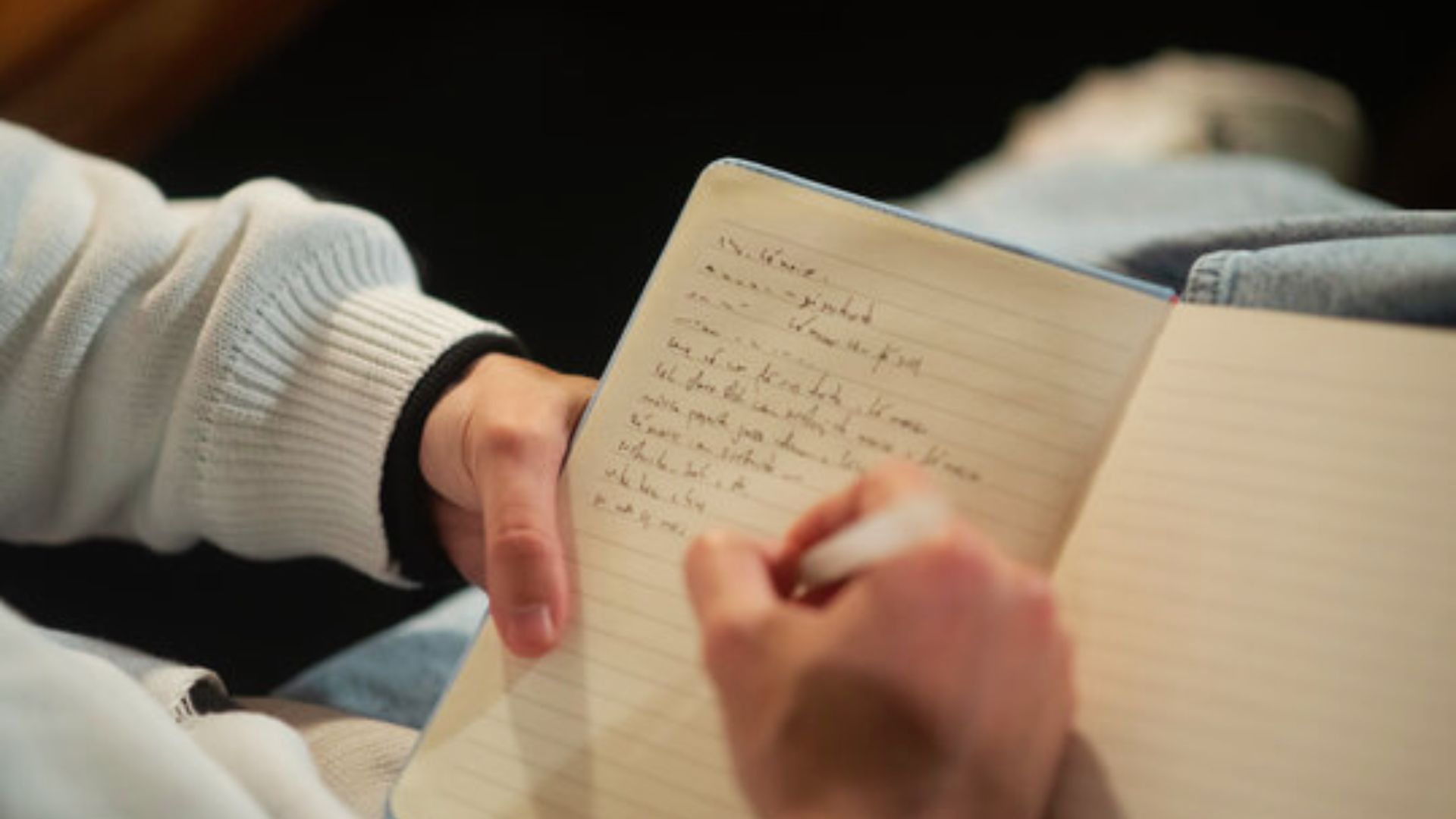
You can write a short poem for her by borrowing one move from a poet instead of facing a blank page.
The poems above give you three: confess that your gift is smaller than she deserves, offer one piece of proof that you pay attention, or refuse every alternative in favor of her. Each fits in four lines.
The confession comes from Yeats, whose speaker admits he is poor and offers dreams instead of heavenly cloths.
Yours might read: I would give you the whole night sky, / but I have only the porch light, / and I leave it on for you. The proof comes from Dickinson, who does not describe her love so much as hand over evidence.
Try: Here is my proof that I notice: / your tea order, your tired laugh, / which key you reach for first. The refusal comes from Jonson, whose speaker would not trade her gaze for the drink of the gods.
Try: Offer me any city’s skyline / and I would still turn down the view / for the one across the kitchen table.
All three lean on one detail that only the two of you would recognize. Yeats has his cloths, Rossetti her peacocks, and Jonson his wreath, and that single object is what turns short poems for her from borrowed lines into something that sounds like you.
Keep the Poem Small and the Detail Specific
The seven poems agree on one thing: she feels special when a speaker admits what she means to them, not when the speaker lists her virtues.
Yeats, Teasdale, and Dickinson give you the deepest confessions, Rossetti and Jonson give you joy and play, and Poe and Herrick give you admiration.
Any of these short poems to make her feel special can be sent exactly as written.
For your next step, write three lines of your own using one of the moves above, so you have a version in your own voice waiting beside the classic.
Frequently Asked Questions
What Do You Call a Four-Line Poem?
A four-line poem, or a four-line stanza inside a longer one, is called a quatrain. It is short enough to fit on one phone screen, which makes it easy to send and easy to remember.
Should I Send a Poem After an Argument?
Apologize in plain words first, because a poem that arrives alone can feel like a way around saying sorry. Once things have settled, a short poem can follow as a sign of what she matters to you.
Can a Poem With a Sad Tone Still Make Her Feel Special?
Yes, because a poem that admits a cost or a loss often reads as more sincere than one that only praises. Read the last line before sending, since that is the feeling she is most likely to keep.
How Often Should I Send Her a Poem?
A poem chosen for a specific moment lands harder than a daily stream, because the surprise is part of the effect. Save poems for times when ordinary words have run out, and use your own plain sentences the rest of the time.