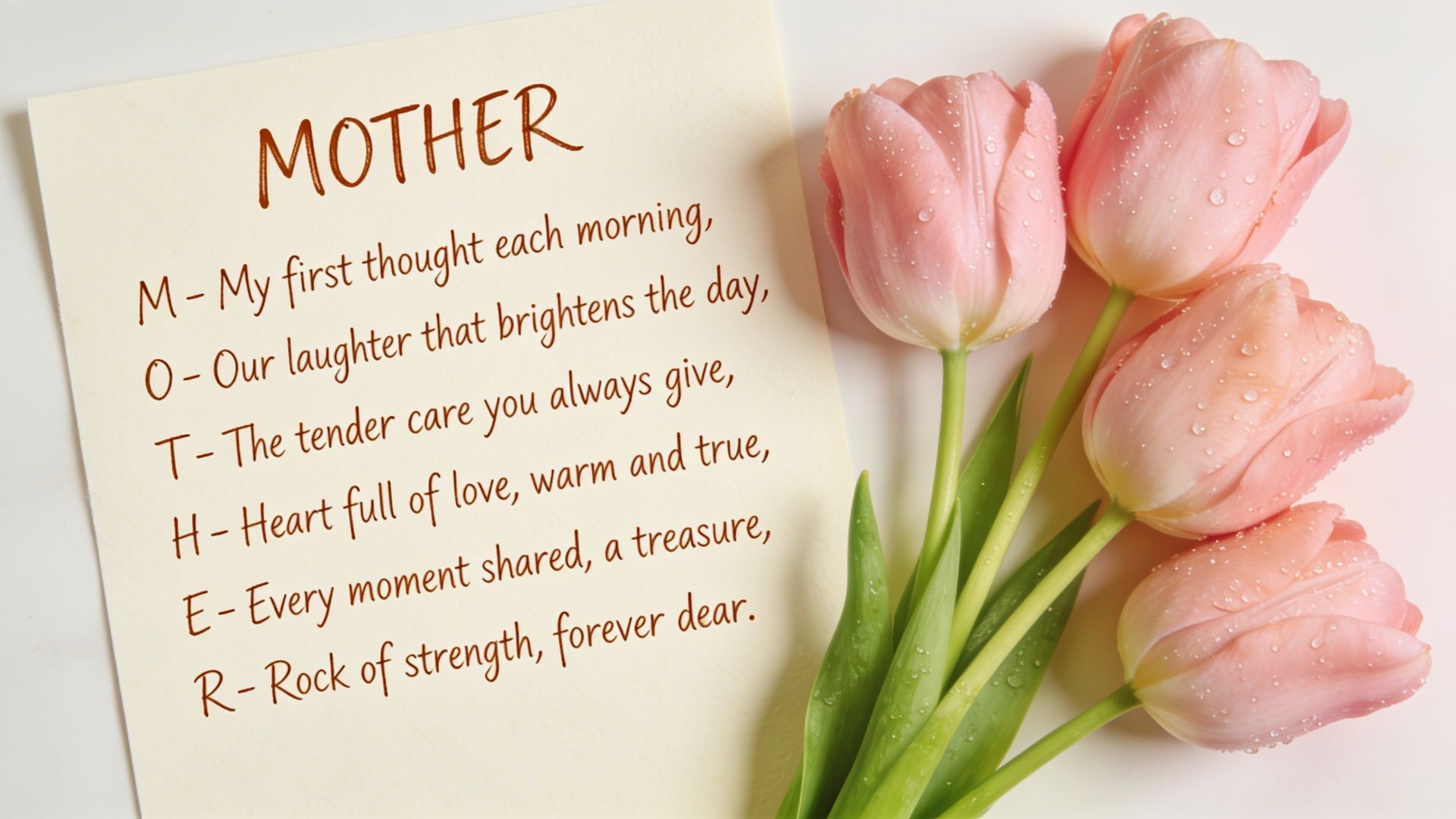




You want her to know how much she matters, but “you’re amazing” feels flat by the time you type it, and the card aisle never has the right words.
A good poem fills that gap, because a poet already found the language and all you add is the reason you chose it.
Below, you’ll find six poems with the poet, the year, what each one says, and the moment it suits, from short poems for her that fit in a text to good morning poems for her to make her smile.
Reading the Older Words Before You Send Them
Five of the six poems below were first published between 1609 and 1850, so a few words need a quick translation before they reach her.
Thee, thou, thy, and thine are old forms of you and your, and in Shakespeare’s day thou was the familiar form used with someone close, which is why love poems lean on it.
Elsewhere you’ll meet o’er for over, ‘gins for begins, and hath for has. If a word might stall her, put its plain meaning in brackets after the line you send, so she can enjoy the poem without a dictionary.
Romantic Classics for Cards and Anniversaries

Romantic poems to make her feel special suit a handwritten card, an anniversary, or any moment when you want her to keep the words.
The three below praise her character, count what she means to you, and love her without exaggeration.
Two famous choices are missing on purpose: Yeats’s “When You Are Old” is thought to have been written for Maud Gonne, who turned down his proposals, and Shakespeare’s Sonnet 18, though among the best known, is generally read as addressed to a young man.
She Walks in Beauty by Lord Byron
Byron wrote this in 1814 after seeing Anne Wilmot, his cousin’s wife, in a black mourning dress at a London party.
It praises her calm mind and innocent heart as much as her looks, so it works for someone you have just started to love.
She walks in beauty, like the night
Of cloudless climes and starry skies;
And all that’s best of dark and bright
Meet in her aspect and her eyes;
Thus mellowed to that tender light
Which heaven to gaudy day denies.
One shade the more, one ray the less,
Had half impaired the nameless grace
Which waves in every raven tress,
Or softly lightens o’er her face;
Where thoughts serenely sweet express,
How pure, how dear their dwelling-place.
And on that cheek, and o’er that brow,
So soft, so calm, yet eloquent,
The smiles that win, the tints that glow,
But tell of days in goodness spent,
A mind at peace with all below,
A heart whose love is innocent!
Credit: George Gordon, Lord Byron, “She Walks in Beauty,” written 1814; first published in Hebrew Melodies (London: John Murray, 1815).
Sonnet 43 (“How Do I Love Thee?”) by Elizabeth Barrett Browning
Barrett Browning wrote the sonnets in Sonnets from the Portuguese while Robert Browning courted her, and they were printed in 1850 under a title that hides the fact that the poems are her own.
In Sonnet 43, she counts the ways she loves him, from the deepest reach of her soul to the quietest daily need, which suits an anniversary or wedding card. Our list of I love you poems has more in this vein.
How do I love thee? Let me count the ways.
I love thee to the depth and breadth and height
My soul can reach, when feeling out of sight
For the ends of being and ideal grace.
I love thee to the level of every day’s
Most quiet need, by sun and candle-light.
I love thee freely, as men strive for right;
I love thee purely, as they turn from praise.
I love thee with the passion put to use
In my old griefs, and with my childhood’s faith.
I love thee with a love I seemed to lose
With my lost saints. I love thee with the breath,
Smiles, tears, of all my life; and, if God choose,
I shall but love thee better after death.
Credit: Elizabeth Barrett Browning, “Sonnet 43 (‘How do I love thee?’),” from Sonnets from the Portuguese, written 1845-46; first published in Poems (1850).
Sonnet 130 by William Shakespeare
This sonnet from Shakespeare’s 1609 collection mocks the flattering comparisons poets of his day used, saying her eyes are nothing like the sun, and then declares his love as rare as any woman praised with false comparisons.
It suits a partner who likes humor and distrusts flattery.
My mistress’ eyes are nothing like the sun;
Coral is far more red than her lips’ red;
If snow be white, why then her breasts are dun;
If hairs be wires, black wires grow on her head.
I have seen roses damasked, red and white,
But no such roses see I in her cheeks;
And in some perfumes is there more delight
Than in the breath that from my mistress reeks.
I love to hear her speak, yet well I know
That music hath a far more pleasing sound;
I grant I never saw a goddess go;
My mistress, when she walks, treads on the ground.
And yet, by heaven, I think my love as rare
As any she belied with false compare.
Credit: William Shakespeare, “Sonnet 130,” first published in Shake-speares Sonnets (London: Thomas Thorpe, 1609).
Phenomenal Woman for Friends, Sisters, and Daughters
Not every poem that makes a woman feel special is a love poem. Maya Angelou’s “Phenomenal Woman” first appeared in Cosmopolitan in 1978 and then in her collection And Still I Rise.
It tells a woman that her worth does not depend on a fashion model’s size or any conventional idea of beauty, which fits a friend, sister, daughter, or partner who needs to hear it.
Pretty women wonder where my secret lies.
I’m not cute or built to suit a fashion model’s size
But when I start to tell them,
They think I’m telling lies.
I say,
It’s in the reach of my arms,
The span of my hips,
The stride of my step,
The curl of my lips.
I’m a woman
Phenomenally.
Phenomenal woman,
That’s me.
I walk into a room
Just as cool as you please,
And to a man,
The fellows stand or
Fall down on their knees.
Then they swarm around me,
A hive of honey bees.
I say,
It’s the fire in my eyes,
And the flash of my teeth,
The swing in my waist,
And the joy in my feet.
I’m a woman
Phenomenally.
Phenomenal woman,
That’s me.
Men themselves have wondered
What they see in me.
They try so much
But they can’t touch
My inner mystery.
When I try to show them,
They say they still can’t see.
I say,
It’s in the arch of my back,
The sun of my smile,
The ride of my breasts,
The grace of my style.
I’m a woman
Phenomenally.
Phenomenal woman,
That’s me.
Now you understand
Just why my head’s not bowed.
I don’t shout or jump about
Or have to talk real loud.
When you see me passing,
It ought to make you proud.
I say,
It’s in the click of my heels,
The bend of my hair,
the palm of my hand,
The need for my care.
’Cause I’m a woman
Phenomenally.
Phenomenal woman,
That’s me.
Credit: Maya Angelou, “Phenomenal Woman,” first published in Cosmopolitan, 1978; collected in And Still I Rise (Random House, 1978).
Good Morning Poems for Her to Make Her Smile

Good morning poems for her to make her smile work best when they are short enough to read before she is fully awake and tied to something in her day.
The two below come from the Renaissance, so send the idea instead of the old wording: tell her what is waking up where you are, or what the day feels like with her in it.
The Good-Morrow by John Donne
Printed in 1633, two years after Donne’s death, this poem says that waking beside her turns one small room into a whole world.
“Good-morrow” is Early Modern English for good morning, so borrow the feeling by telling her your morning feels complete once she is in it.
I wonder, by my troth, what thou and I
Did, till we loved? Were we not weaned till then?
But sucked on country pleasures, childishly?
Or snorted we in the Seven Sleepers’ den?
’Twas so; but this, all pleasures fancies be.
If ever any beauty I did see,
Which I desired, and got, ’twas but a dream of thee.
And now good-morrow to our waking souls,
Which watch not one another out of fear;
For love, all love of other sights controls,
And makes one little room an everywhere.
Let sea-discoverers to new worlds have gone,
Let maps to other, worlds on worlds have shown,
Let us possess one world, each hath one, and is one.
My face in thine eye, thine in mine appears,
And true plain hearts do in the faces rest;
Where can we find two better hemispheres,
Without sharp north, without declining west?
Whatever dies, was not mixed equally;
If our two loves be one, or, thou and I
Love so alike, that none do slacken, none can die.
Credit: John Donne, “The Good-Morrow,” probably written in the 1590s, first published in Poems, by J. D. (London, 1633), among the love poems later known as Songs and Sonnets.
Hark, Hark! The Lark by William Shakespeare
This song comes from Act 2, Scene 3 of Cymbeline, where a suitor has musicians serenade Imogen at dawn, and she turns him down.
Lifted out of the play, it simply asks a lady to wake up with the sunrise, so use it as a template: name one thing waking up where you are, then ask her to join the day.
Hark, hark! the lark at heaven’s gate sings,
And Phoebus ‘gins arise,
His steeds to water at those springs
On chaliced flowers that lies;
And winking Mary-buds begin
To ope their golden eyes:
With every thing that pretty is,
My lady sweet, arise:
Arise, arise.
Credit: William Shakespeare, “Hark, Hark! The Lark,” song from Cymbeline, Act 2, Scene 3; the play was first published in the First Folio (1623).
Pick the Poem That Says It for You
Poems to make her feel special do one job well: they say what you mean in words you might not find on your own.
Match the poem to the message you want her to hear, with Byron for admiration, Barrett Browning for devotion, Sonnet 130 for honesty with humor, Angelou for confidence, and Donne or the lark song for mornings.
Then add one sentence about the detail of her that made you choose it, and credit the poet when you share a line.
Choose one poem from this list, send it before her day gets busy, and tell her why it made you think of her.
Frequently Asked Questions
What to Say to Her to Make Her Feel Special?
Thank her for something recent and concrete, then ask an open question about how she is doing. Being listened to can feel as meaningful as being praised.
What Are Some Flirty Poems I Can Write for Her?
Write an acrostic that spells her name with one line per letter, or a three-line haiku in a 5-7-5 pattern. Both formats are short enough to feel playful and easy enough to finish in one sitting.
How to Impress a Girl With Poetry?
Record yourself reading a poem as a voice note, because your voice adds warmth that typed words cannot. Read slowly and pause at each line break so the rhythm comes through.