

A concrete poem is not just words on a page. It is words as a page. The shape is the poem. Change the layout, and you change the meaning entirely.
That idea sounds simple. But seeing it in action, across different poets and different approaches, is what makes it click.
I’ll walk you through real concrete poem examples, from a 16th-century wing-shaped verse to a scattered grasshopper mid-jump. You will understand not just what the form looks like, but what it is actually doing.
What is a Concrete Poem?
A concrete poem is a poem where the words are arranged on the page to form a visual shape.
That shape is not decoration. It is part of what the poem means. Remove it, and you lose something the words alone cannot carry.
The shape does not always mirror the subject literally. Sometimes it reinforces what the words say. Sometimes it pushes against them. Sometimes it extends an idea the words only hint at.
This is what separates concrete poetry from illustrated poetry, and if you want to understand what those building blocks actually are, brushing up on the elements of poetry first makes the whole thing click faster.
There is no drawing alongside the text. The text is the image. The letters, the spacing, the layout all of it does the work together.
The Three Types of Concrete Poems
Concrete poems fall into three types: outline, filled, and typographical. Each one uses the page differently, and that changes how you read them.
1. Outline Shape Poems
In an outline shape poem, the words run along the border of a shape. The text traces the edge of a circle, a wave, a pair of wings and the shape appears because of where the words travel, not what they say.
George Herbert’s “Easter Wings” works this way. The lines contract and expand along the page to form the outline of wings. You follow the shape as you read.
2. Filled Shape Poems
A filled shape poem packs text into the interior of a shape. The silhouette appears through the contrast between dense text and surrounding white space.
The writing must fit the container so line lengths are adjusted, words are spaced out or compressed, and the shape holds everything together from the inside. The reader sees the form before they read a single word.
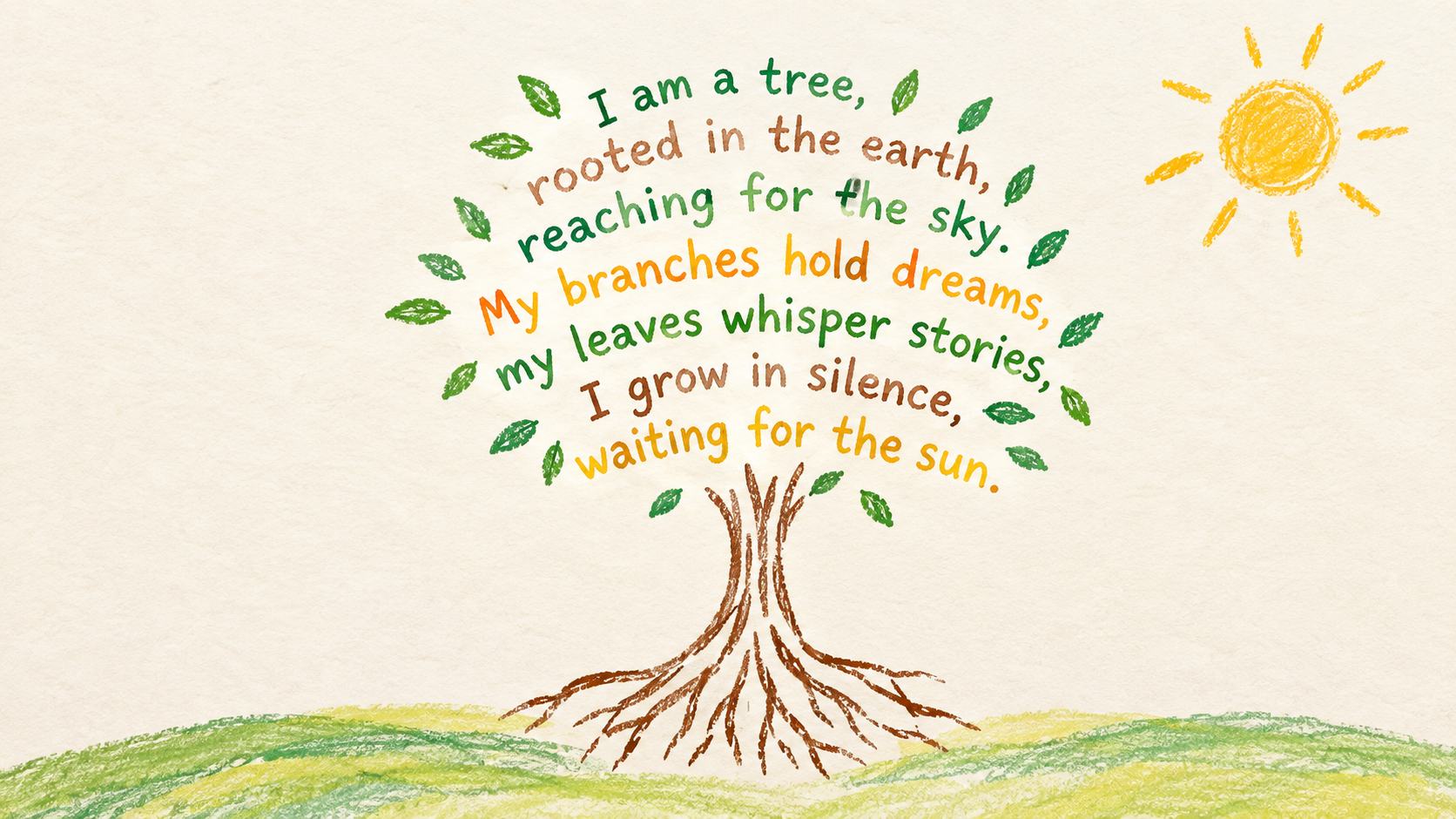
The Tree Poem in the beginner section works exactly this way. Each line grows longer toward the top to fill the canopy outline. The trunk narrows at the base. No drawing involved just line length controlling the shape from the inside out.
3. Typographical and Spatial Poems
This type does not use a shape at all. Words, letters, or fragments are scattered freely across the page to create movement, energy, or disruption.
What makes this type different is that the disorder is not visual decoration. It carries meaning directly.
E.E. Cummings’ “r-p-o-p-h-e-s-s-a-g-r” breaks apart the letters of the word “grasshopper” and scatters them across the page. The word only becomes readable at the very end. That delay mirrors the moment a grasshopper lands after a jump; the insect only makes sense once it stops moving.
The scrambled syntax is not representing the jump. It is the jump. That is the difference between a poem that looks kinetic and one that actually performs movement through language.
Famous Concrete Poem Examples (And What Makes Each Work)

From George Herbert’s “Easter Wings” to E.E. Cummings, each example below shows a different relationship between shape and meaning. In every case, the shape is not a visual choice; it is a meaning choice.
1. “Easter Wings” by George Herbert
Lord, who createdst man in wealth and store,
Though foolishly he lost the same,
Decaying more and more,
Till he became
Most poor:
With thee
O let me rise
As larks, harmoniously,
And sing this day thy victories:
Then shall the fall further the flight in me.
The lines shrink toward the middle, then open back out. That movement is not decorative; it traces the poem’s argument. Fall, then restoration. Poverty, then flight.
Herbert does not describe the shape of wings. He builds the theological arc of the poem into the shape itself. Read it as a block of text and the structure collapses. The form is the argument, and if you want to slow down and really track what a poem is doing structurally, it helps to know how to annotate a poem before you move through the rest of these examples.
2. “Swan and Shadow” by John Hollander
What
A pale
Signal will
Appear
When
The
X
Of
Evening
Strikes
The
Hour
Of
Folding
Time
And
The
Glassy
Lake
Darkens
Around
Elms
And
Reeds
Become
Silences
Whose
Voice
Was
The text above the white space forms the swan’s body. The text below mirrors a reflection on still water.
What makes this different is that the visual device and the conceptual subject are the same thing. The poem is about reflection. The page performs reflection. Take the layout away and the poem loses its entire point, not just its appearance.
3. “Forsythia” by Mary Ellen Solt
F o r
o r s y
t h i a
F O R S Y T H I A
f o r s y
t h i a F
O R S Y
Solt does not draw a forsythia plant and fill it with words. She takes the plant’s branching structure and uses it as the typographic logic of the poem.
The letters of F-O-R-S-Y-T-H-I-A radiate outward the way branches grow from a centre point, in multiple directions. The layout comes from biology, not from a visual reference.
That is what places this poem in the 1960s concrete movement. Language and visual form were not treated as separate things. One grew from the other.
4. “A Pair of Wings” by Stephen Hawes
And as the byrde dothe fle with wynges twayne
Above the trees and mountaynes hye and playne
So doth the soule of man with joye and grace
Above the worlde take his auncient place
And from the earthe ascende full ryght
Above the sterres bryght
As birdes of lyght
Fle in syght
This poem was written in the early 16th century, well before concrete poetry had a name. The stanzas are arranged to trace the outline of wings on the page.
But notice what it does not do. The lines do not contract and expand to enact meaning the way Herbert’s do. They trace a picture. The shape illustrates the subject rather than performing it.
That distinction matters. It shows that shaped verse has existed for centuries and that what separates illustration from argument is how much work the shape is actually doing.
5. “r-p-o-p-h-e-s-s-a-g-r” by E.E. Cummings
r-p-o-p-h-e-s-s-a-g-r
who
a)s w(e loo)k
upnowgath
PPEGORHRASS
eringint(o-
aThe):l
eA
!p:
S a
(r
rIvInG .gRrEaPsPhOs)
to
rea(be)rran(com)gi(e)ngly
,grasshopper;
The word “grasshopper” is broken apart across the page. Letters are reordered, capitalised mid-word, interrupted by punctuation. You cannot read it the way you read normal text.
That difficulty is the point. The scrambled letters perform the insect’s movement mid-air, disorienting, incomplete. The word only resolves at the very end: grasshopper.
The layout does not represent a jump. It is the jump experienced through the act of reading. That is what makes this poem one of the clearest examples of typographical concrete poetry ever written.
6. “Ziggurat” by Emmett Williams
i
a m
h e r e
w a i t i n g
f o r y o u t o
s e e w h a t I s e e
w h e n I l o o k a t y o u
a n d f i n d y o u l o o k i n g b a c k
Williams was a central figure in the 1960s concrete movement. This poem builds line by line into a pyramid shape, each line longer than the last until the thought completes at the base.
What makes this different from a filled shape poem is that the expanding structure mirrors the growing weight of what is being said. The form is not chosen for appearance. It follows the emotional logic of the words building toward a single complete moment.
7. “Silencio” by Eugen Gomringer
silencio silencio silencio
silencio silencio silencio
silencio silencio
silencio silencio silencio
silencio silencio silencio
Gomringer repeats the word “silencio”, Spanish for silence, across every position on the page except the centre. The gap in the middle is left empty.
That space is the poem. The word surrounds the silence it describes. You do not read about silence here. You encounter it as a physical absence on the page. No other example in this list makes its point with less material and more precision.
8. “The Lobster” by Edwin Morgan
l o b s t e r
l o b s t e
l o b s t
l o b s
l o b
l o
l
Morgan was a Scottish poet who used concrete form to strip language down to its visual bones. Here the word “lobster” loses one letter per line until only the first letter remains.
The shrinking text mirrors the way a creature disappears, retreating, reducing, and disappearing. The poem does not describe disappearance. It performs it letter by letter. What you are left with is a single character where a whole word used to be.
Concrete Poem Examples for Students and Beginners
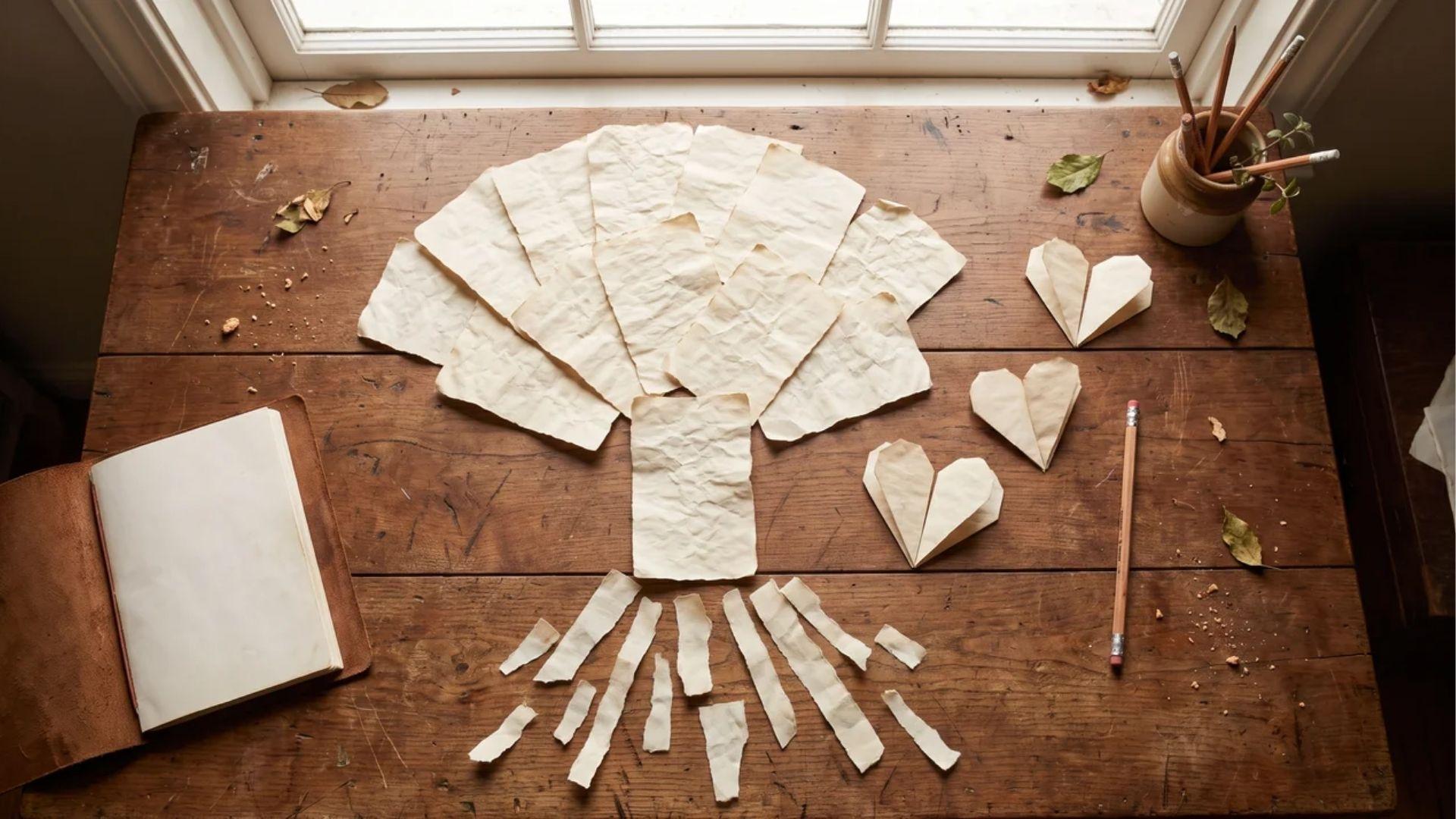
Beginner concrete poems use the same shape-meaning principle as the famous ones. The only difference is complexity: simpler shapes, simpler language, same core logic.
You do not need advanced craft to write one. You need a subject with a clear visual form and words that belong to it.
1. Rain Poem
c
l
o
u
d
s
g
a
t
h
e
r
i
n
g
d
r
o
p
s
f
a
l
l
i
n
g
d
o
w
n
w
e
t
This works because the reading direction already matches the subject. Your eye moves top to bottom exactly the way rain falls.
No complex shape-building is needed here. The poem earns its form just by following the natural movement of the thing it describes. That is the easiest entry point into concrete poetry: find a subject that already moves in one direction, then let the text follow it.
2. Tree Poem
s u n l i g h t
l e a v e s r u s t l e
b r a n c h e s s p r e a d w i d e
g r o w i n g o u t w a r d e v e r y d a y
r o o t s r e a c h d o w n i n t o d a r k s o i l
s t e m r i s e s s l o w a n d s t r a i g h t a n d s t r o n g
t r u n k
t r u n k
The lines get longer toward the top. That widening creates the canopy. The narrow base holds it up like a trunk.
No drawing involved just line length doing the visual work. This is what the filled-shape approach looks like when it is kept simple. Students learn quickly that controlling how long each line runs is enough to build a recognisable shape on the page.
3. Heart Poem
i l o v e y o u y o u a r e m y
y o u a r e w a r m w o r l d a n d
a n d k i n d a n d m y h o m e
t r u e a n d y o u a n d e v e r y
m a k e e v e r y d a y w i t h
d a y w o r t h y o u i s
l i v i n g e n o u g h
f o r f o r m e
y o u a l w a y s
a r e a l w a y s
e v e r y t h i n g
i w i l l
e v e r
n e e d
The words trace the outline of a heart. The subject love, closeness, belonging matches the shape the reader already knows.
That match is what makes the heart shape work for beginners. The shape carries meaning before a single word is read. The poem’s job is to make sure the words earn that shape, not just fill it.
Key Takeaways
Concrete poems work because the page is never neutral. Where a word sits, how long a line runs, where the text breaks all of it carries meaning.
The best concrete poem examples show that the shape is not added at the end. It is part of the thinking from the start.
If you want to try it, start with one subject and one clear shape. Let the words earn the layout. You will figure out the rest as you go.
Frequently Asked Questions
How do you make a concrete poem?
Pick a subject with a clear visual form. Write words that belong to it, then arrange them on the page so the layout matches or extends the meaning. The shape and the words should work together, not separately.
What are the rules for concrete poetry?
There are no fixed rules. The one principle that holds across every example is that the visual arrangement must contribute to meaning. If removing the shape changes nothing, the poem is not doing its job.
What is the difference between a concrete poem and a shape poem?
In a shape poem, words sit inside or along an outline without being altered. In a concrete poem, the typography, spacing, or syntax itself is manipulated. The text does not just fill a shape. It becomes one.
Who invented concrete poetry?
No single person invented it. George Herbert was writing shaped verse in the 1600s. The formal movement emerged in the 1950s, led by poets like Eugen Gomringer and the Brazilian Noigandres group. They were the first to treat it as a defined literary practice.


