

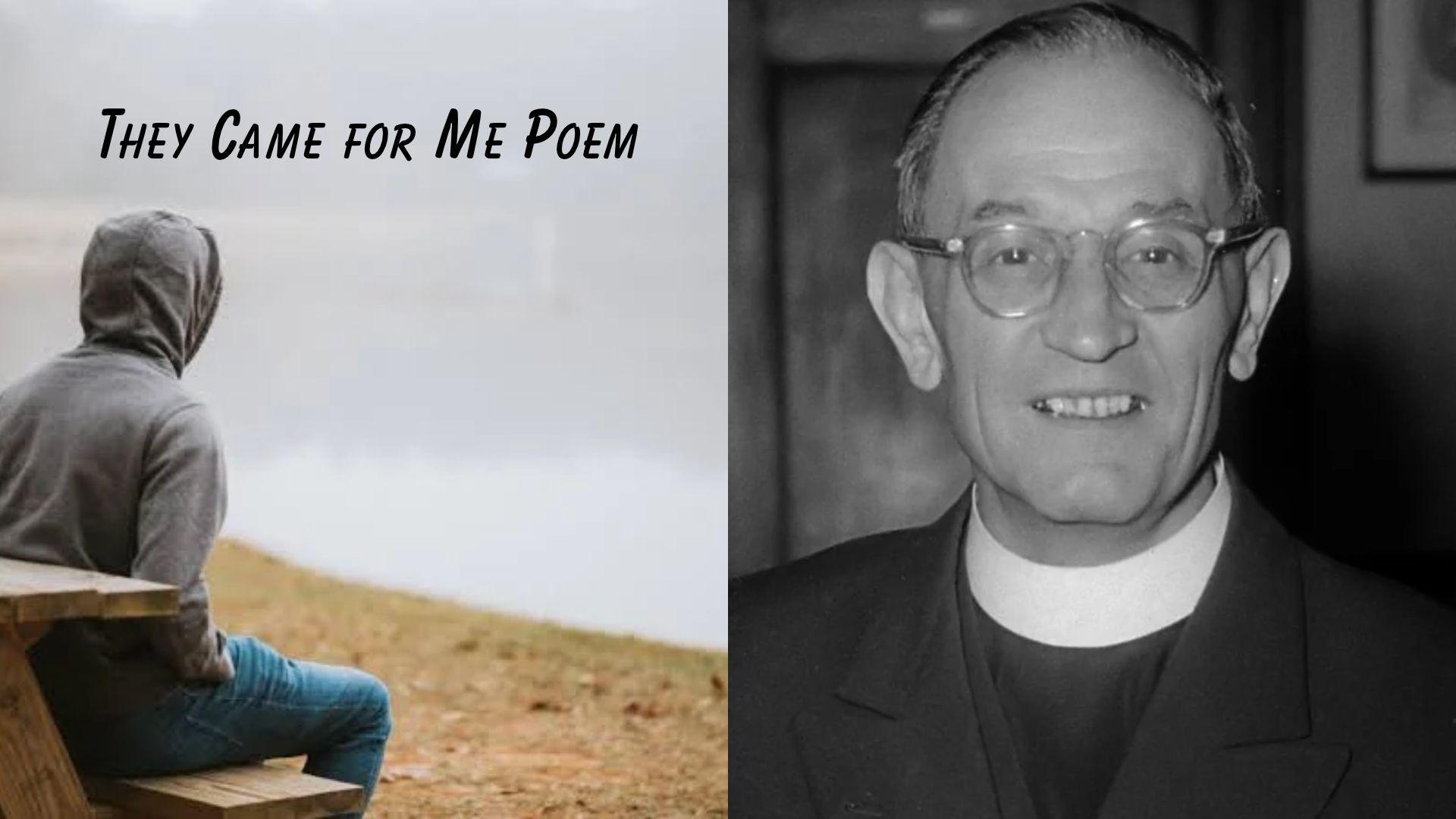
The “they came for me” poem is a short postwar statement by German pastor Martin Niemöller, usually printed as “First They Came.”
It names groups the Nazis persecuted while the speaker stayed silent, then ends with the speaker taking himself and no one left to speak for him.
The silent speaker is Niemöller himself, describing his own choices between 1933 and 1937, which is why the statement reads first as a confession and only second as a warning.
The sections ahead cover where the words came from, why the versions disagree, and what the lines mean.
They end with seven poems that take up the same questions, from Maya Angelou’s Still I Rise to W. H. Auden’s “Refugee Blues.”
What Is the “They Came for Me” Poem?
The “they came for me” poem is Martin Niemöller’s confession of his own silence under Nazism.
He first spoke it in lectures he gave in the western zones of Allied-occupied Germany in 1946.
The United States Holocaust Memorial Museum treats it as a quotation rather than a poem, because the versions come from impromptu talks, not one fixed text.
Niemöller (1892 to 1984) was a Lutheran pastor and a decorated World War I U-boat officer. He belonged to right-wing, antisemitic movements in the 1920s and voted for the Nazi Party in March 1933.
They Came for Me Poem Text and Its Shifting List of Victims

Most printed versions follow one four-part pattern. Each early stanza names a group that was taken, admits “I did not speak out,” and excuses the silence because the speaker was not one of them. The final stanza then turns the pattern on the speaker himself.
The list of victims is what changes from one version to the next. The Holocaust Encyclopedia’s Niemöller entry explains that he improvised his lectures and named different groups at different times.
Those groups included communists, socialists, trade unionists, Jews, people with disabilities, and Jehovah’s Witnesses.
The museum’s own version, which closes its permanent exhibition, is the safest text to quote, credited as attributed to Niemöller.
| Source | Groups Named, in Order |
| Niemöller’s Frankfurt speech, January 6, 1946 (prose) | Communists, the incurably sick, Jews, occupied countries |
| U.S. Holocaust Memorial Museum | Socialists, trade unionists, Jews, the speaker |
| Holocaust Memorial Day Trust (UK) | Communists, socialists, trade unionists, Jews, the speaker |
| New England Holocaust Memorial, Boston | Communists, Jews, trade unionists, Catholics, the speaker |
The table raises an obvious follow-up question about which list came first.
Is There a “First They Came” Poem Original?
There is no single original version. Historian Harold Marcuse of the University of California, Santa Barbara, found that Niemöller’s own spoken versions always began with communists and ended with himself.
However, he could not trace the polished, repeating poem to any text Niemöller wrote or approved.
Marcuse’s research on the quotation traces it to a November 1945 visit Niemöller paid to the former Dachau camp, which left him asking where he had been from 1933 to 1937.
The earliest documented version is his January 6, 1946 speech in Frankfurt, given in prose.
The rhythmic form was circulating by the early 1950s and reached print in Milton Mayer’s 1955 book They Thought They Were Free.
What the Lines Say and Why They Work

With the history in place, the lines can be read on their own terms, first for what happens and then for how they are built.
They Came for Me Poem Summary
The speaker remembers the Nazis seizing one group after another. At each step, he stays silent because he does not belong to that group.
In the last stanza, they come for him, and nobody is left to defend him, because he never defended anyone else.
The early stanzas change only the group’s name, so the reader feels time passing through repetition alone. The final stanza is the only place where that pattern breaks.
Analysis: The Bystander as Speaker
Any They Came for Me poem analysis has to start with who is talking. The speaker is neither victim nor hero but a bystander.
His repeated excuse works like a ledger that records the same choice several times, showing how silence becomes a habit before anyone recognizes it as a decision.
The groups were chosen with care. Marcuse notes that the statement is often called the bystanders’ credo, because Niemöller named people his church audiences would not instinctively defend.
Its lesson is to protect those under physical threat even when you disagree with them, so using the lines only to add your own group to the list turns that meaning around.
The phrase “no one left” describes a community already taken apart, not only a personal risk. John Donne set out the same idea centuries earlier in the meditation known as No Man Is an Island.
Niemöller’s statement gives only the bystander’s side, and the poems below supply the voices it leaves out.
7 Poems With Themes Similar to “They Came for Me”

None of these poems copy Niemöller’s structure, since his is a confession and theirs are mostly defiance or appeals for refuge.
Each one still starts from people being pushed aside and asks who will answer for them.
Works published before 1931 are in the U.S. public domain, so the three older poems are quoted briefly, and the four copyrighted poems are paraphrased.
1. “Still I Rise” by Maya Angelou
This poem appeared in Angelou’s 1978 collection, And Still I Rise (Random House).
The speaker answers an unnamed “you” who has tried to erase her with lies written into history, and each stanza finds her rising again.
Because the poem is under copyright, it is paraphrased here. Niemöller’s speaker learns too late that silence left him undefended, while Angelou’s speaker stands alone and refuses to shrink.
2. “If We Must Die” by Claude McKay
McKay’s Shakespearean sonnet first appeared in the July 1919 issue of The Liberator. He wrote it after white mobs attacked Black communities during the Red Summer of 1919.
The poem is in the public domain and closes on its central claim: “Pressed to the wall, dying, but fighting back!” The contrast with Niemöller is about timing.
His speaker waits until the danger reaches him, while McKay’s calls his “kinsmen” to stand together first.
3. “The New Colossus” by Emma Lazarus
Lazarus wrote this public domain sonnet on November 2, 1883, for an auction funding the Statue of Liberty’s pedestal.
A bronze plaque with its text was mounted inside the pedestal in 1903. The poem names the statue “Mother of Exiles” and sets her against “the brazen giant of Greek fame,” a symbol of conquest.
Lazarus had volunteered with Jewish refugees on Ward’s Island, and her poem imagines a nation that chooses welcome over exclusion.
4. “Let America Be America Again” by Langston Hughes
Hughes wrote this poem in 1935, published it in the July 1936 issue of Esquire, and revised it for A New Song in 1938.
It is under copyright, so only one brief excerpt appears here: the speaker’s repeated aside that “America never was America to me.”
A second voice then speaks for poor white workers, Black Americans, Native Americans, and immigrants.
Niemöller lets his groups fall one at a time, whereas Hughes gathers them into a single voice.
5. “Refugee Blues” by W. H. Auden
Auden completed this poem in March 1939, soon after moving to New York. It is about Jewish refugees from Nazi Germany who met indifference when they sought asylum.
The poem is under copyright, so you can read it through Facing History’s reprint of Auden.
In it, a refugee couple is turned away by a consul, a committee, and a speaker at a public meeting, and each stanza closes on “my dear.”
It reads as the other side of Niemöller’s confession: his speaker said nothing, and Auden’s speakers live with that silence.
6. “A Litany for Survival” by Audre Lorde
Lorde’s poem appeared in her 1978 collection The Black Unicorn as a litany, a prayer built on repetition. It is paraphrased here because it is under copyright.
The poem addresses people on the margins who were taught to be afraid, and it argues that silence never kept them safe, so they may as well speak. That is the same lesson Niemöller’s last stanza reaches too late.
7. “I, Too” by Langston Hughes
Hughes published “I, Too” in Survey Graphic in March 1925, and it reappeared in The Weary Blues (1926) under the title “Epilogue.”
The poem is in the public domain and ends on “I, too, am America.”
Its “darker brother” is sent to eat in the kitchen when company comes, and he predicts that those who exclude him will one day be ashamed.
Read beside Niemöller, it offers the other possible ending, in which the excluded person keeps speaking.
What These Poems Have in Common
All seven poems begin with exclusion or threat, and they differ in how the speaker responds.
Angelou and McKay resist, Lazarus welcomes, Hughes demands inclusion in two ways, Auden testifies, and Lorde urges speech.
Niemöller’s speaker is the exception, because he is the bystander who failed to respond.
| Poem | Main Theme | Connection to “They Came for Me” |
| “Still I Rise” | Resistance | Responding to oppression |
| “If We Must Die” | Defiance | Facing persecution together |
| “The New Colossus” | Refuge | Welcoming displaced people |
| “Let America Be America Again” | Inequality | Uniting marginalized voices |
| “Refugee Blues” | Persecution | Living with others’ silence |
| “A Litany for Survival” | Survival | Speaking despite fear |
| “I, Too” | Exclusion | Challenging discrimination |
Reading down the rows, one split stands out. Six of these speakers are the people being pushed aside, and the seventh, Lazarus’s statue, is the one opening the door.
That is the perspective Niemöller’s statement cannot give.
Sum Up
The They Came for Me poem lasts because it is honest about the speaker’s own failure. Its shifting list of victims also asks each new audience to consider whom it is ignoring.
Niemöller gives the bystander’s account, and the seven poems above give the accounts of people who were pushed aside, who fought back, or who were welcomed.
Pick the theme you most want to understand, whether resistance, refuge, inequality, displacement, or speaking up.
Then read that poem aloud right after Niemöller’s statement, so you can hear the two voices answer each other.
Frequently Asked Questions
What Is the Poem That Ends With “And Then They Came for Me”?
It is Martin Niemöller’s postwar statement, usually titled “First They Came.” Historian Matthew Hockenos borrowed its closing words for his 2018 biography of the pastor, Then They Came for Me, published by Basic Books.
What Are the Lyrics to the Poem “First They Came for the Immigrants”?
No authoritative text exists, because Niemöller never named immigrants. It is a modern rewrite. One 2018 campaign in Durham, North Carolina, printed its own version on yard signs, so the wording depends on the adapter.
What Does the Poem “First They Came for the Communists” Mean?
Communists were among the first people sent to Nazi camps in 1933. In a 1946 speech, Niemöller admitted that his church ignored them as enemies of religion, so starting with them exposes his earliest silence.
What Is a Famous Quote From Martin Niemöller?
Beyond “First they came,” Niemöller is remembered for a January 1934 meeting with Hitler. There he told Hitler that no one, not even Hitler himself, could take away the church’s responsibility for the German people.