



Poetry tends to find people when something hurts or when a feeling is too big to say plainly.
That is often the moment readers land on Pablo Neruda, the Chilean poet who gave heartbreak, desire, a buried dog and a kitchen onion the same direct, unhurried voice.
His lines travel well because they sound like someone talking to you, not performing for a crowd.
Below, you’ll find ten Pablo Neruda poems in full, each with a summary and a credit line, so you can read them in one place.
If you only want his romantic work, our guide to Pablo Neruda love poems goes deeper into that side of his writing.
Who Pablo Neruda Was and How His Poems Reach English
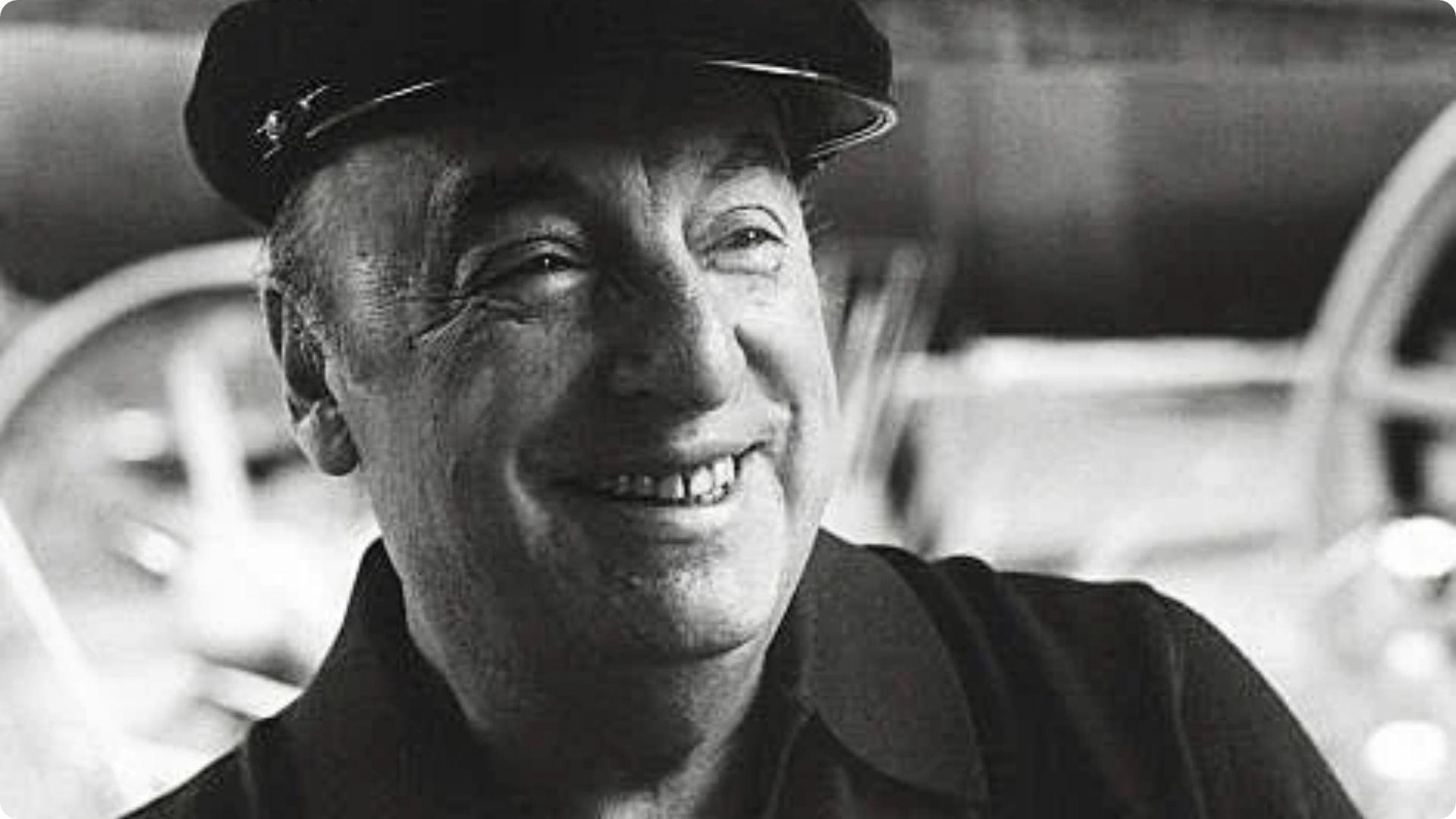
Pablo Neruda was a Chilean poet born Neftalí Ricardo Reyes Basoalto in Parral on July 12, 1904.
He took his pen name in 1920 in memory of the Czech poet Jan Neruda, won the Nobel Prize in Literature in 1971, and died on September 23, 1973, as the Nobel Prize biographical page records.
His range runs from teenage heartbreak to an ode about a kitchen onion, one of the poems in our poems about food guide. English versions of the same poem differ, so each entry credits the translator where one could be confirmed.
Two common versions of Poem 20, for example, disagree on whether the night in the second line is starry or shattered.
Famous Pablo Neruda Love Poems
His best-known love poems come from three books: Twenty Love Poems and a Song of Despair (1924), The Captain’s Verses (1952), and One Hundred Love Sonnets (1959).
“Poem 20” (Tonight I Can Write)
The speaker says tonight he can write the saddest lines, then looks back at a mutual love only some of the time.
He says he no longer loves her, then admits that perhaps he still does. It speaks most directly to readers in the middle of heartbreak, since it says grief plainly with no decoration.
Tonight I can write the saddest lines.
Write, for example, ‘The night is starry
and the stars are blue and shiver in the distance.’
The night wind revolves in the sky and sings.
Tonight I can write the saddest lines.
I loved her, and sometimes she loved me too.
Through nights like this one I held her in my arms.
I kissed her again and again under the endless sky.
She loved me, sometimes I loved her too.
How could one not have loved her great still eyes.
Tonight I can write the saddest lines.
To think that I do not have her. To feel that I have lost her.
To hear the immense night, still more immense without her.
And the verse falls to the soul like dew to the pasture.
What does it matter that my love could not keep her.
The night is starry and she is not with me.
This is all. In the distance someone is singing. In the distance.
My soul is not satisfied that it has lost her.
My sight tries to find her as though to bring her closer.
My heart looks for her, and she is not with me.
The same night whitening the same trees.
We, of that time, are no longer the same.
I no longer love her, that’s certain, but how I loved her.
My voice tried to find the wind to touch her hearing.
Another’s. She will be another’s. As she was before my kisses.
Her voice, her bright body. Her infinite eyes.
I no longer love her, that’s certain, but maybe I love her.
Love is so short, forgetting is so long.
Because through nights like this one I held her in my arms
my soul is not satisfied that it has lost her.
Though this be the last pain that she makes me suffer
and these the last verses that I write for her.
Credit: Pablo Neruda, “Poema 20,” Veinte poemas de amor y una canción desesperada (Twenty Love Poems and a Song of Despair), 1924. Translator: W.S. Merwin
“Poem XV” (I Like for You to Be Still)
The speaker likes his beloved best when she is silent, because her stillness makes her seem absent.
He compares her to a butterfly, the night, and the word melancholy, and the poem ends on a distance that resembles death.
Readers who prefer quiet, unresolved love poems about the gap between two people will find it a good fit.
I like for you to be still: it is as though you were absent,
and you hear me from far away and my voice does not touch you.
It seems as though your eyes had flown away
and it seems that a kiss had sealed your mouth.
As all things are filled with my soul
you emerge from the things, filled with my soul.
You are like my soul, a butterfly of dream,
and you are like the word Melancholy.
I like for you to be still, and you seem far away.
It sounds as though you were lamenting, a butterfly cooing like a dove.
And you hear me from far away, and my voice does not reach you:
Let me come to be still in your silence.
And let me talk to you with your silence
that is bright as a lamp, simple as a ring.
You are like the night, with its stillness and constellations.
Your silence is that of a star, as remote and candid.
I like for you to be still: it is as though you were absent,
distant and full of sorrow as though you had died.
One word then, one smile is enough.
And I am happy, happy that it’s not true.
Credit: Pablo Neruda, “Poema XV,” Veinte poemas de amor y una canción desesperada, 1924. Translator: W.S. Merwin
“Sonnet XVII”
The speaker says what his love is not before saying what it is: hidden, plain, and free of pride, ending in a closeness where “you” and “I” blur.
It is addressed to Matilde Urrutia, whom Neruda married in 1966, and Robin Williams recites it in the 1998 film Patch Adams.
It suits anyone choosing a love poem to read aloud without clichés, and readers new to the form can start with our sonnet poem examples.
I do not love you as if you were salt-rose, or topaz,
or the arrow of carnations the fire shoots off.
I love you as certain dark things are to be loved,
in secret, between the shadow and the soul.
I love you as the plant that never blooms
but carries in itself the light of hidden flowers;
thanks to your love a certain solid fragrance,
risen from the earth, lives darkly in my body.
I love you without knowing how, or when, or from where.
I love you straightforwardly, without complexities or pride;
so I love you because I know no other way
than this: where I does not exist, nor you,
so close that your hand on my chest is my hand,
so close that your eyes close as I fall asleep.
Credit: Pablo Neruda, “Soneto XVII,” Cien sonetos de amor, 1959.
“If You Forget Me”
The poem is a chain of “if” statements. The speaker’s love will mirror hers, fading slowly if hers fades, and if she forgets him suddenly, she shouldn’t look for him.
It appeals to readers who want a love poem built on conditions instead of a vow.
I want you to know
one thing.
You know how this is:
if I look
at the crystal moon, at the red branch
of the slow autumn at my window,
if I touch
near the fire
the impalpable ash
or the wrinkled body of the log,
everything carries me to you,
as if everything that exists,
aromas, light, metals,
were little boats
that sail
toward those isles of yours that wait for me.
Well, now,
if little by little you stop loving me
I shall stop loving you little by little.
If suddenly
you forget me
do not look for me,
for I shall already have forgotten you.
If you think it long and mad,
the wind of banners
that passes through my life,
and you decide
to leave me at the shore
of the heart where I have roots,
remember
that on that day,
at that hour,
I shall lift my arms
and my roots will set off
to seek another land.
But
if each day,
each hour,
you feel that you are destined for me
with implacable sweetness,
if each day a flower
climbs up to your lips to seek me,
ah my love, ah my own,
in me all that fire is repeated,
in me nothing is extinguished or forgotten,
my love feeds on your love, beloved,
and as long as you live it will be in your arms
without leaving mine.
Credit: Pablo Neruda, “Si tú me olvidas,” Los versos del capitán, first published anonymously in Italy in 1952; the edition carrying Neruda’s name appeared in Chile in 1963. English edition: The Captain’s Verses, translated by Donald Walsh
Pablo Neruda Short Poems About Poetry and Silence

Both poems fit on a single page, which suits readers who want Pablo Neruda short poems first.
“Poetry”
The speaker recalls poetry arriving in his youth from the night, something striking his soul, and his writing his first vague line.
Writers and students curious about how a poet describes the start of writing tend to get the most from it.
And it was at that age… Poetry arrived
in search of me. I don’t know, I don’t know where
it came from, from winter or a river.
I don’t know how or when,
no they were not voices, they were not
words, nor silence,
but from a street I was summoned,
from the branches of night,
abruptly from the others,
among violent fires
or returning alone,
there I was without a face
and it touched me.
I did not know what to say, my mouth
had no way
with names,
my eyes were blind,
and something started in my soul,
fever or forgotten wings,
and I made my own way,
deciphering
that fire,
and I wrote the first faint line,
faint, without substance, pure
nonsense,
pure wisdom
of someone who knows nothing,
and suddenly I saw
the heavens
unfastened
and open,
planets,
palpitating plantations,
shadow perforated,
riddled
with arrows, fire and flowers,
the winding night, the universe.
And I, infinitesimal being,
drunk with the great starry
void,
likeness, image of
mystery,
felt myself a pure part
of the abyss,
I wheeled with the stars,
my heart broke loose on the wind.
Credit: Pablo Neruda, “La poesía” (“Poetry”), Memorial de Isla Negra, 1964.
“Keeping Quiet”
Everyone counts to twelve and stays still, so that fishermen, salt gatherers and war planners all pause.
Neruda says he doesn’t mean inactivity or death, and the speaker closes by counting again and leaving. Teachers and anyone who wants a short poem about stopping often reach for it.
Now we will count to twelve
and we will all keep still.
For once on the face of the earth
let’s not speak in any language,
let’s stop for one second,
and not move our arms so much.
It would be an exotic moment
without rush, without engines,
we would all be together
in a sudden strangeness.
Fishermen in the cold sea
would not harm whales
and the man gathering salt
would look at his hurt hands.
Those who prepare green wars,
wars with gas, wars with fire,
victory with no survivors,
would put on clean clothes
and walk about with their brothers
in the shade, doing nothing.
What I want should not be confused
with total inactivity.
Life is what it is about;
I want no truck with death.
If we were not so single-minded
about keeping our lives moving,
and for once could do nothing,
perhaps a huge silence
might interrupt this sadness
of never understanding ourselves
and of threatening ourselves with death.
Perhaps the earth can teach us
as when everything seems dead
and later proves to be alive.
Now I’ll count up to twelve
and you keep quiet and I will go.
Credit: Pablo Neruda, “A callarse,” Estravagario, 1958. Translator: Alastair Reid
Odes and Elegies for Everyday Things

Neruda’s odes praise ordinary things, and his late elegy for a dog gives loss the same plain attention.
“Ode to the Onion”
The poem follows the onion into the kitchen, through the pot, hot oil, and a salad over tomato, and ends on the knife and the onion’s single tear.
Cooks and readers who enjoy poems of praise for ordinary things will feel at home, and it makes a friendly first step into his odes.
Onion,
luminous flask,
your beauty formed
petal by petal,
crystal scales expanded you
and in the secrecy of the dark earth
your belly grew round with dew.
Under the earth
the miracle
happened
and when you clumsy
green stem appeared,
and your leaves were born
like swords
in the garden,
the earth heaped up her power
showing your naked transparency,
and as the remote sea
in lifting the breasts of Aphrodite
duplicated the magnolia,
so did the earth
make you,
onion,
clear as a planet,
and destined
to shine,
constant constellation,
round rose of water,
upon
the table
of the poor.
Generously
you undo
your globe of freshness
in the fervent consummation
of the cooking pot,
and the crystal shred
in the flaming heat of the oil
is transformed into a curled golden feather.
Then, too, I will recall how fertile
is your influence on the love of the salad,
and it seems that the sky contributes
by giving you the shape of hailstones
to celebrate your chopped brightness
on the hemisphere of a tomato.
But within reach
of the hands of the common people,
sprinkled with oil,
dusted
with a bit of salt,
you kill the hunger
of the day-laborer on his hard path.
Star of the poor,
fairy godmother
wrapped
in delicate
paper, you rise from the ground
eternal, whole, pure
like an astral seed,
and when the kitchen knife
cuts you, there arises
the only tear
without sorrow.
You make us cry without hurting us,
I have praised everything that exists,
but to me, onion, you are
more beautiful than a bird
of dazzling feathers,
you are to my eyes
a heavenly globe, a platinum goblet,
an unmoving dance
of the snowy anemone
and the fragrance of the earth lives
in your crystalline nature.
Credit: Pablo Neruda, “Oda a la cebolla” (“Ode to the Onion”), Odas elementales, 1954.
“A Dog Has Died”
The speaker buries his dog in the garden, admits he believes in a heaven only for dogs, and recalls walks on the winter shore at Isla Negra.
He ends by saying there are no goodbyes for a dog who has died. Anyone grieving a pet will recognize it, and so will readers who prefer an elegy without sentimentality.
My dog has died.
I buried him in the garden
next to a rusted old machine.
Some day I’ll join him right there,
but now he’s gone with his shaggy coat,
his bad manners and his cold nose,
and I, the materialist, who never believed
in any promised heaven in the sky
for any human being,
I believe in a heaven I’ll never enter.
Yes, I believe in a heaven for all dogdom
where my dog waits for my arrival
waving his fan-like tail in friendship.
Ai, I’ll not speak of sadness here on earth,
of having lost a companion
who was never servile.
His friendship for me, like that of a porcupine
withholding its authority,
was the friendship of a star, aloof,
with no more intimacy than was called for,
with no exaggerations:
he never climbed all over my clothes
filling me full of his hair or his mange,
he never rubbed up against my knee
like other dogs obsessed with sex.
No, my dog used to gaze at me,
paying me the attention I need,
the attention required
to make a vain person like me understand
that, being a dog, he was wasting time,
but, with those eyes so much purer than mine,
he’d keep on gazing at me
with a look that reserved for me alone
all his sweet and shaggy life,
always near me, never troubling me,
and asking nothing.
Ai, how many times have I envied his tail
as we walked together on the shores of the sea
in the lonely winter of Isla Negra
where the wintering birds filled the sky
and my hairy dog was jumping about
full of the voltage of the sea’s movement:
my wandering dog, sniffing away
with his golden tail held high,
face to face with the ocean’s spray.
Joyful, joyful, joyful,
as only dogs know how to be happy
with only the autonomy
of their shameless spirit.
There are no good-byes for my dog who has died,
and we don’t now and never did lie to each other.
So now he’s gone and I buried him,
and that’s all there is to it.
Credit: Pablo Neruda, “Un perro ha muerto” (“A Dog Has Died”), published after his death in Jardín de invierno (Winter Garden), 1974. English translation: Alfred Yankauer
Poems of City Life and Memory

These two poems come from different decades and show how far Neruda’s voice moved.
“Walking Around”
The speaker is worn out by his own body and by ordinary city places such as tailor shops and cinemas.
Readers drawn to the stranger, more surreal Neruda, or anyone who feels flattened by city routine, will connect with it.
It so happens I am sick of being a man.
And it happens that I walk into tailorshops and movie houses
dried up, waterproof, like a swan made of felt
steering my way in a water of wombs and ashes.
The smell of barbershops makes me break into hoarse sobs.
The only thing I want is to lie still like stones or wool.
The only thing I want is to see no more stores, no gardens,
no more goods, no spectacles, no elevators.
It so happens I am sick of my feet and my nails
and my hair and my shadow.
It so happens I am sick of being a man.
Still it would be marvelous
to terrify a law clerk with a cut lily,
or kill a nun with a blow on the ear.
It would be great
to go through the streets with a green knife
letting out yells until I died of the cold.
I don’t want to go on being a root in the dark,
insecure, stretched out, shivering with sleep,
going on down, into the moist guts of the earth,
taking in and thinking, eating every day.
I don’t want so much misery.
I don’t want to go on as a root and a tomb,
alone under the ground, a warehouse with corpses,
half frozen, dying of grief.
That’s why Monday, when it sees me coming
with my convict face, blazes up like gasoline,
and it howls on its way like a wounded wheel,
and leaves tracks full of warm blood leading toward the night.
And it pushes me into certain corners, into some moist houses,
into hospitals where the bones fly out the window,
into shoeshops that smell like vinegar,
and certain streets hideous as cracks in the skin.
There are sulphur-colored birds, and hideous intestines
hanging over the doors of houses that I hate,
and there are false teeth forgotten in a coffeepot,
there are mirrors
that ought to have wept from shame and terror,
there are umbrellas everywhere, and venoms, and umbilical cords.
I stroll along serenely, with my eyes, my shoes,
my rage, forgetting everything,
I walk by, going through office buildings and orthopedic shops,
and courtyards with washing hanging from the line:
underwear, towels and shirts from which slow
dirty tears are falling.
Credit: Pablo Neruda, “Walking Around,” Residencia en la tierra II, 1935. Neruda gave it an English title that translators kept, and by the early 1980s at least a dozen English versions existed, according to Tomás Q. Morín’s translator’s note.
“Youth”
One long sentence piles up the sensations of adolescence, from fruit and sugar to hay and hidden rooms, and closes on a lamp tipped over in the rain.
Readers who like memory poems built from images instead of a story will enjoy it.
Acid and sword blade: the fragrance
of plum in the pathways:
tooth’s sweetmeat of kisses,
power and spilth on the fingers,
the yielding erotic of pulps,
hayricks and threshing floors, clandestine
recesses that tempt through the vastness of houses;
bolsters asleep in the past, the bitter green valley,
seen from above, from the glasses’ concealment;
and drenching and flaring by turns, adolescence
like a lamp overturned in the rain.
Credit: Pablo Neruda, “Juventud” (“Youth”), Canto General, 1950. English translation: Ben Belitt, in Selected Poems of Pablo Neruda (copyright Fundación Pablo Neruda, 2009).
Pablo Neruda’s Poems and What They Leave Behind
The ten poems above show how wide Neruda’s range runs, from the open grief of Poem 20 to the kitchen praise of an onion ode and the plain tenderness of a dog’s burial, all in everyday language.
That directness is why a single Pablo Neruda poem can land even through a translator, though the translator’s choices still shape what you hear.
Pick the poem from this list that fits your mood and read it twice, then find a second English version and note which lines change. Tell us in the comments which translation you trusted and why.
Frequently Asked Questions
Where Is Pablo Neruda Buried?
Neruda is buried at his home in Isla Negra, on Chile’s coast, beside his wife Matilde Urrutia, as he wished. His remains were moved there from Santiago’s Cementerio General in December 1992. They were exhumed in 2013 during an investigation into his death and reburied at Isla Negra in April 2016.
How Many Poems Did Pablo Neruda Write?
Estimates run to nearly 3,500 poems across more than 35 books. The most comprehensive single English volume, Ilan Stavans’s The Poetry of Pablo Neruda, collects nearly 600 of them.
Which Movie Features Pablo Neruda as a Character?
Il Postino (1994), directed by Michael Radford, imagines an exiled Neruda befriending a village postman who learns to love poetry. Philippe Noiret plays Neruda. The film is based on Antonio Skármeta’s novel Ardiente paciencia (Burning Patience) and earned five Academy Award nominations.


