

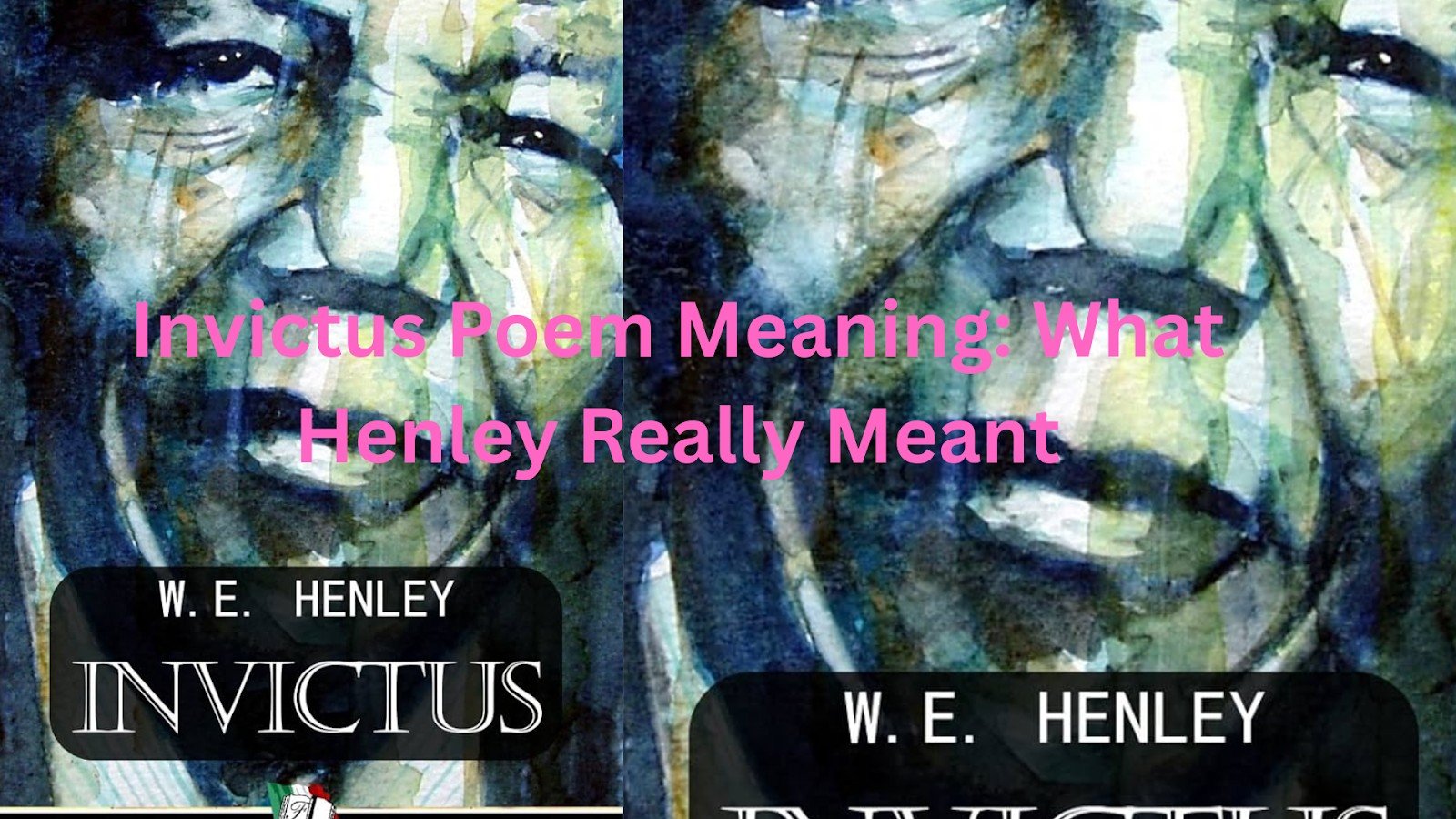
You may know the famous lines about being the master of fate, but the story behind them adds weight. Henley wrote Invictus while healing in a hospital after losing his leg and facing severe illness. His bold tone shows a man holding on to inner strength.
Here, you can read the full poem along with clear guidance on the meaning of each part. The themes, structure, and writing choices help explain why the poem still feels strong. Seeing how Henley shaped his thoughts makes the meaning easier to take in.
If you need this for class or personal reading, this keeps everything together in a simple way. It offers steady support as you work to understand his message. His claim of being unconquered shows determination, and many continue to find comfort in his words.
The Complete Poem by William Ernest Henley
This is the full original text. Read it through once before we analyze it. Notice how the tone builds from darkness to defiance.
Out of the night that covers me, Black as the pit from pole to pole, I thank whatever gods may be For my unconquerable soul.
In the fell clutch of circumstance, I have not winced nor cried aloud. Under the bludgeonings of chance, my head is bloody, but unbowed.
Beyond this place of wrath and tears Looms but the Horror of the shade, And yet the menace of the years Finds and shall find me unafraid.
It matters not how strait the gate, How charged with punishments the scroll, I am the master of my fate, I am the captain of my soul.
Henley wrote this in 1875 at age 27. He was lying in a hospital bed recovering from tuberculosis. Doctors had already amputated his left leg. He faced the possibility of losing his other leg too.
The poem was first published in 1888 without any title. Different newspapers called it “Myself,” “Master of His Fate,” and “Captain of My Soul.” In 1900, editor Arthur Quiller-Couch gave it the title “Invictus.” That’s Latin for “unconquered” or “undefeated.”
What Does Invictus Mean?
There are two levels to understand: the surface message and the deeper meaning.
The Surface Message
On the surface, this looks like a motivational poem. It sounds like Henley is just encouraging people to stay strong during hard times. That’s how most people read it.
Here’s what you see at first glance:
- A declaration of personal strength in the face of suffering
- The speaker refuses to be defeated by life’s circumstances
- He asserts control over his spirit despite external hardships
- The central idea: inner strength is unconquerable
That reading is correct, but incomplete. There’s something much more radical happening beneath these words.
Henley wasn’t just writing about staying positive. He was making a controversial statement about where power really comes from.
The Deeper Meaning
Henley rejects all external authority. This includes God, fate, and even death itself. He places all power within the individual. That’s a bold and dangerous claim.
Look at how each stanza defies a different force:
- Stanza 1: Darkness and despair
- Stanza 2: Circumstance and chance
- Stanza 3: Death and time
- Stanza 4: Divine judgment and God
This poem was written from an atheist perspective. Henley didn’t believe in God. When he suffered, he couldn’t look to heaven for comfort.
The only place he could find strength was within himself. That’s what “unconquerable soul” really means. It’s about radical self-reliance and personal autonomy when you have nowhere else to turn.
Stanza by Stanza Analysis
Now I’ll take you through the poem line by line. Each stanza has layers of meaning you might miss on the first read.
Stanza One: Emerging from Darkness
The poem opens in total darkness. This isn’t just nighttime. It’s deep, crushing despair that covers everything.
“Out of the night that covers me, / Black as the pit from pole to pole” paints a picture of complete darkness. The “night” represents suffering and despair. Henley compares it to “the pit,” which means hell. This darkness covers the entire world “from pole to pole.” There’s no escape from it.
“I thank whatever gods may be / For my unconquerable soul” is the only time Henley acknowledges higher powers. But notice his exact words: “whatever gods may be.” Not “God.” Not even “the gods.”
He’s uncertain if any gods exist at all. And what does he thank them for? Not for saving him. Not for comfort. He thanks them for giving him an “unconquerable soul.” In other words, he thanks them for making him strong enough not to need them.
Stanza Two: Refusing to Submit
Now Henley turns to life’s circumstances. He’s talking about all the things that happen to you that you can’t control. Sickness. Loss. Pain. Bad luck.
“In the fell clutch of circumstance / I have not winced nor cried aloud” uses personification. Circumstance has a “clutch,” like a hand grabbing you. “Fell” means cruel. Life has grabbed him hard, but he refuses to show weakness. He hasn’t “winced” (flinched) or “cried aloud” (complained).
“Under the bludgeonings of chance / My head is bloody, but unbowed” admits damage but not defeat. A “bludgeon” is a heavy club used as a weapon.
Life’s random events have beaten him. His head is “bloody” from the beating. But it’s “unbowed.” He hasn’t lowered his head in submission or shame. The alliteration of the “b” sounds (bloody, but, unbowed) creates a harsh, pounding rhythm. You can almost hear the blows.
Stanza Three: Facing Death Without Fear
The third stanza gets darker. Henley looks past his current suffering to what’s coming: death. And he’s still not afraid.
“Beyond this place of wrath and tears / Looms but the Horror of the shade” describes death waiting ahead. “This place” is our current life, full of “wrath and tears” (anger and sadness). Beyond it “looms” something scary.
The “Horror of the shade” means death. “Shade” was a common Victorian term for the afterlife or the grave.
“And yet the menace of the years / Finds and shall find me unafraid” uses both past and future tense. The “menace of the years” is all the suffering that time brings. It “finds” him now (present/past).
It “shall find” him in the future. But he will be “unafraid” in both cases. The repetition of “find” hammers home his point: no matter when death comes, his courage won’t change.
Stanza Four: The Famous Declaration
This final stanza is the most controversial. Henley directly challenges Christian teaching. These lines shocked many Victorian readers.
“It matters not how strait the gate, / How charged with punishments the scroll” is packed with biblical references. The “strait gate” comes from Matthew 7:13-14, where Jesus talks about the narrow gate leading to heaven.
The “scroll charged with punishments” refers to the book of judgment in Revelation 20:11-15. Henley is saying: even if Christianity is true, even if there’s a judgment day with punishments written down, it doesn’t matter to him.
“I am the master of my fate, / I am the captain of my soul” are the most famous lines in the poem. “Master” means complete authority. “Captain” uses nautical imagery, he’s steering his own ship.
The present tense “I am” makes this his permanent identity. He’s not hoping to be in control. He claims he already is. This is a direct rejection of God’s authority. Instead of God being the master and captain, Henley claims that title for himself.
Structure and Literary Devices
The way Henley built this poem reinforces his message. Every choice matters, from the rhythm to the rhyme scheme.
Form and Rhythm
The poem has a tight, controlled structure. This isn’t an accident. The form mirrors the content.
Here’s how it’s organized:
- Four stanzas with four lines each (16 lines total)
- ABAB rhyme scheme in every stanza
- Iambic tetrameter: 8 syllables per line with stress on every second syllable
- The steady rhythm mirrors his unwavering control
- The consistent structure reinforces the theme of self-control
Why does this matter? A poem about being “unconquered” needs to sound unconquered. The steady beat never breaks.
The rhyme scheme never fails. Just like the speaker’s courage never wavers. The form proves the content.
Key Literary Devices
Henley uses specific techniques to make his points stronger. These devices aren’t just decoration. They create meaning.
Here are the main literary devices:
- Personification: Night “covers” him, circumstance has a “clutch” (giving human qualities to non-human things)
- Simile: “Black as the pit” (direct comparison using “as”)
- Metaphor: “Bludgeonings of chance,” “Horror of the shade” (indirect comparison)
- Alliteration: “Bloody, but unbowed” (repeated “b” sound)
- Allusion: References to Matthew 7 and Revelation 20 (biblical references)
- Anaphora: “I am” repeated in the final lines (repetition for emphasis)
- Metonym: “This place of wrath and tears” stands for Earth (substituting a related concept)
These devices work together. The personification makes abstract ideas feel like physical threats.
The alliteration creates harsh sounds that match the harsh content. The biblical allusions show exactly what Henley is rejecting. Every device serves the poem’s purpose.
Major Themes in Invictus
Let me break down the big ideas Henley explores. These themes explain why the poem still matters today.
Suffering and Resilience
This is the central theme of Invictus. The whole poem is about refusing to let suffering define who you are.
Henley’s approach to pain:
- He acknowledges it, then defies it through a pattern in each stanza: describe adversity, then affirm strength
- Each stanza follows call and response: Life hits (darkness, beating, death, judgment), he stands back up (unconquerable, unbowed, unafraid, master)
- This isn’t complaining, but declaring a philosophy: pain is real, but it doesn’t have to break you
- The pattern keeps repeating: darkness leads to defiance, pain transforms into pride
That’s the resilience Henley teaches. He doesn’t ignore suffering, he refuses to be conquered by it.
Free Will vs. Fate
The famous line “I am the master of my fate” is all about free will. Henley rejects the idea that your life is predetermined. He insists you have choices, even in terrible circumstances.
Here’s the key distinction he makes:
- You can’t control what happens to you (circumstance, chance, death)
- You can control how you respond to what happens
- Fate doesn’t determine who you are
- Your choices determine who you are
This is about personal agency. Even when life beats you down, you decide whether to bow your head or keep it high. You choose whether to face death with fear or courage. External events don’t write your story. You do. That’s what Henley means by being the “captain” of his soul.
Self-Reliance and Defiance
Watch how Henley progressively rejects external authority. Each stanza takes away another source of outside power. By the end, he’s standing alone against everything.
The progression goes like this:
- Stanza 1: Barely acknowledges that gods might exist
- Stanza 2: Defies circumstance and chance
- Stanza 3: Declares himself unafraid of death
- Stanza 4: Rejects God’s judgment and authority
All authority is placed within the individual. Henley doesn’t look to heaven. He doesn’t accept fate. He doesn’t fear death. He doesn’t submit to God. The only power he recognizes is the power inside himself. This is radical individualism taken to its limit.
Religious Defiance
The final stanza directly challenges Christianity. Victorian readers would have caught this immediately. Henley isn’t just ignoring God. He’s actively rejecting Him.
Why is this controversial?
- Biblical references make it clear: Jesus taught the “strait gate” leads to heaven, but Henley says it doesn’t matter. Revelation describes judgment, but Henley doesn’t care.
- Henley’s atheism shapes everything: When you don’t believe in God, where do you find strength? His answer: within yourself.
- Reflects post-Darwin doubt: Science was challenging the Bible, and Henley’s poem gives voice to that questioning of religious faith.
- The shocking part: He’d rather face God’s punishment than submit to His authority, echoing Satan’s “Better to reign in Hell, than serve in Heaven.”
Henley prefers autonomy with consequences over obedience with salvation. That’s what makes this poem both inspiring and troubling.
Conclusion
You now have a clearer sense of what Henley expressed in Invictus. He wrote it during his hardest days, using each part of the poem to stand firm against darkness, circumstance, death, and the idea of outside judgment. His words show a person trying to hold steady when life felt harsh and uncertain.
The rhythm, references, and firm tone all support his message. The steady beat suggests control, and the religious hints show what he chose to stand apart from. Through this approach, he urged readers to place strength within themselves and rely on their own sense of direction.
Many readers find the poem strong and thought-provoking, while others question the limits of complete self-reliance. If this explanation helped you see the poem more clearly, you can share it with someone who is studying it.
Frequently Asked Questions
What does Invictus mean in the poem?
Invictus is Latin for “unconquered” or “undefeated.” The title was added in 1900 by editor Arthur Quiller-Couch. It perfectly captures the poem’s message: the speaker refuses to be conquered by suffering, circumstance, death, or divine judgment. His spirit remains unconquerable despite life’s hardships.
What is the main meaning of the Invictus poem?
The poem means that inner strength is unconquerable. Henley declares radical self-reliance, rejecting external authority, including God. Written from an atheist perspective, it shows finding strength within yourself when you have nowhere else to turn. Each stanza defies a different force: darkness, circumstance, death, and judgment.
Why did William Ernest Henley write Invictus?
Henley wrote Invictus in 1875 at age 27 while recovering in a hospital. He had tuberculosis and had already lost his left leg. Facing the possibility of losing his other leg, he wrote this poem to declare his unconquerable spirit despite suffering and his rejection of religious comfort.
What does “I am the master of my fate, captain of my soul” mean?
These famous lines mean Henley claims complete authority over himself. “Master” means total control. “Captain” uses nautical imagery showing he steers his own ship. He rejects God’s authority and insists that only he controls his inner life and responses to circumstances, not fate or divine will.
What are the main themes in Invictus?
The main themes are suffering and resilience, free will versus fate, self-reliance, and religious defiance. Henley shows that while you can’t control circumstances, you control your responses. The poem progressively rejects external authority, placing all power within the individual rather than God or fate.