



Read these two sentences: “It was a cold morning.” and “Frost furred the window, and the blanket had gone stiff under my fingers.” Both say the same thing, yet only the second one probably made you shiver.
That gap between telling a reader something and letting them feel it is where the imagery definition in literature starts to matter, and it explains why a few well-chosen details can do more than a page of explanation.
Here’s what this guide covers: seven types of imagery with short original examples, the difference between literal and figurative imagery, three public-domain works analyzed sense by sense and a three-step method for writing about imagery in an essay.
What Does Imagery Mean in Literature?
Imagery in literature means language that builds sensory pictures in a reader’s mind.
Writers use specific details of sight, sound, smell, taste, touch, and movement so that readers experience a scene instead of only hearing about it.
The term applies to poetry, novels, short stories, and plays.
In Oregon State’s guide to imagery, Raymond Malewitz describes it as words chosen to speak to the reader’s senses, and he adds that imagery often shows what a character or narrator thinks, not only what a scene looks like.
Imagery is one of the elements of poetry, and it works the same way in prose.
The word has a second meaning outside the classroom, where it can refer to photographs or satellite pictures, but in literature it refers to words, not pictures.
With that definition in place, the next question is how many kinds of imagery there are.
Types of Imagery in Literature
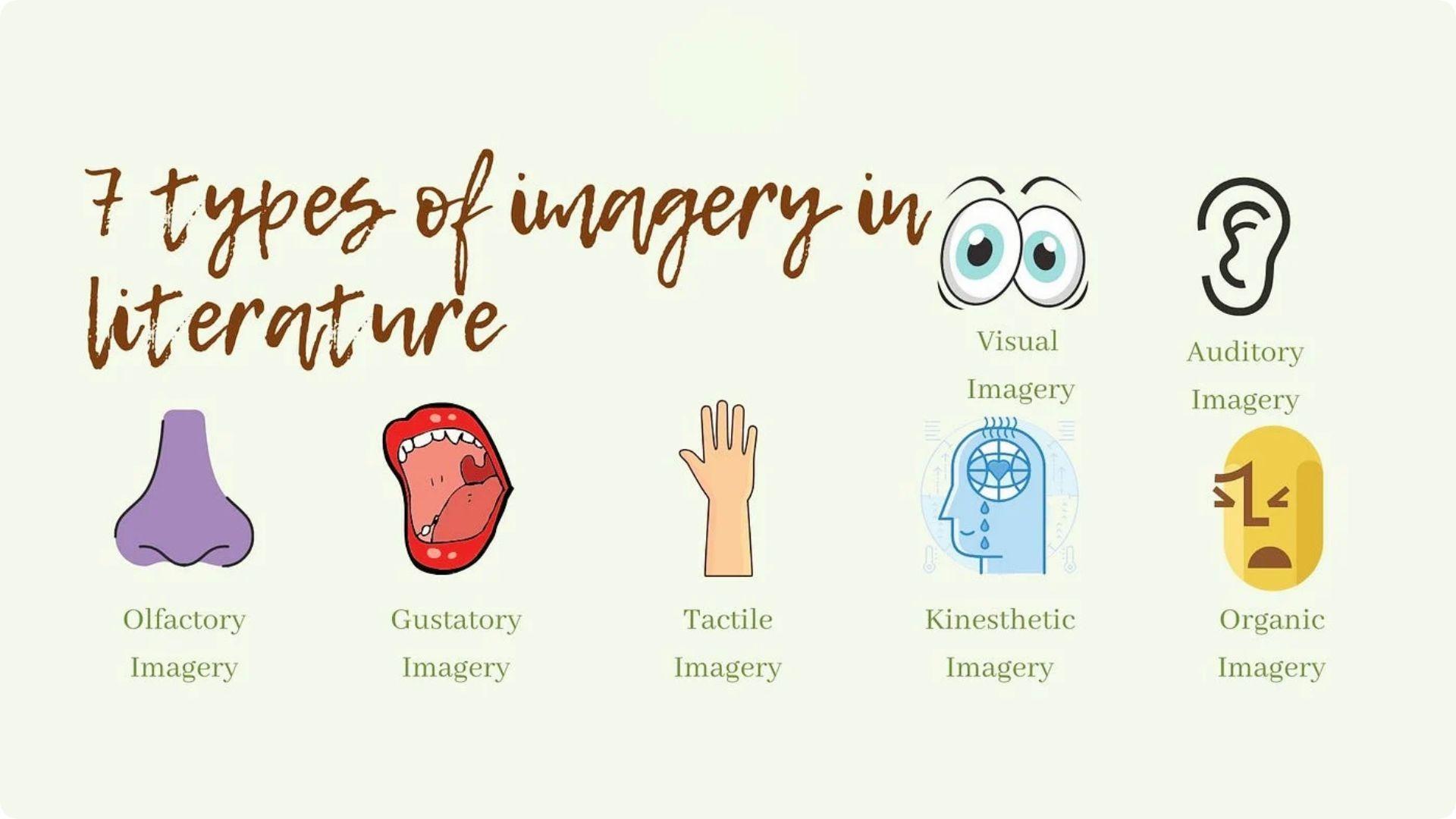
Imagery comes in seven types: visual (sight), auditory (sound), olfactory (smell), gustatory (taste), tactile (touch), kinesthetic (movement), and organic (internal sensation).
Most classroom lists stop at the first five, so check which set your teacher uses. Every example below is original, written to show the type as plainly as possible.
Visual and Auditory Imagery
The visual imagery definition in literature is the plainest of the set: description that appeals to sight, including color, shape, light, size, and pattern.
Readers notice it first, so some readers treat “imagery” and “visual description” as the same thing.
“The lamp threw a yellow circle across the wet pavement” is a visual example, since every word helps you see the scene.
Auditory imagery appeals to hearing, and silence counts. “The screen door slapped shut, and then the whole house went quiet” gives you a sharp sound followed by its absence, which sets a mood without naming a feeling.
Olfactory, Gustatory, and Tactile Imagery
Olfactory imagery covers smell, as in “The hallway smelled of wet wool and boiled cabbage.” Gustatory imagery covers taste, as in “The coffee tasted of smoke and old pennies.”
Tactile imagery covers touch, including texture and temperature, as in “The rope was rough and damp, and it bit into her palms.”
Smell and taste tend to work as shortcuts to memory, because readers match the detail against scents and flavors from their own lives, so a phrase like “boiled cabbage” can set a scene faster than a paragraph of description.
Kinesthetic and Organic Imagery
Kinesthetic imagery describes movement and muscle effort, as in “She pushed into the wind until her calves burned.”
Organic imagery covers sensations inside the body, such as hunger, a pounding pulse, or a dry mouth, as in “Her heart thudded in her ears, and her mouth went dry.”
Classroom lists tend to leave these two out, yet they carry much of the tension in action scenes and moments of fear.
Literal vs. Figurative Imagery
Both kinds of imagery reach the senses, but they get there differently.
Literal imagery describes something as it is, while figurative imagery compares it to something else so the comparison builds the picture.
| Literal Imagery | Figurative Imagery | |
| How it works | Describes the object directly | Compares one thing to another |
| Example | “The apple was red and waxy.” | “The apple glowed like a small red lantern.” |
| Sense reached | Sight | Sight, plus a sense of warmth |
| Best for | Clear, precise scenes | Adding feeling or deeper meaning |
The second sentence still appeals to sight, but it arrives there through a simile and adds a warmth the first sentence lacks.
Students often mix up the terms here.
Similes, metaphors, and personification are tools, and imagery is what those tools can produce, so “the fog padded up the street on soft paws” is figurative language that creates imagery because you can see and almost feel the fog moving.
Our guide to figurative language in poetry covers the tools in more detail.
Imagery also overlaps with symbolism without being the same thing: a snowfield described in sharp, cold detail is imagery, and if a story keeps returning to that snowfield as a stand-in for loneliness, it becomes a symbol as well.
Seeing these distinctions in real texts is easier than learning them in the abstract, so three short public-domain works come next.
Imagery Examples in Literature From Poetry and Prose
Seeing imagery in real texts makes the types easier to recognize, so here are three public-domain works with the senses marked as they appear.
Imagery in Poetry: Wordsworth and H.D.
The Poetry Foundation’s imagery glossary entry describes imagery in a poem as elements that invoke any of the five senses.
The imagery definition in poetry is the same as in prose, but a poem has fewer words to work with, so each image carries more weight.
Both poems below are in the public domain, so each appears in full.
William Wordsworth’s “I Wandered Lonely as a Cloud” was first published in 1807, and this is the revised version from 1815:
I wandered lonely as a Cloud
That floats on high o’er Vales and Hills,
When all at once I saw a crowd,
A host of golden Daffodils;
Beside the Lake, beneath the trees,
Fluttering and dancing in the breeze.
Continuous as the stars that shine
And twinkle on the Milky Way,
They stretched in never-ending line
Along the margin of a bay:
Ten thousand saw I at a glance,
Tossing their heads in sprightly dance.
The waves beside them danced, but they
Out-did the sparkling waves in glee:—
A Poet could not but be gay
In such a jocund company:
I gazed—and gazed—but little thought
What wealth the show to me had brought:
For oft when on my couch I lie
In vacant or in pensive mood,
They flash upon that inward eye
Which is the bliss of solitude,
And then my heart with pleasure fills,
And dances with the Daffodils.
The poem opens with a simile, “lonely as a Cloud,” which makes the speaker feel light and adrift before any flower appears.
Sight takes over next, through “golden Daffodils,” a “never-ending line” along a bay, and stars that “twinkle on the Milky Way.”
Kinesthetic imagery carries the rest, since the flowers flutter, dance, and toss their heads, and the waves dance too.
The final stanza turns the imagery inward: the daffodils “flash upon that inward eye” as a remembered picture, and the speaker’s heart “dances” with them, which is organic imagery for plain happiness.
H.D.’s “Oread” is much shorter, and it was first published in 1914 in the magazine BLAST. An oread is a mountain nymph in Greek myth, and she is the speaker:
Whirl up, sea—
Whirl your pointed pines.
Splash your great pines
On our rocks.
Hurl your green over us—
Cover us with your pools of fir.
Here the verbs do most of the work. “Whirl,” “splash,” and “hurl” are kinesthetic, and they make the sea feel like a force rushing in.
“Green” and “pointed pines” supply the sight, and “cover us” adds touch, as if the water were settling over her.
The key move is the metaphor, because the sea is described as a forest.
Oregon State’s teaching notes on imagery use this poem to ask what that comparison shows about the speaker, and the answer is that a mountain nymph can only picture the sea in terms of the trees she knows.
Imagery in Novels and Short Stories
Kate Chopin’s short story “The Story of an Hour,” first published in 1894, uses imagery to show a character’s mind.
Mrs. Mallard has just learned that her husband has died, and she sits alone at an open window:
She could see in the open square before her house the tops of trees that were all aquiver with new spring life. The delicious breeath of rain was in the air. In the street below a peddler was crying his wares. The notes of a distant song which someone was singing reached her faintly, and countless sparrows were twittering in the eaves.
Sight comes first, in the quivering treetops, followed by smell in “the delicious breath of rain.”
The rest is sound: the peddler’s cry, the faint song, and the twittering sparrows.
No sentence announces a feeling, yet the spring imagery hints at the freedom she senses alongside her grief, a reading Malewitz also offers.
The same approach works in novels, where an author may repeat one kind of imagery across chapters to build a pattern the reader learns to follow.
Why Writers Use Imagery
Writers rely on imagery for three jobs, and each one shows up in the passages above.
It shows instead of telling:In that passage, Chopin does not state that Mrs. Mallard feels freedom stirring, because the trembling trees and spring air carry the meaning.
It sets mood and tone: Eliot’s smoke, steam, and grime make the city feel worn out before any speaker comments on it.
And it draws on the reader’s own memories,since a detail like rain on pavement lets you supply the rest from your own experience, which makes the scene feel personal.
Those three jobs also point to what you should look for when you write about imagery yourself.
How to Spot and Analyze Imagery in a Text
To analyze imagery, find the sensory details in a passage, name the sense each one appeals to, and explain what the images reveal about mood, character, or theme.
Use these three steps on any poem or story:
- Mark the sensory words. Underline each word that points to a sense, like whirl, pointed pines, and splash in “Oread.”
- Name the sense. Label each mark as visual, auditory, olfactory, gustatory, tactile, kinesthetic, or organic.
- Explain the effect. Tie the images to the thoughts of a character, narrator, or speaker, as Malewitz advises. For example: “H.D.’s verbs make the sea feel like a force rushing over the speaker.”
Imagery Comes Down to the Senses
Imagery is sensory language that lets readers see, hear, smell, taste, and feel a scene, and strong readers also ask what those senses reveal.
Seven types cover the range, from visual and auditory to kinesthetic and organic, and both literal and figurative versions count when they create a sensory picture.
Eliot’s smoky evening and Chopin’s open window teach the same lesson from two directions: images work hardest when they tie to a mood or a character’s mind.
This imagery definition in literature gives you what you need to start annotating on your own.
Try this next: pick one short poem or a paragraph from a story you are reading, mark every sensory detail, name the sense, and write one sentence on what it adds.
Frequently Asked Questions
What Is Synesthetic Imagery?
Synesthetic imagery blends two senses in one phrase, such as “a loud yellow shirt” or “sweet music.” The writer borrows words from one sense to describe another, which gives the line a surprising, layered feel.
How Is Imagery Used in Plays?
In a play, imagery lives mostly in the spoken lines, since the audience hears the words rather than reads them. Romeo’s “It is the east, and Juliet is the sun” paints a picture of light with a single metaphor. Set design and lighting then add visual imagery on top of the dialogue.
What Is the Difference Between Imagery and Description?
Descriptions can simply state facts, such as “the room was large.” Imagery picks details that reach a sense, such as “the room smelled of cold ashes.” Every image is a description, but not every description creates an image.


